Keeping your baby carrier fresh and clean is essential for daily infant hygiene, but putting a high-performance soft structured carrier through the laundry requires care. If you are wondering how to wash baby carrier Ergobaby models without causing irreversible damage, the secret lies in protecting its core structural components. From high-density EVA foam waistbands to reinforced nylon webbing and specialized plastic buckles, improper laundering techniques can lead to material degradation or even plastic impact fractures.
While manufacturer manuals often provide bare-minimum washing tips, they frequently ignore the mechanical friction created inside a washing machine drum. Laundering your carrier incorrectly can strip away fire-retardant fabric properties, warp dense shoulder padding, or compromise load-bearing seams.
In this comprehensive, step-by-step guide, we break down the exact pre-wash preparation, detergent selection, machine settings, and air-drying protocols needed to sanitize your Ergobaby carrier safely while preserving its long-term structural safety. For additional manufacturer care guidelines, you can review the official Ergobaby Care Guide. Always wash new carriers prior to their initial use to eliminate industrial finishing residues.
Table of Contents
Ergobaby Carrier Washing Instructions at a Glance
| Washing Parameter | Safe Recommendation | Incorrect Practice | Damage / Safety Risk |
|---|---|---|---|
| Water Temperature | Cold / Lukewarm (30°C–40°C) | Hot Water (>50°C) | Shrinks cotton layers, warps internal EVA foam, and distorts 3D mesh airflow pores. |
| Detergent Type | Mild, Liquid “Free & Clear” | Powder, Bleach, Brighteners | Erodes load-bearing “box-X” stitching and leaves chemical residues that irritate infant skin. |
| Fabric Softener | Completely Excluded | Liquid Softeners / Dryer Sheets | Deposits a waxy film that clogs 3D mesh pores and breaks down internal foam elasticity. |
| Machine Prep | Buckled inside Mesh Wash Bag | Unbuckled / Loose in Drum | Heavy plastic buckles slam against the drum, causing stress cracks or plastic impact fractures. |
| Wash & Spin Cycle | Delicate Cycle (Max 800 RPM) | Heavy-Duty Cycle / High Spin | Severe centrifugal force distorts high-density waist padding and stretches safety webbing. |
| Drying Protocol | Air Dry in Shade Only | Tumble Drying / Direct Sun | Dryer heat warps foam padding, weakens elastic loops, and UV rays fade fabric dyes. |
Spot-Cleaning Protocol: Primary Maintenance Method
To preserve load-bearing seams and extend your carrier’s lifespan, spot-cleaning should be your primary maintenance method for managing small stains, drool, or milk spills. Full machine laundering subjects load-bearing seams to mechanical wear and should be reserved only for heavy soil.
- Prepare Supplies: Gather a clean microfiber cloth, lukewarm water, and a mild liquid baby detergent.
- Blot the Area: Dampen the cloth and softly dab the stained spot. Avoid scrubbing harshly, which can force organic matter deeper into woven fibers or 3D mesh panels.
- Apply Mild Soap: Place a small drop of detergent onto the damp cloth and dab the stain until it lifts.
- Rinse Thoroughly: Use a second clean cloth dampened with plain water to wipe away all soap residue. Residual soap can attract dirt and irritate sensitive infant skin.
- Air Dry Completely: Allow the cleaned area to air dry in a shaded, well-ventilated space before using the carrier.
For more detailed methods on treating common infant stains, read our guide on localized spot-cleaning techniques.
Pre-Wash Checklist: Securing Velcro, Snapping Buckles, and Loosening Webbing
Learning how to wash baby carrier ergobaby models safely starts long before you run the water cycle. Following a comprehensive pre wash checklist for soft structured baby carriers protects both your carrier’s fabric integrity and your washing machine drum during the cycle. Proper prep work is the best way of preventing baby carrier strap damage during machine wash cycles. For model-specific assembly and prep, always refer to the official Ergobaby instruction manuals.
Mandatory Pre-Wash Step: Unzip the seat compartment on hip seat models (like the Lift and Alta) and remove the internal molded foam base before washing. Submerging this rigid foam deforms the ergonomic seat angle required for healthy infant hip development and voids the manufacturer warranty.
1. Fasten All Velcro Hooks & Loop Strips
- Fully secure all hook-and-loop waistbands, lumbar support pads, and neck extenders to focus on protecting baby carrier buckles and velcro in the laundry.
- Exposed hook velcro acts like a brush against soft mesh, organic cotton, and padded straps, leading to severe surface pilling and thread pulling.
- Keeping velcro mated prevents lint and loose threads from clogging the grip teeth, preserving its holding strength over time.
- Fastening these tabs ensures the waistband stays flat and structurally aligned throughout the entire spin cycle.
2. Snap Every Buckle and Fastener
- Click together every chest clip, waist belt buckle, and shoulder strap fastener before loading.
- Unclipped heavy plastic buckles thrash inside the washing machine drum, which can crack the plastic hardware or scratch the washer interior.
- Closed buckles maintain the structural layout of the carrier, preventing webbing straps from becoming severely tangled during agitation.
- Buckling all clips reduces harsh noise and vibration caused by loose hardware hitting the machine walls.
3. Fully Loosen All Webbing Straps
- Extend every adjustment strap to its maximum length before washing.
- Knowing how to prepare baby carrier for washing machine cycles means opening up tightly pulled webbing folds so gentle detergent can wash away trapped sweat, dead skin cells, and milk residue hidden inside buckle tracks.
- Un-cinching the webbing releases tension on high-stress seam joints during the spin cycle, helping to extend the lifespan of the internal stitching.
- Fully loosened webbing allows the entire carrier to rinse and dry evenly without trapping moisture in thick folds.
4. Empty Pockets & Use a Pillowcase or Laundry Bag
- Check every zippered storage pouch, hip belt pocket, and hood slot for loose teether clips, pacifiers, tissues, or metal items.
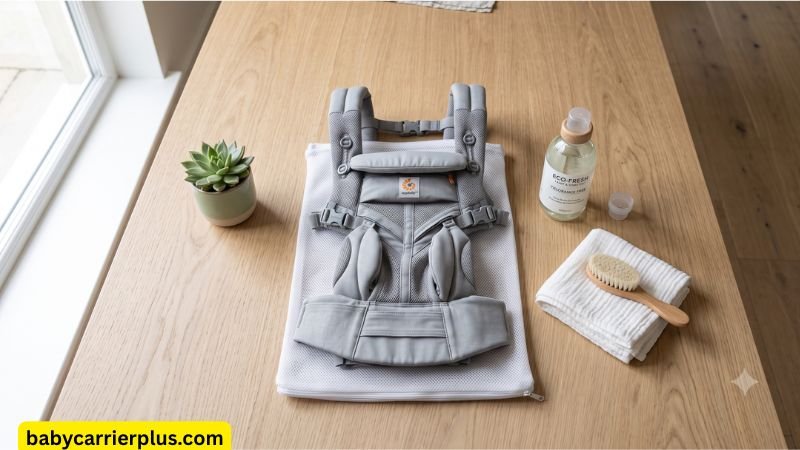
- Place the fully secured baby carrier inside a mesh laundry bag or a zipped pillowcase to add an extra barrier against hardware friction.
- Zip up all pocket enclosures after checking to prevent items from catching on internal mesh linings.
- Using a protective wash bag stops straps from wrapping tightly around the washing machine’s center agitator.
Selecting the Correct Detergent: Protecting Carrier Fibers and Infant Skin
Choosing the correct detergent is essential when learning how to wash baby carrier Ergobaby systems safely. Soft structured carriers feature specialized EVA foam, nylon webbing, and 3D mesh or organic cotton panels that demand gentle chemical care. Using standard aggressive detergents can strip flame resistance, degrade load-bearing thread, and leave toxic residues that cause severe infant skin irritation.
The Danger of Bleach, Brighteners, and Fabric Softeners
- No Chlorine Bleach: Avoid bleach and heavy stain removers because chlorine degrades organic cotton and nylon polymers, weakening high-load “box-X” safety stitching.
- No Optical Brighteners: Skip mass-market detergents with synthetic brighteners that coat fibers and cause contact dermatitis or allergic flare-ups when infants suck on shoulder straps.
- No Fabric Softeners: Never use liquid softeners or dryer sheets on an Ergobaby 3D mesh airflow carrier; the waxy coating clogs ventilation pores and degrades internal EVA foam elasticity.
- No Powder Detergents: Powdered soaps dissolve poorly in cold water cycles (30°C to 40°C), leaving abrasive deposits trapped inside shoulder and lumbar padding.
Best Practices for Selecting a Safe Detergent
- Use Mild Liquid Formulas: Pick a plant-based, pH-neutral non-toxic liquid laundry detergent or safe laundry detergent for baby carrier cleaning that disperses instantly in cold water.
- Choose Fragrance-Free Options: Select hypoallergenic “Free & Clear” products to eliminate synthetic perfumes and dyes.
- Halve the Dosage: Use half the recommended cap amount for small loads to prevent excess suds from remaining inside thick padding.
- Run an Extra Rinse: Add an extra plain-water rinse cycle to ensure all soap is completely flushed from internal foam layers.
If you are recovering from surgery or need a specialized design, check out our guide on choosing a post C-section waistless baby carrier.
Machine Wash Settings: Selecting the Gentle Cycle, Temperature Limits, and Low Spin Speeds
Once your pre-wash prep is complete and you have chosen a safe detergent, setting up your washing machine correctly is the final mechanical step in learning how to wash baby carrier Ergobaby models without damage. High spin speeds, hot water, and heavy agitation cycles can warp internal structural padding, stretch out elastic safety loops, and put unnecessary stress on buckle connection seams.
To protect your carrier’s technical fabrics and internal support layers, always configure your washer using these precise settings:
1. Select the Delicate or Gentle Cycle
- Minimize Mechanical Friction: Always choose the Delicate, Gentle, or Hand Wash cycle on your machine.
- Protect Load-Bearing Seams: Gentle drum agitation prevents excessive twisting and pulling on the reinforced “box-X” stitching that secures the shoulder straps to the main panel.
- Prevent Mesh Abrasion: For an Ergobaby 3D mesh airflow carrier, a slow agitation cycle prevents synthetic mesh pores from snagging against the drum wall.
Lock Water Temperature Between 30°C and 40°C
- Use Cold or Warm Water Only: Set the water temperature to cold or lukewarm, staying strictly within the 30°C to 40°C (86°F to 104°F) range. Setting up your washer correctly is essential when learning how to wash baby carrier ergobaby systems without causing mechanical damage.
- Avoid Fiber Shrinkage: Hot water causes cotton fabric layers to shrink unevenly, which misaligns internal padding and ruins the ergonomic fit.
- Prevent Pore Distortion: High heat degrades synthetic materials, melting or warping the ventilation gaps in high-airflow mesh models.
3. Limit Spin Speed to Low (Maximum 800 RPM)
- Cap at 800 RPM: Set your spin cycle to Low or Spin-Drain Only, keeping the speed under 800 RPM.
- Preserve EVA Foam Panels: High-speed centrifugal forces compress and distort the high-density EVA foam inside the waist belt and lumbar support panel, causing them to turn soft or lumpy.
- Prevent Hardware Impact: Low spin speeds keep the carrier from slamming hard against the drum. Premium carrier buckles are engineered from polyoxymethylene (POM), a high-density thermoplastic which is susceptible to micro-fracturing when subjected to repeated impacts against metallic washing machine drums during high-speed spin cycles.
Note: Do not machine wash ultra-soft newborn carriers and wraps that feature delicate viscose and rayon knit blends (such as the Embrace and Aura Wrap). Machine agitation stretches these knit fabrics and loosens their structural tension; they must be hand-washed in cold water.
Drying the Carrier: Why the Tumble Dryer Destroys Structural Padding and Webbing
After completing a gentle wash cycle, drying your baby carrier correctly is just as important as the washing process itself. The single biggest mistake parents make when learning how to wash baby carrier Ergobaby models is tossing the wet carrier directly into a tumble dryer. High thermal exposure destroys the technical core of soft structured carriers, leading to warped support panels, melted safety loops, and compromised load-bearing webbing.
To preserve your carrier’s ergonomic integrity and keep your baby safe, always follow strict air-drying protocols.
Why High Heat from Tumble Dryers Destroys Baby Carriers
- Melts Internal EVA Foam Padding: High heat breaks down the molecular cell structure of the high-density EVA foam inside the lumbar support panel and shoulder straps. This causes the padding to warp, shrink, or become soft and lumpy, ruining its ability to distribute weight evenly.
- Degrades Nylon Webbing and Elastic Loops: Machine heat degrades the synthetic polymers in heavy-duty nylon adjustment webbing and weakens the elastic safety loops located on buckle ends, increasing the risk of strap slippage.
- Cracks and Warps Heavy Plastic Buckles: The extreme heat combined with high-speed tumbling causes plastic chest clips and waist belt buckles to become brittle, leading to hairline cracks or hardware failure under load.
- Shrinks Cotton and Distorts Mesh Panels: Tumble drying shrinks outer cotton layers unevenly relative to inner padding, while high heat distorts the ventilation pores of an Ergobaby 3D mesh airflow carrier.
Safe Air-Drying Best Practices
- Always Hang to Air Dry: Hang your carrier in a well-ventilated indoor space or shaded outdoor area to dry naturally. Use a sturdy hanger passed through the shoulder straps to distribute the weight evenly.
- Lay Stretchy Knits Flat to Dry: Hybrid knit carriers and stretchy wraps (such as the Ergobaby Embrace and Aura Wrap) must be laid flat on a clean, dry towel. Never hang wet knit fabrics on a clothesline or hanger, as gravity will pull down on the saturated fibers, permanently stretching out the shoulder panels and ruining structural tension.
- Reshape Linen While Damp: When drying a linen carrier, smooth out creases and gently reshape the panel while moist. If desired, iron on a low heat setting while slightly damp to restore softness.
- Avoid Direct Sunlight Exposure: Never leave dark-colored or organic cotton carriers to dry in direct, intense sunlight. Harsh UV rays break down textile dyes, fade colors, and weaken exposed thread fibers over time.
- Lay Flat for Heavy Foam Models: If your carrier model features an extra-dense waist belt, lay it flat on a dry towel in the shade to prevent wet padding from sagging or pulling downward due to gravity.
- Allow Full 24-Hour Drying Time: Because the high-density shoulder foam and lumbar pads trap moisture, allow up to 24 hours for the carrier to dry completely before re-buckling or using it with your baby.
Post-Wash Inspection: Restoring Strap Tension and Buckle Functionality
Completing the air-drying process is not the final step; performing a thorough post-wash inspection ensures your carrier is completely safe before placing your baby inside. Washing machines can sometimes shift buckle tracks, twist nylon webbing, or expose pre-existing thread wear. Knowing how to wash baby carrier Ergobaby systems correctly means coupling your wash routine with a mandatory 30-second safety check. Performing these structural checks ensures your carrier continues to meet strict JPMA safety certification standards before you place your baby inside.
Take a few moments to inspect every critical joint, clip, and strap to restore full operational functionality:
1. Perform the Buckle Click & Stress Test
- Listen for the Click: Fasten every plastic buckle—including the heavy waist belt clip, chest clip, and shoulder strap fasteners. Ensure each buckle produces a loud, firm “click” when engaged.
- Check for Impact Cracks: Flex the plastic housing gently and inspect for micro-cracks, stress whitening, or chipped teeth caused by machine drum impact.
- Test Under Tension: Firmly tug on both sides of every fastened buckle to confirm the locking mechanism holds tight under load without slipping loose.
2. Restore Strap Tension and Untwist Webbing
- Clear Webbing Tracks: Check that the heavy-duty nylon adjustment webbing hasn’t twisted inside the buckle slots during agitation. Straighten any folds so straps sit flat against your body.
- Glide Adjustment Check: Pull all webbing adjustment straps back and forth through their buckle tracks to confirm smooth, effortless gliding.
- Engage Safety Elastic Loops: Ensure the elastic safety loops at the ends of the strap buckles are intact. Pull the buckle through its corresponding safety elastic loop as designed—this acts as an essential backup lock if a buckle ever accidentally unclips. Ensuring proper strap tension post-wash is critical; review our postpartum babywearing comfort considerations to learn how to properly readjust your carrier.
3. Inspect High-Load Safety Stitching
- Examine the “Box-X” Seams: Carefully check the reinforced “box-X” stitching where the shoulder straps and waist belt attach to the main panel.
- Look for Thread Wear: Ensure no threads have frayed, pulled loose, or unraveled during the washing cycle. If you notice severe seam degradation, do not use the carrier until it is repaired or evaluated.
- Check Padding Alignment: Feel along the internal high-density EVA foam waist belt and shoulder straps to make sure the padding sits flat and smooth without any bunched-up or folded corners.
The ErgoPromise Lifetime Guarantee terms cover manufacturing defects, but improper laundering such as tumble drying on high heat, using chlorine bleach, or washing structured hip seats without removing the internal foam base will explicitly void your warranty coverage.
Conclusion
Learning how to wash baby carrier Ergobaby systems correctly is all about balancing daily infant hygiene with long-term mechanical safety. By taking the time to buckle every fastener, insert the carrier into a protective mesh wash bag, select a mild liquid cleanser, and stick strictly to low-temperature air-drying, you preserve the structural integrity of your gear. These simple habits prevent high-density EVA foam warping, protect plastic hardware from drum impact cracks, and ensure that load-bearing stitching remains strong for every carry.
Regular maintenance not only extends the overall lifespan of your carrier but also safeguards your financial investment for future siblings or resale value. Taking these small preventative steps eliminates the risk of unexpected hardware failure while ensuring your baby is always surrounded by non-toxic, skin-safe fabrics. Routine care combined with a quick post-wash safety check guarantees that your Ergobaby carrier stays fresh, comfortable, and completely reliable as your baby grows.
Frequently Asked Questions
Can I machine wash my Ergobaby carrier in hot water?
No, you should never wash your Ergobaby carrier in hot water. Always use cold or lukewarm water between 30°C and 40°C (86°F to 104°F). Hot water shrinks cotton layers, warps internal EVA foam padding, and melts the ventilation pores on 3D mesh airflow models.
Can I put my Ergobaby carrier in the dryer?
No, tumble drying a soft structured carrier is dangerous for its hardware and internal padding. The high heat degrades internal EVA foam, warps plastic buckles, and damages elastic safety loops. Always hang your carrier to air dry in a shaded, well-ventilated area.
How often should I wash my baby carrier?
To extend the lifespan of load-bearing seams and padding, avoid full machine washes unless necessary. Spot-clean minor drool or spit-up with a damp cloth and mild soap. Reserve full machine washes for heavy soil or every few months of regular use.
Why do I need a wash bag when learning how to wash baby carrier ergobaby hardware?
Placing the buckled carrier inside a dedicated mesh wash bag protects both your carrier and washing machine. It prevents heavy plastic buckles from slamming against the washing drum, which can cause micro-cracks or plastic impact fractures.
Is it safe to use fabric softeners or bleach on a baby carrier?
No. Bleach weakens the nylon and cotton threads used in critical load-bearing safety seams. Fabric softeners leave a waxy film that clogs 3D mesh airflow pores and degrades internal foam elasticity. Always use a mild, fragrance-free liquid detergent.
About the Author: Hafiz Nauman Baig is a PhD Scholar in Zoology specializing in Fisheries at Quaid-i-Azam University. Leveraging advanced statistical data analysis in R Studio and research expertise in aquatic adaptation and oxidative stress, he provides rigorous, evidence-based safety and ergonomic evaluations for baby gear.