Intro
This article was reviewed for general safety alignment with established babywearing guidelines. It does not replace medical advice. Choosing a baby wrap in 2025 requires more than comfort—it requires safety, proper fit, and attention to infant airway positioning.
How This Baby Wrap Guide Was Created
We tested 12 baby wraps over multiple weeks, during daily activities including walking, household chores, sitting, and short outings. Testing included infants from newborn to approximately 20 lbs, focusing on tension retention, sag resistance, and airway visibility.
The postpartum era represents a transitional phase filled with intensive changes both physically and mentally. In this so-called ‘fourth trimester,’ the baby is programmed to be physically close to their mother. Studies published in the Journal of Pediatrics concluded that carrying the baby or baby wrap wearing at least three hours a day can result in a marked decrease in infant crying, especially during late afternoon.
As a parent and babywearer who has personally reviewed over 12 baby wraps in real-life situations, I would be the first to support that having a superior baby wrap is far from being just an extravagance-it is more like an extremely gentle, transitional experience from the womb to the outside world. Nevertheless, personal safety always, always comes first. All the baby wraps reviewed in this guide are reviewed according to the highly recommended guidelines of T.I.C.K.S. safety standards, which are in line with the latest ASTM International soft carrier safety standard, ASTM F2236-24, particularly concerning the issues of airway visibility, upright positioning, and ergonomic support to the hip area. Truly, this will allow the parent to experience the pleasure of “hands-free baby closeness. At BabyCarrierPlus, we focus on evidence-based babywearing safety, ergonomic positioning, and caregiver education to help parents make confident decisions.
Watch the video given below about Tutorial: Baby Wrap Carrier Regular Hold By KeaBabies | Basic Tie | Babywearing For Newborn Onwards
Watch this helpful Video by KeaBabies on YouTube
Biomechanics of Babywearing: Hip, Spine, and Ergonomic Support
Modern carriers focus on biomechanics, particularly because of the prolonged usage involved in caring for the baby. If properly seated, baby carriers would support healthy hips in babies as well as proper spinal alignment in infants. Furthermore, comfort would be enhanced for the mother and baby. In simple terms: the right wrap supports your baby’s hips, spine, and breathing while staying comfortable for you.
The M-Position and the “Cone of Stability”
The M-position (also known as the frog-leg or spread-squat position) remains the foundation of ergonomic babywearing. Current guidance recognizes that healthy hip positioning is not a single fixed posture but instead falls within a “cone of stability.”
Optimal Alignment (Clinical Reference Range):
- Hip abduction (leg spread): approximately 40°–55°
- Hip flexion (knees bent): approximately 90°–110°
This alignment helps keep the femoral head evenly seated in the center of the hip socket.
Developmental Flexibility:
As babies grow, safe positioning may include:
- slightly more leg spread with less flexion, or
- slightly more flexion with less spread
Both variations are considered healthy as long as the knees remain higher than the buttocks and the thighs are well supported.
Cartilage Sensitivity in Early Hip Development
In newborns, the hip joint is still forming. The socket is shallow, and its edges are composed largely of soft cartilage, similar in firmness to the outer ear.
- Why this matters:
Prolonged positioning with the legs hanging straight down and hips extended may place uneven pressure on the soft socket edges during early growth. - Role of wraps:
A properly adjusted baby wrap supports the thighs from knee to knee, helping maintain flexed, supported hips during the first six months, when hip development is most sensitive.
Spinal Development and Inward-Facing Ergonomics
Infant spinal development progresses in stages, and babywearing should support—rather than override—these natural changes.
- Infant benefit:
Inward-facing (heart-to-heart) carries support the newborn’s natural spinal rounding (total kyphosis) and provide full torso contact. This is especially important because the head accounts for a large proportion of body weight in early infancy. - Adult benefit:
Research in adult biomechanics shows that inward-facing carries are also more ergonomic for caregivers. Keeping the baby’s center of gravity closer to the adult’s own center of gravity reduces muscular strain compared with outward-facing or arm-carrying positions.
Pelvic Scoop for a Deep, Supported Seat
To help achieve and maintain the M-position, caregivers can use a simple adjustment commonly called a pelvic scoop.
- Gently tilt the baby’s pelvis toward your body as they settle into the baby wrap
- This encourages natural hip flexion
- It creates a deeper seat, so weight is distributed across the thighs rather than the crotch
This small adjustment often improves comfort for both baby and wearer.
Spinal Development by Age (Quick Reference)
- 0–3 months — Total Kyphosis:
Support the natural C-shaped curve and provide nape-of-neck support. - 3–6 months — Cervical Lordosis:
Neck curvature begins to form as head control strengthens. - 6–12 months — Thoracic & Lumbar Curves:
The spine gradually transitions toward an S-shape as sitting, crawling, and early mobility develop.
Adhering to a few general guidelines can reduce the hazards. The acronym TICKS might help you stay on course.
Safety Note
As of February 22, 2025, the updated ASTM International F2236-24 standard applies in the United States. This standard introduced stricter testing requirements for leg-opening safety and more consistent warning labels for nursing and airway awareness in soft infant carriers.
Parents and caregivers are encouraged to choose wraps and carriers that meet current standards in addition to following proper positioning practices. This article provides general educational information and does not replace guidance from a pediatrician, pelvic health physical therapist, or certified babywearing educator. For a clear visual breakdown of safe positioning, see our guide on how to hold a newborn safely with proper head and neck support.
Safety Protocols: The T.I.C.K.S. Rule (Updated for 2025)
Safe babywearing depends on correct positioning and constant awareness, especially when using a baby wrap for extended periods. The most accepted safety standard associated with babywearing and being safely worn is the rule associated with the mnemonic T.I.C.K.S. This is essentially a safety checklist intended to minimize risks associated with airway compromise, slumping, and postural insecurity, especially in newborn babies. These standards are primarily prophylactic in nature.
The acronym ‘T.I.C.K.S.’ represents the following: Tight, In View Always, Close Enough to Kiss, Keep Chin Off Chest, and the baby’s ‘Supported Back.’ These are applicable in all the upright positions and are vital during the first few months.
Tight (T)
The wrap or carrier should fit snugly, like a firm hug.
- Loose fabric allows the baby to slump downward
- Slumping is a primary risk factor for positional asphyxia
- A snug fit keeps the baby upright and reduces strain on the caregiver’s back
Proper tension helps maintain both airway safety and postural support.
In View Always (I)
You must be able to always see your baby’s face by simply glancing down.
- Fabric should never cover the baby’s mouth or nose
- You should not need to unzip, untie, or move fabric to check breathing
- In cradle-style holds, the baby must face upward, not toward the caregiver’s body
Constant visibility allows immediate detection of discomfort or airway compromise.
Close Enough to Kiss (C)
The baby should be positioned high on the chest.
- When you tilt your head forward, you should be able to kiss the baby’s head
- A baby carried too low may press their face against the wearer’s body
- High placement also improves weight distribution and reduces shoulder and lower-back strain
This guideline is especially important when using a sling wrap newborn, where positioning can gradually shift if not monitored.
Keep Chin Off Chest (K) Two-Finger Rule
As of 2025, the T.I.C.K.S. protocol has standardized a minimum two-finger space between the baby’s chin and chest.
- Two fingers should always fit comfortably under the chin
- Chin-to-chest positioning can compress the airway
- Newborns lack the neck strength to self-correct
Using only one finger is now considered an insufficient safety margin for young infants.
Supported Back (S) Natural C-Curve
The wrap should support the baby’s natural C-shaped spinal curve, especially in the newborn stage.
- The spine should not be forced straight
- The baby’s tummy and chest should rest flat against the caregiver
- Proper C-curve support prevents slumping and secondary airway compression
When the first four T.I.C.K.S. principles are met, spinal support usually follows naturally.
Accuracy & Safety Confirmation
✔ Loose fabric is a leading cause of slumping and airway risk
✔ Baby’s face must always remain visible without adjusting fabric
✔ High placement protects both the baby’s airway and the caregiver’s posture
✔ Cradle holds must face upward, never inward
✔ Two-finger chin clearance reflects current best practice
Why This Matters
Babywearing often involves longer carrying durations than short-term transport. Following the updated T.I.C.K.S. protocol ensures that closeness, comfort, and hands-free movement never come at the expense of safety. This information is educational and not a substitute for individualized medical advice from a healthcare provider or pelvic health physical therapist.

Material Science and Textile Engineering in Baby Wraps
The functionality of a baby wrap also relies not just on its design but also on textile technology principles such as the direction of stretching, recovery abilities, how densely it is woven, and the durability of its materials. In other words, a good baby wrap promotes your baby’s hip, spinal alignment, and breathing while being comfortable for you at the same time. If you’re unsure about newborn hygiene routines, this guide on whether it’s safe to bathe a newborn daily explains best practices clearly.
Lenzing™ Modal: The Sustainable Choice for “Fourth Trimester” Breathability
Wraps made with Lenzing™ Modal such as those from Solly Baby—are engineered for softness, airflow, and durability.
Key material advantages:
- Ultra-lightweight and moisture-wicking, ideal for hot or humid climates
- High pilling resistance, outperforming standard bamboo viscose under frequent washing
- Produced using closed-loop manufacturing, where over 99% of water and solvents are recycled
This makes Modal particularly well-suited for newborns during the fourth trimester, when temperature regulation and skin comfort are most critical.
French Terry Cotton/Spandex: Support with High Tension Elastic Recovery Functions
High-end wraps such as the Boba Classic are made from French terry cotton blended with spandex.
From the engineering perspective:
• The fabric has widthwise and lengthwise stretching properties (often referred to as four-way stretching)
• Elastic recovery to a high degree enables it to regain its original form upon removal of tension
• Super Recovery resists creep, a permanent deformation that can occur in lower grade wraps when carrying a pack for a prolonged period
It offers more sustained support for heavier babies than the modal fabrics.
Bamboo Viscose: Thermodynamic Regulation for All-Season Versatility
Bamboo viscose blends—used in wraps like the Boba Serenity—are valued for their thermoregulatory behavior.
Material characteristics include:
- Improved heat retention in cooler conditions
- Enhanced cooling and airflow in warmer environments
- Softer hand-feel, though generally less resistant to pilling than Lenzing™ Modal
These fabrics are often chosen for seasonal versatility rather than maximum durability.
Fabric Weight (GSM): Calibrating Density for Safety and Molding
Fabric density is measured using GSM (grams per square meter) and plays a critical role in breathability, molding, and long-term comfort.
Recommended GSM ranges:
- Low GSM (180–240):
Best for newborns; easier to mold, tie precisely, and maintain airflow - Medium GSM (240–280):
Universal range; supports infants through approximately 15–20 lb - High GSM (280+):
Typically used for toddlers or woven wraps; highly supportive but bulkier for beginners
Choosing the correct GSM ensures that an infant wrap provides adequate support without compromising breathability or ease of adjustment. For safe sleep alongside babywearing, this guide on infant wearable blankets and baby sleep sacks explains safer alternatives to loose bedding.
Why Textile Engineering Matters
“Stretch direction, elastic recovery, fiber content, and density all impact the behavior of the material over time not just how the material feels on day one, High quality materials will retain shape, resist wear and tear, and continue to provide optimal positioning.
It can be difficult to wrap the fabric around your body in a way that supports a baby, and it takes some ability to get it tight enough to prevent drooping.
Comparison Table: Top 2025 Baby Wraps
The following comparison highlights the best baby wrap options for 2025 based on safety, fabric performance, and newborn suitability.”
| Brand | Weight Range | Fabric Type | Best For |
|---|---|---|---|
| Solly Baby | 8 – 25 lbs | Tencel Modal | Newborns & Warm Weather |
| Boba Classic | 7 – 35 lbs | Cotton/Spandex | Durability & Value |
| Moby Classic | 8 – 35 lbs | 100% Cotton | Sturdy Support |
| KeaBabies | 7 – 35 lbs | Cotton/Spandex | Affordability & Length |
| Wildbird Aerial | 7 – 25 lbs | CloudBlend (Modal/Tencel) | Hybrid Convenience |
Note: All brands are recognized as “Hip Healthy” by the International Hip Dysplasia Institute.
2025 Brand Analysis and Market Overview of Baby Wraps (Refined)
The market for baby wraps in 2025 is more driven by engineering than popularity. Today, manufacturers of high-quality baby wraps are more concerned with the properties of the fibers than with appearances.
Solly Baby
Focus: Support during the fourth trimester, breathability, and sustainability
Solly Baby is primarily linked to the early postpartum time, especially the “fourth trimester.” Solly Baby wraps are made of 100% Tencel™ Modal fabric, manufactured through closed-loop processing, whereby more than 99% of water/solvents are recycled.
In terms of performance functionality, the “barely-there” design of Solly provides a slender look and creates a flow of air to avoid overheating newborns, particularly when the climate is warmer. The design repositions Solly among the high-end caregivers who prioritize skin-to-skin contact and environmentally friendly production when it comes to newborn care. If you’re breastfeeding while babywearing, this guide on how to identify elastic nipples and flanges can help prevent discomfort during nursing or pumping.
Boba Wrap
Category Focus: High-value durability and elastic recovery
The Boba Wrap stands out because of its composition, which is a French terry cotton and spandex knit. This fabric feels slightly plush against one’s skin. In the engineering of textiles, the Boba Wrap fabric is excellent due to its perfect elastic recovery, the degree of a fabric’s ability to regain its original dimensions after it is distended.
This characteristic makes Boba wraps less prone to sagging, an aspect that is common with low-quality cotton wraps, as soon as infants hit or surpass the 20lb mark. Consequently, Boba is competitively positioned within the long-term use category of the market for infant wrapping materials.
Moby Wrap
Category Focus: Legacy design and structural sturdiness
Moby Wraps continue to be a staple product within the babywearing industry. Moby Classic is constructed from 100% cotton fabric. Generally, this fabric is single-direction or vertical stretch fabric. Though this fabric offers less flexibility while trying the carrier, experienced babywearers seem to welcome this additional element of stability.
This design makes the learning curve for new parents’ steeper when compared with two-way stretch options, but it continues to provide appeal for parents looking for the traditional, supportive feel of a wrap. New parents may also find this roundup of baby freebies in 2025 helpful for accessing practical essentials during the early months.
KeaBabies
Category Focus: Size inclusivity and accessibility
KeaBabies has a niche in offering high value with both cost-effectiveness and good engineering. Also, its longer size (around 202.7 inches) greatly enhances accessibility to the stroller for the taller parent or caregiver
The fabric blend (95% cotton and 5% spandex) offers multi-directional stretches so that it can be as effective as high-end wraps at a reasonable cost. Thus, KeaBabies is a common starting point for parents who are both expecting or just learning about babywearing.
WildBird Aerial
Category Focus: Hybrid wrap-carrier innovation for early infancy
The WildBird Aerial is a highlight hybrid category in the year 2025. It brings together wrap-like softness with buckle-based structure using CloudBlend™ fabric, an engineered blend of Tencel™, Modal, and Elastane.
It features a padded waist belt that sits higher on the torso, thereby supporting weight distribution while intentionally bypassing common C-section incision zones. This gives this carrier particular relevance to early postpartum recovery.
Market Insight Summary
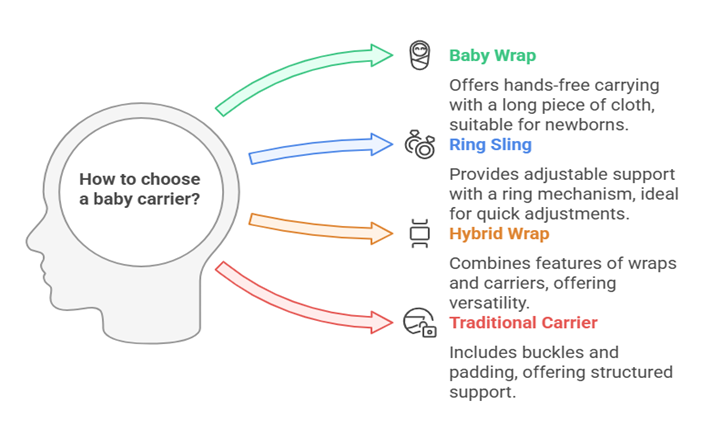
Across the market, babywearing products now cluster into clearly defined categories:
- Newborn-optimized wraps: Emphasize breathability, softness, and low fabric bulk
- Extended-use wraps: Focus on elastic recovery and higher weight tolerance
- Inclusive designs: Prioritize fabric length and adaptability across body types
- Hybrid systems: Blend wrap comfort with structural convenience
Safety and Certification Context (2025)
- All major brands discussed above are officially recognized as “Hip Healthy” by the International Hip Dysplasia Institute, confirming support for proper hip positioning.
- At present, as of February 22, 2025,Most major brands sold in the U.S. are designed to align with the updated ASTM F2236-24 safety requirements, particularly regarding labeling and airway awareness, specifically with regards to the labeling and safety guidelines on nursing and airway awareness.
- These differences help parents and health professionals choose appropriate baby-wearing alternatives based on stages of developmental adaptation, mechanics of the body, and standards of safety, not just familiar brands.

Specialized Considerations in Modern Babywearing (Expert Update for 2025)
In addition to safety requirements, baby-wearing experts in 2025 are placing greater emphasis on other factors such as post Childbirth recovery, Inclusive design metrics, and ethical engineering principles for baby wrap garments in 2025. All these factors serve to guarantee not only safe baby-wearing but also healthy baby-wearing for the baby as well as the mother.
1. Postpartum Healing: C-Section Comfort and Pelvic Floor Recovery
The existence of high-waist tie-scoop neck designs is well known for providing comfort during a C-section due to their ability to avoid the incision area. Nevertheless, new advice on postpartum support is now being addressed beyond incision support, independently of childbearing delivery methods.
Key Expert Considerations
- Pressure Management:
The proper positioning of the baby wrap can also prevent ‘swayback’ posture, which can put pressure on the abdominal contents and the healing tissue after surgery. Additionally, a neutral posture promotes the healing process in patients who suffer from conditions like diastasis recti or prolapse of the pelvic contents. - The 6-Week Benchmark:
Increasingly, informational guidance recognizes that while these wraps can be used immediately post-partum, many pelvic health physical therapists advise waiting at least six weeks after a caesarean section before prolonged babywearing. This permits the transverse abdominal muscle to return to its resting state. - Postural Support:
High waist baby wrap ties: This type of wrap tie provides gentle support to the abdomen to maintain good posture when standing, walking, or lifting.
In the same way as other forms of postpartum care to restore maternal wellness following pregnancy, guidance from a qualified health care provider is required prior to starting load bearing as part of healing.
2. Size Inclusivity: The 5.5-Yard Industry Standard
Authentic baby wrap size inclusivity can only be accurately measured by technical terms rather than marketing terms.
Universal Fit Specifications
- Length Standard:
The ideal width of a wrap, measuring 5 meters or roughly 5.5 yards, is considered the benchmark for a perfect fit. With this size, petite, average, and full-figured caregivers can do the cross-over tie. - Width Considerations:
An ideal wrap width falls between 20–26 inches.
Finer scales may not provide a deep, supportive seating position
Too broad wraps appear cumbersome on petite figures
These factors make it possible for a baby carrier to wrap to support the baby’s weight evenly while being flexible enough to suit everybody at every stage in between.
3. Ethical Engineering: Circularity and Chemical Transparency
In 2025, “eco-conscious” babywearing is increasingly defined by verifiable engineering standards, not general sustainability claims.
Circular Fiber Production
- Lenzing™ Modal, used by several leading baby wrap manufacturers, is produced via a closed-loop (circular) process, where over 99% of solvents and water are recycled.
- This significantly reduces environmental impact compared to conventional cotton processing.
Parents Certifications Can Verify
Caregivers seeking chemical safety and ethical assurance can look for:
- OEKO-TEX® Standard 100 – verifies that fabric is free from harmful substances such as heavy metals, formaldehyde, and certain flame retardants
- Global Organic Textile Standard (GOTS) – certifies organic fiber sourcing and responsible processing across the supply chain
These certifications provide transparency around both material safety and manufacturing ethics.
Why These Standards Matter
Modern baby wrap wear is now a reality that occurs daily and even for extended periods. If harmony is achieved regarding design perspectives for postpartum biomechanics, body acceptance, and ecological sustainability, baby wearing can be healthy for babies and sustainable from a production perspective.
In Conclusion:
By the year 2025, babywearing had evolved into a crucial parenting aid in modern times, something that lies between tradition and advanced material science. In response to a booming industry open to “smart” materials, as well as innovative uses of eco-friendly production, there is a clear goal of each caregiver, as there was in the beginning, which is “to provide a safe, ergonomic environment that supports natural biomechanics.” By strictly following the guidelines of T.I.C.K.S. with products approved by the revised mandatory safety requirements of ASTM F2236-24, parents can begin their first year of parenthood with confidence. “Every family is unique, and the best baby wrap will be the one that keeps both you and your baby happy, happy, and safe.”
Whether you choose lightweight breathability for a summer newborn or the high tension and elastic recovery for a heavier infant, the right wrap is much more than a carrier-it is a conduit to emotional regulation and neurological development. Fundamentally, it’s known about informed choices, enabling parents to safeguard their physical health through good posture while giving infants the “fourth trimester” closeness that starts life on a healthy footing. The right baby wrap supports both infant safety and caregiver comfort, making it an essential tool during the fourth trimester.”
Written by Hafiz Nauman Baig
Parent and babywearer, researcher with direct testing experience in various baby wrap types. This report is based on practical wear testing, present ASTM F2236-24 safety standards, Hip Dysplasia Institute Recommendations, and textile engineering principles pertinent to baby carriers.
FAQ: Common Caregiver Concerns
Is it possible to breastfeed in a baby wrap?
Yes. Breastfeeding in a baby wrap is possible by temporarily lowering the baby to breast level while maintaining a clear, unobstructed airway at all times. After feeding, the baby must be repositioned back into a high, tight carry so the face is visible and the airway remains open.
How long can a baby stay in a wrap?
There is no strict time limit as long as the baby is comfortable, alert, and positioned correctly. Caregivers should still provide regular breaks for supervised floor time to support motor development such as rolling and reaching.
Is it possible to “over-wear” a baby?
Babywearing is safe when done correctly, but it should not fully replace floor time. Infants benefit from opportunities to stretch, move freely, and practice gross motor skills alongside being carried.
What should I do if my baby starts to sag in the wrap?
Sagging usually indicates insufficient tension or that the baby has exceeded the optimal weight range of the wrap fabric. Most stretchy wraps perform best up to approximately 20–25 pounds. Retighten the wrap or transition to a more supportive carrier if needed.
This article provides general educational information and does not replace personalized advice from a pediatrician or pelvic health professional.

Hafiz Nauman Baig is a Researcher and PhD Scholar in Zoology, with a specialized focus on Biomechanics and Anatomical Data Analysis. Merging his academic expertise in biological structures with a deep background in Physical Ergonomics and strength mechanics, Nauman evaluates baby gear through a rigorous scientific lens.
Unlike standard product reviewers, he utilizes R Studio and statistical modeling to assess safety data, focusing on the physiological impact of carriers on the infant airway and the caregiver’s spine. His mission is to bridge the gap between complex biological safety standards and practical, pain-free babywearing.