
Bringing home a baby is always a moment of sheer happiness, but it is also an introduction to a world filled with unknowns. In the beginning, new moms find themselves struggling to learn a whole new language. But while conventional infant guides concentrate on the average growth patterns, they do not talk about the peculiarities of a baby’s physiology. This parent guide aims to fill in those gaps by providing you with real information on newborn health and milestones. Knowing what is really going on inside will help you take care of your baby with confidence.
Understanding these biological quirks works symmetrically with proper positioning architectures featured in our baseline infant carrying newborn care guide.
Pediatric Sleep Physiology: The Neurobiology of Active Sleep
When tracking newborn health and milestones, many new mothers are shocked to discover that newborn sleep is incredibly loud and active. During active sleep—which makes up about half of their sleep cycle, babies frequently twitch, squirm, make funny faces, and even grunt or cry briefly while remaining completely asleep. This lighter stage of sleep is crucial for their rapid brain development, but parents often mistake these noises as a sign that the baby is awake or in pain, leading to accidental wakeups. While focusing on physical play is essential for motor skills, introducing foundational cognitive milestones by teaching infants to read early on can drastically accelerate their language development and preschool readiness.
Key Facts About Active Sleep:
- Skeletal Muscle Movement: Unlike adults, a newborn’s muscles are not paralyzed during active REM sleep, allowing them to move and wiggle freely.
- Normal Sleep Sounds: Grunting, whimpering, and irregular breathing are standard sleep behaviors as their nervous systems mature.
- The Pause Technique: Always wait 30 to 60 seconds when you hear your baby fuss at night to see if they drift back into quiet sleep on their own.
- Infant Dyschezia (Not Constipation): Prolonged grunting, turning red, and straining before passing a soft stool is often “infant dyschezia.” Infants are simply learning how to coordinate their abdominal and pelvic floor muscles.
- Clinical Warning: Never use rectal stimulation (such as thermometers or suppositories) to help the baby poop, as this interferes with their natural muscle-learning process.
- Spotting True Respiratory Distress: While grunting in sleep is normal, you should seek immediate emergency care if your baby shows signs of pathological respiratory distress. Look out for intercostal retractions (the skin sucking in between or under the ribs), nasal flaring, or sustained rapid breathing exceeding 60 breaths per minute.
Neonatal Endocrinology: Pseudomenstruation and Breast Buds
When managing newborn health and milestones, you will often find that the first 24 hours of your baby’s life are usually peaceful and sleepy, but the second night brings a dramatic shift known as “Second Night Syndrome”. As newborns fully wake up to the world, they realize they are no longer in the warm womb and will frequently seek comfort through continuous cluster feeding and crying. This sudden shift, combined with extreme maternal exhaustion, creates a high-risk window where parents are prone to accidentally falling asleep while holding their baby. Monitoring these physical layers ensures you can securely protect newborn health and milestones using the top safety standards found in our hack-proof baby monitors guide.
Key Facts About Surviving the Second Night:
- Establishing Your Supply: Continuous nursing on night two is a natural cue for your body to start producing mature breast milk.
- Preventing Infant Falls: The risk of dropping a baby due to exhaustion peaks between 3:00 AM and 7:00 AM on the second postpartum night.
- Safe Sleep Setup: If you feel drowsy, immediately place your baby in their safe, flat bassinet on their back rather than risking falling asleep on a couch or bed.
- AAP Safe Sleep Guidelines: To prevent suffocation and sleep-related injuries, caregivers must strictly follow the American Academy of Pediatrics (AAP) safe sleep rules. Always place the baby flat on their back (supine position) on a firm mattress. Ensure the sleep environment is entirely bare (remove all loose blankets, soft objects, and pillows), and never put a hat on a sleeping infant indoors to prevent overheating.
- Create a Support Shift: Partner with a loved one to divide burping, diaper changes, and holding duties so you can get uninterrupted rest.
Neonatal Endocrinology: Pseudomenstruation and Breast Buds
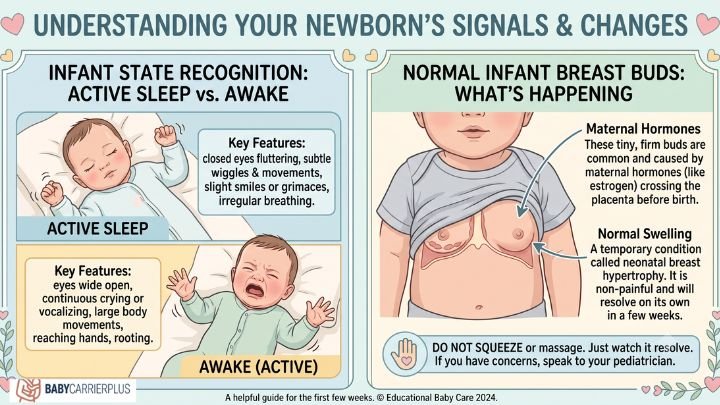
When observing newborn health and milestones, it is important to know that while in the womb, your baby is exposed to high hormone levels, particularly estrogen. After birth, this sudden drop in maternal hormones can trigger some startling but entirely normal physical changes in both baby boys and girls. Many parents panic when they spot swollen chest lumps or fluid leaking, but these are harmless, temporary reactions that fade as the baby’s body clears the hormones. Additionally, you can review safe dermal boundary protocols for infants in our updated magnesium lotion for baby sleep guide.
Key Facts About Infant Hormone Changes:
- Newborn Breast Buds: It is common for both boys and girls to develop small, firm subareolar nodules (lumps) under their nipples, which may last for a few weeks to several months.
- Witch’s Milk: Sometimes a newborn’s swollen breasts will leak a few drops of milky fluid; this is harmless and will stop on its own.
- Baby Girl Mini-Periods: Female infants may experience a harmless white vaginal discharge or even a small amount of bright red vaginal bleeding (pseudomenstruation).
- CRITICAL WARNING – Never Squeeze or Massage: Caregivers must never squeeze, pinch, or massage swollen infant breast buds. Mechanical manipulation can introduce dangerous surface skin pathogens into the breast tissue, leading to Staphylococcus aureus mastitis—a severe acute bacterial infection that requires immediate hospitalization and intravenous antibiotics.
Safe Formula Preparation, Sanitization, and Hydration Mechanics
While considering newborn health and milestones, it is vital to note that precise nutrition and baseline hydration form the foundational matrix of early infantile development. To prevent systemic metabolic strain on the infant’s immature renal system, clinical feeding protocols must prioritize exact mechanical safety over anecdotal methods.
Second, parents occasionally miscalculate formula ratios, making it too dilute which starves the baby of nutrients or too concentrated, which can lead to severe dehydration. To establish proper circadian alignment and resting routines, optimize your environment with our newborn sleep schedule guide.
Key Facts About Smart Feeding:
- Audible Swallow Assessment: First, effective milk transfer is dictated not merely by sucking rhythm, but by audible swallowing. Caregivers must listen closely for swallowing sounds and watch for deep, steady jaw movements to confirm the infant is successfully ingesting calories.
- Precise Formula Ratios & Water Intoxication Warning: Always read the formula packaging instructions carefully. Overdiluting the formula (adding excess water to “stretch” the supply) is incredibly dangerous. It can cause a life-threatening condition called “water intoxication” and severe hyponatremia, leading to cerebral edema (brain swelling) and generalized seizures.
- The 1-Hour Leftover Rule: Once a baby begins feeding from a bottle, bacteria from their saliva enter the milk. Any remaining formula must be discarded strictly within 1 hour and must never be refrigerated or reheated.
- Identify Silent Dehydration: Watch for fewer than six wet diapers a day, lack of tears, or extreme lethargy, which can indicate critical hydration issues.
Essential Development & Care Timeline
The following table provides a quick reference for physical and social progression throughout your baby’s first year:
To audit clinical guidelines on how newborn health and milestones correlate with neurodevelopment, read the CDC Pediatric Surveillance Framework. This resource ensures your metrics strictly align with updated, evidence-based population thresholds.
| Age | Motor Milestones | Social & Cognitive Milestones | Parent Support Tip |
|---|---|---|---|
| 2 Months | Lifts head briefly during tummy time | Smiles when you talk to or smile at her | Talk back to your baby using coos |
| 4 Months | Holds head steady without support | Copies facial expressions like smiles | Give supervised tummy time daily |
| 6 Months | Leans on hands to support herself when sitting; rolls from tummy to back | Responds to name; blows raspberries; laughs and squeals | Put toys slightly out of reach |
| 9 Months | Gets to a sitting position by herself | Is shy or fearful around strangers; looks when name is called; makes repetitive babbling sounds (“mamamama”, “bababababa”) | Play hide-and-seek games |
| 12 Months | Walks holding on to furniture (cruising); may take first independent steps | Calls parents “mama” or “dada” specifically; waves “bye-bye”; understands “no” and pauses briefly; shakes head “no” | Set clear, calm limits for safety |
Frequently Asked Questions
Question 1 Why does my sleeping baby grunt, wriggle, and make noises?
This is called active sleep, a normal REM stage where baby brains develop rapidly. Their muscles are not paralyzed, so they wiggle and grunt without actually being awake.
Question 2 Why is my baby crying so much on the second night?
This is “Second Night Syndrome,” where your baby misses the womb and cluster feeds to help establish your milk supply. Keep them close, and safely rest when they sleep.
Question 3 Is it normal for my baby girl to have vaginal bleeding?
Yes, this is pseudomenstruation caused by the sudden drop in maternal hormones after birth. It is entirely harmless and will stop on its own within a few weeks.
Question 4 Why does my newborn have hard lumps under their nipples?
These are newborn breast buds caused by maternal hormones crossing the placenta in the womb. They are normal for boys and girls and resolve without treatment.
Question 5 How can I tell if my breastfed baby is actually eating?
Do not just watch them suck; listen closely for swallowing sounds and watch for deep, steady jaw movements. Six or more wet diapers daily after day five confirms they are getting enough milk.
Question 6 What is the safest way to mix baby formula?
Always read and follow the packaging directions exactly to measure water and powder correctly. Improperly diluting formula starves your baby of nutrients and can cause serious health issues.
Conclusion
Recognizing the biological idiosyncrasies that exist with your baby could change your entire experience as a parent, particularly as you monitor newborn health and milestones. Understanding such things as how to spot active sleep, getting through the second night of cluster feeding, and embracing the fact that there will be hormones involved could mean a life of postpartum anxiety free of worry and filled with love. Bear in mind that all babies develop in their own time and that your maternal intuition is your greatest strength. For a complete structural overview of nighttime soothing mechanics, read our newborn sleep and soothing biological guide.