
Understanding the science of Newborn Sleep and Soothing is a primary challenge for new parents, especially when faced with structural back strain from just ten minutes of holding an upset baby. The information in this guide is for educational purposes only and does not replace professional medical advice, diagnosis, or treatment. Always consult a pediatrician regarding infant health and safety.
Unlike advertising campaigns that try to persuade people of something, this analysis reveals all the science behind baby sleep and comforting techniques. If you would like to know how to stop a baby from crying and falling asleep without being exhausted yourself, you will find out everything in this study. To master the fundamental mechanics of physical proximity and holding geometry, consult our primary infant carrying newborn care guide.
It is biologically correct for babies to be held, and this induces physiological relaxation. However, if held inappropriately, safety becomes an issue. This article assures us of giving insight into how natural processes work, thus offering ways of making sure your baby will sleep well when held, all the while ensuring the baby’s airways remain open and the body of the caregiver does not suffer in the process.
🛠️ Comparative ‘Specification Analysis’ Table
The following table provides a structural comparison of primary carrier materials used to facilitate infant sleep and calming:
| Material Classification | Elasticity and Load Physics | Structural Weight Limits | Clinical and Regulatory Notes |
|---|---|---|---|
| 100% TENCEL™ Modal | Elastic tension provides uniform, snug pressure across the torso, distributing weight and reducing localized mechanical strain. | 8 to 25 lbs (3.6 to 11.3 kg); certified for full-term neonates. | Complies with ASTM F2907; certified as “Hip Healthy” by the International Hip Dysplasia Institute. |
| 100% Woven Cotton | Moderate diagonal stretch (shear resistance); anchors the pelvis and supports spinal kyphosis. | 8 to 35 lbs (3.6 to 15.9 kg) based on weave density. | Complies with EN 13209-2; highly supportive for maintaining physiological spinal alignment. |
| Woven Linen & Hemp | High tensile strength with near-zero stretch; provides vertical leverage for heavier infants. | 7 to 45 lbs (3.2 to 20.4 kg); supports long-duration carrying. | Highly supportive for toddler stages; requires precise shoulder positioning to prevent chafing. |
| 3D Polyester Mesh | High structural stiffness; transfers load directly to padded waistbands and shoulder harnesses. | Up to 45 lbs (20.4 kg); typically requires a newborn insert under 4 months. | Maximizes ventilation to prevent neonatal heat stress; requires regular inspection of buckle hardware. |
| Neoprene / Water-Friendly Mesh | Elastic memory retains shape when wet, utilizing hydrostatic buoyancy during water immersion to reduce effective load. | 8 to 25 lbs (3.6 to 11.3 kg); engineered specifically for brief water deployment and showers. | Quick-drying and chlorine-resistant. Not optimized for prolonged dry carrying due to low static structural rigidity. |
🔬 Researcher’s Takeaway:
In simple words: While elastic wraps can soothe newborns, fabric sag in loose wraps can pull the infant into a dangerous chin-to-chest position, compressing the trachea. Caregivers must maintain a tight fit to support the spine and keep the chin elevated. In case of larger infants, the stiffness of the fabrics used – such as linen, or mesh structure – acts as a rigid platform and transfers the weight to the hips of the caregiver and saves him/her from exerting physical strength. The structural stiffness guarantees stable newborn sleep babywearing position profiles without causing any muscle fatigue.
Biophysical Modeling of Carrier Load Distribution The load-distribution mechanics of babywearing can be modeled using static mechanics. To prevent lower back strain in the caregiver, a carrier must distribute the infant’s mass symmetrically. The torque acting on the caregiver’s lumbar spine is a function of the infant’s distance (d) from the wearer’s center of gravity and the pelvic tilt angle (θ): Στ = m · g · d · cos(θ). In non-ergonomic carriers, the lack of a structured lumbar waistband increases the distance (d), which increases the torque acting on the caregiver’s lower back. By using a wide pelvic waistband, the normal force (N) is distributed across the pelvis: N = [m · g · cos(θ)] / A. This biomechanical explanation shows parents that wide-based carriers protect spinal health while keeping the infant safe.
The Evolutionary Biology of Newborn Sleep and Soothing
Secondary Altriciality: Why Human Infants Expect Constant Proximity
For one to fully appreciate the dynamics of newborn sleep babywearing, it is essential to appreciate the uniqueness of human infants within the animal kingdom. According to the science of newborn sleep and soothing, human infants are born in a transitional state and need physical touch to provide security reminiscent of their stay inside the womb. For those who find it difficult to calm a crying baby when it’s time for bed, knowledge of the following biological limitations is essential:
- Secondary Altriciality: Human newborns are evolutionarily distinct; they are born physically helpless and immature like nest-bound animals (rabbits/mice) yet possess fully active sensory systems that constantly seek the caregiver’s proximity.
- The Bipedal Trade-Off: In the field of zoology, bipedal locomotion meant that the female’s pelvis had to be narrower. The increase in the size of the human brain in conjunction with the above factor made the baby premature at birth.
- The 25% Brain Metric: The human infant brain is only 25% of its adult size at birth, while the newborn chimp brain is 50% of the adult size. Due to lack of the motor coordination to hang on the mother’s fur, the infants depend solely on mechanical transportation.
Moreover, the human body milk is biologically designed for such close contact. The body milk of human beings is low in fat content and very high in sugar content compared to the body milk of those species that build nests and leave their offspring for extended durations. This combination demands the need for constant closeness and feeding of the child. The ancestral environment was adapted to such cooperation, whereby mothers and grandmothers would carry babies.
The Physiology of the “Fourth Trimester”
The first three months of an infant’s life are often referred to as the “fourth trimester”. During this phase, skin-to-skin contact and carrying trigger profound physiological benefits:
- Oxytocin Release: Close physical contact stimulates the endocrine system, promoting the release of oxytocin (the bonding hormone) in both the caregiver and the infant. This hormone reduces stress, lowers parental postpartum anxiety, and supports successful lactation.
- Cardiorespiratory Stability: Clinical research has shown that physical touch not only helps keep the baby’s heart rate, breathing rate, and blood pressure stable, but also improves their oxygen saturation levels.
- Energy Conservation: Cuddling up with someone’s warm chest means that the baby is conserving energy that they will not need to regulate their body temperature or cry with. This energy goes towards development.
Implementing a structured babywearing setup helps parents master:
- Neurological Shift: Constant contact triggers the safe transport response, calming the infant’s nervous system instantly.
- Airway Maintenance: A secure, high-riding posture satisfies structural carrying needs without risking positional neck flexion or respiratory strain.
- Thermal Balance: Proximity helps regulate core neonate temperatures naturally, preserving crucial energy for physiological growth.
Evidence-Based Infant Bedtime Soothing Methods
The Physics and Neurology of the Transport Response
Parents have noted that as soon as they stand up and begin to walk around with their baby, the infant stops crying, but the baby begins crying once they sit down again. For parents to understand the science of sleeping and soothing babies, they must know that what they see here is not manipulative behavior; it is a well-documented reflex phenomenon called the transport response. Scientists at the RIKEN Brain Science Institute headed by Kimi Kuroda explain how this is a survival instinct of mammals.
When carried by a walking caregiver, a unique biological cascade occurs:
- Vestibular Stimulation: The infant experiences a rhythmic, vertical sway at approximately 90 beats per minute, stimulating the balance centers in the inner ear.
- Parasympathetic Activation: This motion immediately triggers the parasympathetic nervous system, causing a rapid decrease in infant heart rate within 30 seconds.
- Motor Regulation: Caregivers achieve a complete cessation of voluntary body movements, muscle tension, and distress vocalizations (crying).
This parasympathetic activation reduces the heart rate by up to 15-20% within 30 seconds, accompanied by decreased motor activity and voluntary body movement. Static holding does not trigger this cardiac vagal pathway; heart rates often remain elevated and crying persists, showing that movement is key to activating the transport response. This cardiac vagal tone can be modeled as a function of the walking frequency (f) and velocity (v):
IBI_infant ∝ ∫ (a_vestibular(f, v) + contact_snug) dt
Where a_vestibular represents the acceleration forces acting on the inner ear. Understanding these mechanics allows caregivers to work in harmony with the infant’s biology to soothe them effectively.
In the wild, this cooperative behavior allowed ancestral mothers to transport their offspring quickly and silently during emergencies without attracting predators. Understanding these mechanics allows parents to learn how to calm a crying baby at bedtime by working in perfect harmony with the baby’s internal biology. Clinical validation available on National Center for Biotechnology Information confirms this walking transport reflex accelerates newborn sleep and soothing.
Implementing the Five-Minute Cuddle Walk Protocol
Based on clinical data, parents looking for reliable newborn sleep babywearing solutions can follow a highly effective, step-by-step soothing protocol to help a crying infant transition to deep rest:
- The Soothing Walk (5 Minutes): Carry the crying infant in an upright, snug position (such as in a wrap) and walk continuously for five minutes. This motion stops crying and induces sleep in nearly half of all infants, whereas stationary holding or rocking in a chair is significantly less effective.
- The Seated Transition (5 to 8 Minutes): Once the infant falls asleep, the caregiver must sit and hold the baby quietly for an additional five to eight minutes before attempting a transfer to the crib. This step is critical because sleeping infants are highly sensitive to separation; their heart rate spikes and they immediately wake up if detached before reaching deep sleep.
- The Crib Transfer: Gently lay the infant down on their back on a firm, flat crib mattress to finish sleeping securely.
Preventing Positional Asphyxia in a Baby Carrier
Understanding Airway Occlusion and Neck Flexion Mechanics
In learning about the entire science of baby sleeping and soothing techniques, the key aspect of safety in teaching parents about these issues is ensuring that positional asphyxia does not occur in baby carriers. Positional asphyxia is a medical problem whereby the positioning of the body of an infant causes an inability to breathe well enough resulting in reduced oxygenation. The danger with this is that it is usually silent with no cries for help.
Unlike adults, the neonatal trachea is highly flexible and narrow, with incomplete cartilaginous rings composed of soft type-II collagen rather than rigid bone. When an infant’s neck flexes forward (chin-to-chest), the mechanical shear stress easily collapses the soft tracheal lumen, causing progressive hypoxia. This is known as the “garden hose effect,” where forward bending forces the airway to fold on itself, silently cutting off airflow.
- Skeletal Proportions: An infant’s head is disproportionately large and heavy, representing a massive percentage of their total body weight, while their neck muscles remain weak and undeveloped.
- Airway Flexibility: A newborn’s trachea (windpipe) is exceptionally flexible, soft, and narrow compared to adult anatomy.
- Neck Flexion Trap: However, when such infants are left in unsecured carriers and even incorrectly swaddled, the effect of gravity results in their heavy heads drooping down and resting on their chests, with their chins pressed against them.
- The Garden Hose Effect: This forward bending forces the soft breathing tube to fold on itself, completely cutting off airflow much like a kinked garden hose.
- Silent Suffocation: Since these infants do not have enough muscles to support themselves and lift their heads up, their airways get obstructed, and hence, these babies cannot call out for help.
The T.I.C.K.S. Safety Checklist for Safe Carrying
To avoid any potential of unintentional airway obstruction, it is necessary that the caregiver adhere to the globally established T.I.C.K.S. guidelines throughout all active carrying procedures:
- T – Tight: The harness or carrier should be fastened tightly to ensure that the infant is held firmly against the body of the caregiver. Otherwise, any looseness of the harness will cause the baby to sink down and obstruct the air passage while straining the lumbar muscles of the caregiver.
- I – In View Always: The carer needs to be able to view the infant’s entire face, nose, and mouth without any difficulty just by looking down. Layers of fabric must never get so tight around the baby’s head that the carer needs to open it up manually to check whether they can breathe or not.
- C – Close Enough to Kiss: The infant’s head must be situated high up in the chest panel of the carer. Just a slight tip of the head forward must enable the carer to kiss the top of the infant’s head.
- K – Keep Chin Off Chest: There should always be a clear distance of a finger width from the bottom of the baby’s chin that ensures the airway is straight and wide open. There should be no curling or compression of the neck.
- S – Supported Back: For an upright carry, the fabric should support the baby in such a way that their spine remains straight and in its natural gentle curve. If the carrier is loose, the baby will end up in a curled “C” shape position.
Identifying and Preventing Babywearing Overheating Symptoms
Thermoregulation Challenges in Neonates
Infants rely on Brown Adipose Tissue (BAT) for non-shivering thermogenesis to maintain their core temperature. When carried, the infant absorbs the caregiver’s metabolic heat, which is trapped by the carrier fabric. If the carrier is made of synthetic materials like polyester, this heat buildup can suppress the infant’s natural BAT thermoregulatory feedback loop. This rapid rise in core temperature causes hypothalamic desensitization, suppressing the respiratory arousal reflex. This suppression is the direct physiological link between overheating and Sudden Infant Death Syndrome (SIDS), making the choice of breathable, natural fibers a critical safety priority.
- Anatomical Limits: They have a high surface-area-to-mass ratio and lack fully functional sweat glands, which means they cannot shed excess body heat easily.
- Heat Absorption: When carried, the infant actively absorbs the caregiver’s metabolic body heat while being enclosed in fabric, which essentially acts as an extra layer of clothing.
- SIDS Correlation: Because overheating is a documented risk factor for sudden infant death syndrome (SIDS), active monitoring is a major safety priority for parents learning how to calm a crying baby at bedtime safely.
Detecting and Addressing Overheating
Caregivers must never rely on an infant’s hands or feet to gauge their temperature, as immature peripheral circulation naturally makes their extremities feel cool. Instead, you must directly feel the back of the infant’s neck or their chest.
The infant’s neck and chest areas feel comfortably warm and dry to the touch.
- • Flushed, bright red cheeks
- • Sweaty or clammy neck/chest
- • Damp hair or wet neckline
- • Rapid, shallow breathing metrics
- • Heat rash (clusters of tiny red dots)
- • Lethargy (abnormally hard to wake up)
Caregivers must actively monitor the infant for specific babywearing overheating symptoms, which include:
- Skin Flushing: Flushed or unusually red cheeks and skin.
- Moisture Buildup: A warm, sweaty neck or chest, and damp hair around the hairline.
- Distress & Respiration: Increased fussiness, rapid breathing, or the appearance of heat rash (small red dots in skin creases).
- The Lethargy Trap: Extreme lethargy or a baby that is unusually sleepy and difficult to wake. This is a critical danger sign; heat-exhausted babies often slip into a deep, unresponsive state that caregivers can mistake for a peaceful nap during a newborn sleep babywearing session.
Emergency Protocol: If these symptoms appear, the infant must be removed from the carrier immediately, undressed, moved to a cool or shaded area, and gently cooled with a damp cloth.
Environmental Dress Code Rules (The “Plus-One” Layer Rule)
To prevent dangerous heat buildup, the carrier itself must be treated as at least one full layer of clothing. Caregivers should adjust the infant’s clothing based on the environmental temperature thresholds:
- Above 90°F (32.2°C): Avoid prolonged outdoor carrying. If carrying is necessary, dress the infant in a diaper only, utilize a highly breathable, non-padded carrier, seek absolute shade, and nurse frequently to maintain hydration. Note that breastfed infants do not need supplemental water; they simply require more frequent feeding.
- 80°F to 90°F (26.7°C to 32.2°C): Dress the infant in a lightweight, short-sleeve bodysuit or romper made of natural fibers. Use a wide-brimmed sun hat and stay strictly in shaded areas.
- 70°F to 80°F (21.1°C to 26.7°C): Dress the baby in a single layer of lightweight clothing and carry an extra layer to add or remove as needed.
Using blackout canopies can support healthy sleep hygiene by regulating light cycles, but they must always allow for proper ventilation to prevent overheating, which is a known risk factor for SIDS.
Clinical Guidelines for Safe Newborn Sleep and Soothing
Pediatric Safe Sleep Standards and the Avoidance of Sitting Devices
When implementing safe babywearing practices, caregivers must distinguish between active, supervised soothing and routine, unsupervised sleep. Grounded in the science of newborn sleep and soothing, clinical guidelines from the American Academy of Pediatrics (AAP) and the Consumer Product Safety Commission (CPSC) state that sitting devices—including car seats, strollers, swings, infant carriers, and slings—are not recommended for routine, unsupervised sleep.
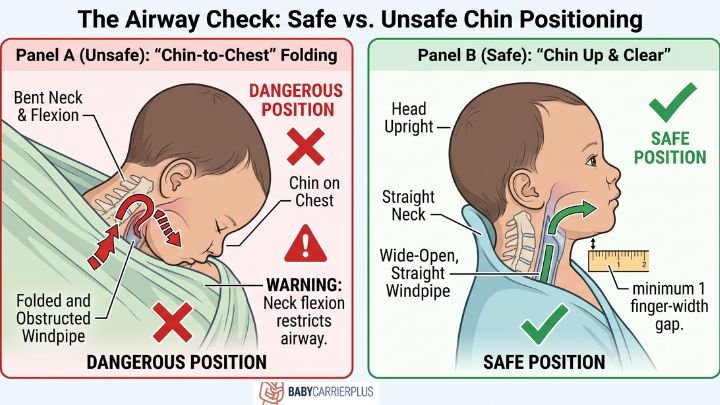
- Airway Collapse: When an infant falls asleep in a seated or semi-upright position, their muscles relax completely. This allows their heavy heads to fall forward, inducing neck flexion that can silently block their airway.
- Supervision Threshold: While infants will naturally fall asleep while being worn, this configuration requires active, continuous supervision by the caregiver. If you are using carrying methods to learn how to calm a crying baby at bedtime, you must remain awake and alert.
- Suffocation Risks: If the caregiver becomes drowsy, falls asleep, or is under the influence of medications or alcohol, the risk of accidental positional suffocation increases dramatically.
- The Safe Transition: As soon as is safe and practical, a sleeping infant should be transferred from the carrier to a firm, flat mattress in a crib or bassinet, lying flat on their back.
Ergonomics of Orthopedic Hip and Spinal Development
Proper babywearing habits must fully support the natural physical development of the infant’s spine and hips to avoid long-term joint strain.
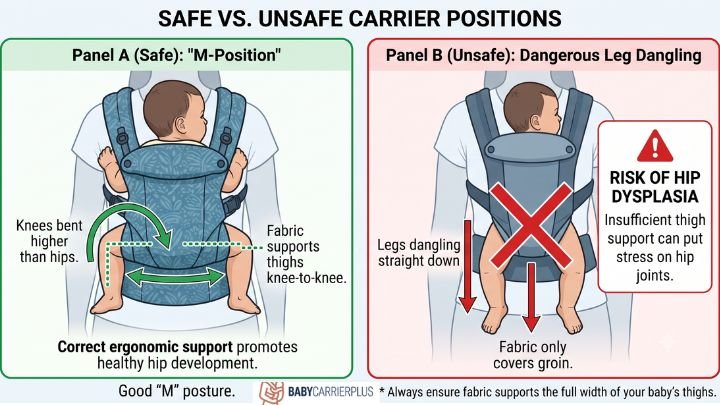
- • Perfect M-Shape: Pelvis is fully anchored with legs spread naturally around the wearer’s torso.
- • Knee-to-Knee Support: Fabric extends fully to the popliteal fossa (knee creases) to prevent dangled leg strain.
- • Femur Extension: Thighs are elevated horizontally, reducing deep mechanical pressure on the acetabulum (hip socket).
- • Physiological C-Spine: Infant spine exhibits a gentle, uninterrupted curved profile from head to sacrum.
- • Pelvic Tuck: Base of the carrier forces a deep seat, tilting the pelvis upward to absorb dynamic walking shocks.
- • Zero Compression: Back panel remains firm but flexible, preventing flat straightening or hyper-extension of the vertebrae.
The “M-Position” (Hip-Healthy Fit)
The International Hip Dysplasia Institute (IHDI) emphasizes that the first six months of life are the most critical for hip joint development. To prevent developmental hip dysplasia—where the thigh bone slips out of its cartilage socket—the carrier must support the infant’s thighs securely from knee to knee. Proper seating rules outlined by the International Hip Dysplasia Institute protect joint alignment during newborn sleep and soothing.
- Frog-Leg Spread: The infant’s thighs should spread wide around the caregiver’s torso, with their knees bent higher than their hips to form an “M-position”.
- Anatomical Angles: The hips should be flexed exactly between 90° and 110°. This specific posture centers the head of the thigh bone perfectly within the hip socket, supporting healthy joint maturation.
- The Dangling Risk: Letting the infant’s legs dangle straight down pulls the thigh bones out of their sockets, which can cause severe joint damage.
The “C-Curve” (Spinal Support)
The baby is born with total kyphosis because there is only one C-shaped curve in the spine at birth. The development of the cervical lordosis (inward S-curved shape of the neck region) starts between 3 to 6 months when babies begin controlling their neck movements, after which thoracic kyphosis develops.
- Structural C-Curve: An ergonomic carrier must fully support this natural C-curve of the infant spine, preventing any unnatural straightening.
- The Facing-Out Constraint: Putting an infant who is very small in a forward carrying position will cause them to bend in a rounded position. This will put pressure on the pelvis of the baby making it tilt backwards while bearing the pressure of each step that the adult takes.
- Age Limits: Therefore, forward-facing carrying should only be done when the baby is awake and no longer than six months of age and can control their own head and body well. It is never to be used while sleeping babywearing.
Special Considerations for Cesarean Recovery and Diverse Body Profiles
Implementing safe carrying habits must also account for the physical recovery and distinct body structures of the caregivers themselves:
- Post-C-Section Adaptations: Cesarean birth is a surgical operation which needs weeks to heal. Recovering mothers should avoid structured waistbands that press on surgical incisions. However, asymmetrical ring slings can strain core muscles; instead, waistless, symmetrical options like a wrap or onbuhimo are preferred.
- Ergonomics for Plus-Size Caregivers: It is important that you get the right fit to avoid posture misalignment. You should consider getting carriers whose shoulder straps can be crossed over one another (x-back). This will ensure that the straps do not pinch the neck or slip off the shoulders.
- Fatigue Mitigation: The use of lumbar support cushions is equally highly efficient in preventing the caregiver from bending their lower spine to balance the front weight load, thus avoiding muscle strain. Use of certified waistband extenders increases the waistband length without weakening its structure.
The ‘Digital Evidence’ Brief
Label Analysis
Official product safety labels and federal instruction manuals contain critical warnings frequently overlooked by casual parenting blogs:
- The 8-Pound Minimum Threshold: The instructions provided by the manufacturer of most elastic bandages warn against use below 8 lbs without consulting a health care professional. Premature or low birth weight infants have very poor muscle tone and smaller air passages, which makes them susceptible to sudden choking.
- Post-Nursing Position Warning: Slings must show warnings visually according to mandatory CPSC labeling regulations. The instructions explain that one must always adjust the baby’s position following nursing so that he/she should be on his/her back. Being left in a reclined position after feeding is one of the main reasons for positional suffocation.
Consumer Analysis
Analyzing caregiver feedback databases highlights three persistent, real-world complaints that directly impact safety and comfort:
- Stretchy Sag and Muscle Strain: The parent’s observation is that although elastic wraps are effective when it comes to newborn babies, they become extremely droopy once the baby gets up to 15-20 pounds. The reason for the drooping of the wraps makes the baby curl, thereby affecting their breathing passage. The caregiver needs to curve her spine to support her back.
- The Origami Complexity Obstacle: New users often describe the process of securing the long strips of fabric as being akin to performing origami; as a result, the tie becomes loose and wrong. A loose tie causes inadequate support for the baby’s head and spine and allows their chin to drop toward their chest.
- Multi-Layer Heat Trapping: The issue with the material wrap is that it involves the wrapping of three complete layers of jersey or modal fabric around the infant. Excessive insulation causes an accumulation of metabolic heat, resulting in fast onset of heat stress, sweating, and heat rash.
The ‘Researcher’s Verdict’ Conclusion
To ensure that the newborn baby sleeps and soothes in peace, a multifaceted approach is necessary which includes both safety and anatomical comfort for the baby. Calming the baby does not revolve around a magic product but on implementing a combination of biological safety measures with physical carrying. With an understanding of the complex system of newborn sleep and soothing processes, parents can use the technique of carrying to trigger the neurological transport response in the infants.
However, learning to soothe a crying baby before sleeping is dependent on one’s ability to understand the fact that physiological comforting should not come before protecting the airways actively. The caregiver should always be on the lookout, observing all the T.I.C.K.S. rules, making sure that the legs are put into the correct orthopedic position and dressing appropriately so as not to cause heat stress. This should help you feel more confident in your newborn sleep baby wearing journey, where the baby is held high, with its chin up, with the appropriate temperature control and eventually transferred onto a hard mattress.