🛍️ Affiliate Disclosure:
As an Amazon Associate, we earn from qualifying purchases. This means if you click a link and make a purchase, we may earn a small commission at no extra cost to you.
👋 Welcome Moms & Dads!
Medical Disclaimer: The information provided in this guide is for educational and gear-selection purposes only and does not replace professional medical advice, diagnosis, or physical therapy treatment. Always consult your OBGYN or healthcare provider to ensure a baby carrier is safe for your specific postpartum and post-C-section recovery timeline.
Scientific Note: This content is for informational purposes to guide your gear choices and does not constitute medical advice. Always consult your pediatrician!
Choosing the right waistless baby carrier is crucial when newborn humans emerge entirely helplessly from birth. This is termed as “altricial” in biology and indicates that your child needs a fourth trimester outside the womb. Your baby will always crave physical closeness. This is so since closeness will enable your baby to regulate their nervous system, increase milk production, and minimize postpartum depression. However, you have undergone significant abdominal surgery.
What next? The waist belts in the conventional soft structured carriers need to be tight to hold the weight. This is the worst thing for your healing body. The hard belt rests on the new surgical point of injury. There is friction, pain, and constant shear stress due to the belt. Are you even able to move around without feeling pain? Early ambulation assists in tissue repair and relieves gas pains, but only if you do not have an ordinary waist belt.
A better choice is needed. The use of a baby carrier without the waist strap brings about dramatic differences. The Japanese-inspired Onbuhimo design does not have the lower strap. The full Japanese word is comprised of onbu (meaning to carry on the back) and himo (meaning a strap, cord, or rope). Omitting himo strips the word of its physical and historical context as a traditional, loop-and-cloth-based carrying system. The design puts the total weight on the shoulders and the powerful upper back muscles. This mechanical bypass relieves shear stress across the rectus abdominis and the healing anterior rectus sheath, allowing safe, early postpartum mobility. It is the perfect baby carrier for your post-C-section recovery.
The Anatomy of Post-Cesarean Recovery and Abdominal Kinematics
Why does wearing a typical baby sling cause so much pain following birth? Your body has undergone tremendous physical damage. A C-section is not just an incision on your skin; it is an extremely invasive procedure. To access your baby, surgeons must cut or separate seven distinct layers of your abdominal wall:
A deep evaluation of abdominal wall anatomy on NCBI underscores how complex horizontal incisions cut through critical fibrous layers.
- Skin: Cut open horizontally through a low Pfannenstiel incision.
- Superficial Fascia: The fatty Camper’s layer and fibrous Scarpa’s tissue.
- Deep Fascia: Important supportive connective tissue sheaths.
- Anterior Rectus Sheath: The dense, tough anchoring wall of your belly.
- Abdominal Muscles: The rectus abdominis (“six-pack”) parted vertically right down the middle line.
- Parietal Peritoneum: The thin, sensitive membrane lining your entire abdominal cavity.
- Uterus: The lower uterine muscular segment holding your baby.
- The Pfannenstiel Incision: A horizontal, slightly curved incision placed 2 to 3 centimeters (two fingerbreadths) superior to the symphysis pubis. Standard carrier waistbands rest directly on this incision site, restricting the microvascular capillary networks essential for tissue remodeling and risking hypertrophic scar formation.
- The Joel-Cohen Incision: A straight transverse incision positioned 3 centimeters superior to the Pfannenstiel line. While this higher entry minimizes blood loss, it places the healing tissue directly under the point of maximum flexion when sitting, making any low-sitting carrier waistband highly painful.
- The Midline Vertical Incision: Frequently reserved for high-stakes emergency cesareans, this vertical entry runs from the symphysis pubis to the umbilicus. This incision is highly vulnerable to outward tension, meaning any waistband can cause painful vertical traction on the wound, necessitating the exclusive use of true waistless carriers like ring slings or high-back Onbuhimos.
Each layer requires optimum blood circulation for reconstructing their integrity. Strapping on a bulky waistband at this intricate surgery site restricts the microvascular system. It leads to micro-tearing and slows down the healing process.
This is precisely the reason that makes a waistless baby carrier better in anatomy. It acknowledges the fact that you need to be free from any kind of pressure from all seven layers.
Tissue Healing Stages and Tensile Strength Recovery
After birth, every wounded layer gets individually sutured. Healing takes time. Your internal baseline strength returns slowly, tracking the precise recovery of fascial tensile strength:
| Time post-surgery | Fascial Tensile Strength | Abdominal Loading Blueprint |
|---|---|---|
| 2 – 3 Weeks | ~25% | Extreme vulnerability. Minimize all core pressure and heavy lifting. |
| 6 Weeks | ~50% | Light activity allowed. Tissue remodeling begins. |
| 12 Weeks | ~75% | Scar maturation phase. Maximum expected recovery. |
Note: A surgical scar maxes out at roughly 75% of pre-surgical tissue strength. It never truly hits 100% again.
The Hidden Perils of Waistbands on Active Adhesions
In the initial 12-week period, your body tissues will be very sensitive to any mechanical force. Regular baby carriers pose an extreme danger at this stage. Tightening the waist belt causes compression force and sheer force to act directly on the wounded area. The necessary microvascular circulation is inhibited, leading to microtears, delayed healing, and formation of hypertrophic scars.
Why does the tissue feel so tight? It comes down to collagen layout:
- Healthy Tissue: Neatly organized in parallel sheets. Think of a tight block of uncooked ramen noodles.
- Traumatized Scar Tissue: Deposited rapidly and completely disorganized. It looks like a tangled bowl of messy, sticky spaghetti.
Such chaotic repair creates adhesions, which are tough, thick bands that connect various layers of the tissues together. The adhesions immobilize your abdomen wall resulting in the pulling sensation and pain. The tight belt on this chaotic state can be compared to applying honey between two layers of plastic foil. It glues the tissue, preventing you from having the normal gait and making the contraction of your abdominal muscles impossible. The baby carrier without a waist is the easiest way to give your abdomen enough space.
Daily Movement Blueprint for Core Protection
To safeguard your healing midline during the critical initial six weeks, dynamic pelvic floor physical therapists recommend adopting these protective lifestyle adaptations:
- The Log-Roll Exit: Don’t perform sit-ups in a straight line upon awakening from sleep. Roll over on the entire body into a log position before slowly pushing oneself to an upright position using arm strength.
- Nose-Over-Toes Standing: Do not use your abdominal muscles when trying to stand from a small seat. Instead, lean forward and position your nose above your toes, then forcefully lift yourself off the chair using just your leg muscles.
- Gentle Floor Mobilization: Lay down flat and practice slight pelvic rocking and pelvic tilting. It will help activate your core muscles and your pelvic floor muscles without causing pain to the scar tissues in your body.
- Smart Babywearing Hardware: Avoid using belts during the initial stages of recovery. High quality, safe baby carriers for C-section recovery eliminate the waist band entirely, protecting your delicate cylinder-shaped anatomy from downward pressure.
Neurological Consequences of Pfannenstiel Incisions
A horizontal Pfannenstiel incision slices straight across your lower belly, intersecting several major nerve pathways. These delicate peripheral networks include:
- Iliohypogastric Nerve: Powers lower abdominal wall muscles and supplies sensation directly above your pubic region.
- Ilioinguinal Nerve: Runs alongside your midline, sending sensory signals to your lower belly, inner thigh, and mons pubis.
- Genitofemoral Nerve: Manages sensory pathways for the upper inner thigh area.
These nerves can get stretched out, injured, or entrapped within scar tissue during surgery or through the application of a tight stitch. Nerve entrapment after surgery occurs in up to 30% of all patients and leads to permanent numbness, severe burning sensation, or sharp electric shocks.
Such irritation results in allodynia neurological condition, wherein your brain perceives harmless touch as an injury to your body. When you suffer from allodynia, even light friction between clothes and skin may be perceived as burning or sandpaper. Tightening your carrier’s belt over these irritated nerves is extremely painful. It raises cortisol levels and stops the secretion of oxytocin hormone.
Using a waistless baby carrier is the single best way to clear your healing abdominal wall. It serves as a highly protective, safe baby carrier for C-section recovery by keeping intense operational zones completely free of heavy friction.
Therapeutic Scar Care and Desensitization
Once your incision closes completely (usually around 3 to 6 weeks postpartum), you can safely introduce targeted, evidence-based therapies to break up internal tightness:
- Desensitization Therapy: Devote 3 to 5 minutes daily rubbing textures across your scar to reset misfiring nerve receptors. Start by using soft cotton swabs and then move on to rougher cloth and even jeans. Brushing against the skin gently with a makeup brush will teach your brain how to get touched without feeling pain. To boost tissue healing alongside safe babywearing, consider using specialized C-section scar recovery tools.
- Scar Tissue Mobilization: During the 6th week, get permission from your physician to carry out scar tissue massage directly. Pinch, lift, and rotate your skin near the scar tissue from various angles using your fingertips. This ensures that any restrictive internal adhesions are broken down and improve blood flow locally.
- Silicone Cupping: Place a suction cup over the scar tissue while it is still covered and use a lubricating agent such as coconut oil. By sliding the cup across the skin for five minutes each day, the skin will be separated from the fascia underneath, which increases elasticity and reduces pull sensation.
The Abdominal-Pelvic Hydrostatic Cylinder and Babywearing Physics
The central part of your body can be seen as a cylinder under pressure. You will have your breathing diaphragm on top, whereas the pelvic floor will form the base of your core. The wall of your core comprises the abdomen muscles.
However, during pregnancy, the walls will stretch to their limit, resulting in diastasis recti. If there is a cesarean delivery, the structural integrity of the core gets completely lost.
The physics of carrying a front-loaded infant can be modeled to show the distribution of forces acting upon the postpartum core cylinder. When an infant is front-carried, the forward mass shifts the system’s center of gravity forward, creating a moment arm and generating rotational torque. To counteract this, the wearer must contract their core, compressing the internal abdominal cavity. This increase in intra-abdominal pressure can be expressed as: P_abdominal = (F_load / A_support) + P_baseline. If a tight, rigid waistband is buckled directly over a healing incision, it constricts the midsection, reducing the support area. This forces the pressure downward onto the vulnerable, postpartum pelvic floor. Conversely, an Onbuhimo transfers the load vertically through the skeletal column, keeping pressure neutral.”
The Water Balloon Effect
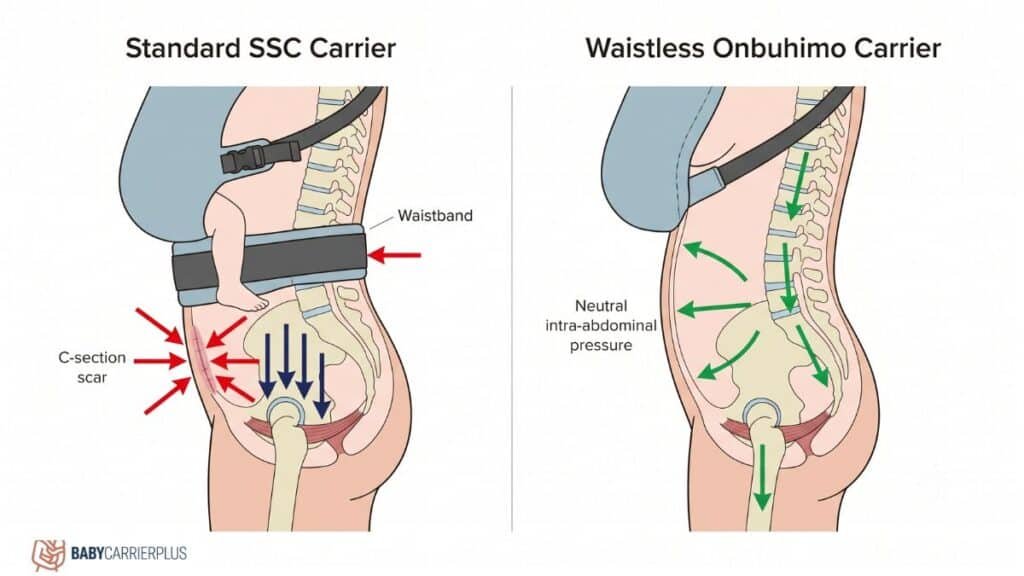
When you use a snug waist belt around a damaged post-surgery abdomen, you exert the same amount of pressure as when you pinch the center of an inflated water balloon. Your weakened abdominal muscles cannot resist. So, all the pressure goes down to crush your pelvic floor.
Think about it. Your pelvic floor had to carry a heavy baby for 40 weeks. It is stressed out and vulnerable to any dysfunction. Applying a conventional baby carrier belt on this weak structure will result in:
According to data on core loading patterns from the American Physical Therapy Association, dynamic abdominal stability requires complete elimination of tight external constriction.
- Pelvic Organ Prolapse (POP): The physical dropping or descent of your bladder, uterus, or rectum because the supporting muscles fail.
- Stress Urinary Incontinence (SUI): Accidental, embarrassing urine leakage whenever you laugh, cough, or walk.
- Pelvic Heavy Dragging: A constant, exhausting sensation of deep pulling and pressure inside your pelvis.
With a waistless baby carrier, you can eliminate the risk of this harmful external compression. The internal pressure that is exerted always remains neutral. Thus, it is one of the safest baby carriers to use after a C-section.
The Physics of Load Distribution: Killing Rotational Torque
What is the secret behind carrying an increasingly heavy child without using a hip belt? The answer lies in basic physics principles, leverages, and torque. For ultimate upper body comfort, you can also explore ergonomic baby carriers for plus-sized parents In babywearing, your spine forms the balance fulcrum. In case your baby hangs too low and away from your body, then the center of mass of the baby moves farther away from your spine axis. This causes the formation of a long lever arm (d), which results in the creation of forward torque (τ=F⋅d).
To avoid falling over, you must constantly contract your upper back, neck, and damaged core muscles to pull yourself backward. This awkward compensation causes severe muscle fatigue and places massive shear stress on your lower back and healing lower abdomen.
Why the “High and Tight” Carry Works:
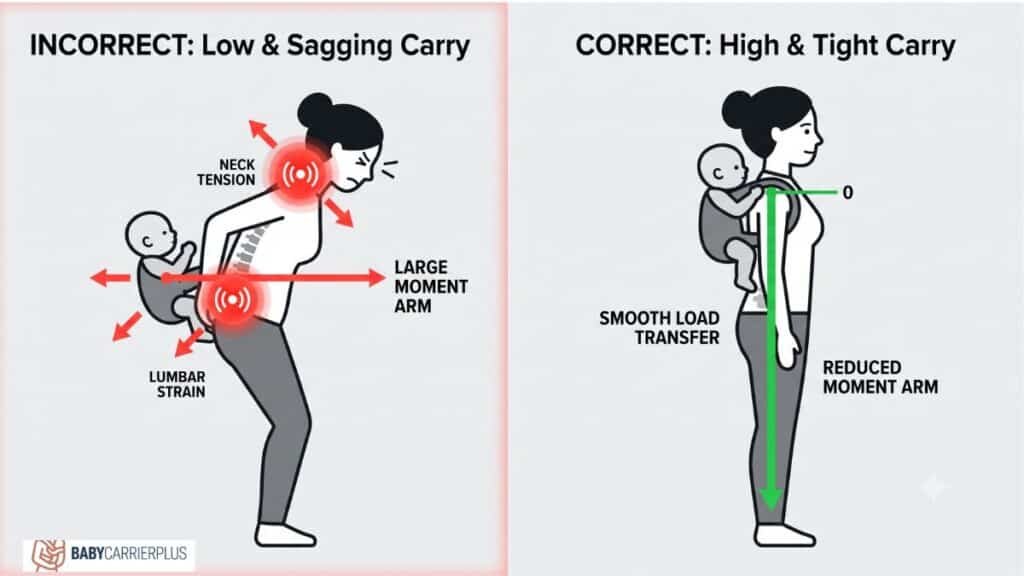
- Zero Moment Arm: The Onbuhimo places your child incredibly high on your upper back, lining their shoulders up with your shoulders.
- No Rotational Torque: This position brings the baby’s weight right over your natural base of support, cutting the horizontal distance (d) down to practically zero.
- Skeletal Weight Transfer: Because the forward pull disappears, the baby’s weight transforms into a direct vertical force traveling straight down your bones.
The job is entirely done by your spine, pelvis, and strong legs. Your soft abdomen that is healing is doing no work at all. Wearing an excellent waistless baby carrier means letting physics do the heavy lifting for you.
Specification Analysis of Major Waistless Carriers
The following comprehensive blueprint compares leading waistless gear alongside highly adaptive options engineered specifically for safe, post-surgical core management.
Promote true waistless options like the LennyLamb Onbuhimo, Sakura Bloom Onbuhimo, or soft, unpadded apron-style carriers like the Ergobaby Embrace.
The Researcher’s Structural Takeaway
However, all recommended carriers are designed to keep the lower transverse incision line free from external pressure. Stress transmission through the human musculoskeletal system bypasses the healing lower abdomen entirely, allowing safe weight distribution across the upper back and shoulders. Choosing a high-quality waistless baby carrier creates a perfect balance between supporting your infant’s natural postural development and protecting your post-surgical recovery.
- LennyLamb Onbuhimo PRO: The wrap woven construction is with heavily padded shoulder straps and Perfect Fit Adjusters (PFAs). The wrap woven construction serves as a substantial cushioning structure and effectively distributes the toddler’s weight from healing tissues.
- Happy Baby Onbuhimo: Designed for optimum breathability and packability due to light linen material. As there is no padding, the weight will rest on your skeletal system and muscles in your back.
- Sakura Bloom Onbuhimo: Excellent design that makes use of high-quality materials. Nevertheless, it requires more effort to adjust the double brass ring than to fasten a buckle.
Timeline Blueprint for Core Recovery
For you to have a highly effective baby carrier that ensures maximum safety for your body, especially after C-section delivery, you should carefully match your hardware to your body tissue recovery time frame:
- The 0-to-3 Month Newborn Window: Firstly, carrying back at this stage poses certain danger to your baby since babies do not have control over their bodies yet. In this case, think about the gentlest equipment that is completely adjustable according to the size of your baby.
- The Mid-Postpartum Phase: Move to more adaptable styles like the apron style Sprout or traditional Meh Dai carriers. Both styles could be snugly adjusted below the bust, which means you will have the entire lower abdomen cylinder free of any pulling action.
- The Late Postpartum Phase (6+ Months): Once your baby becomes capable of sitting on his/her own, and your upper back becomes strong enough, there is a particular waistless baby carrier that is the best thing that can protect your core for years to come.
Digital Evidence Brief: Manual Discrepancies vs. Consumer Realities
Manuals always lie. From the post-partum support community, we learn about a huge difference between fancy branding and reality.
Regulatory Standards and Structural Integrity
In the United States, federal safety mandates are strict. The Consumer Product Safety Commission (CPSC) and ASTM oversee everything:
- ASTM F2236-24: Regulates soft-structured infant gear, locking down buckle strength and preventing fabric slippage.
- ASTM F2907 / Federal Sling Standard: Mandates that fabric slings must physically hold three times their stated weight limit without structural failure.
Mechanical safety is verified. But what about human physics? The actual application of these rules presents massive physical challenges for a healing torso.
The Newborn Carry Controversy
The claims they make are audacious. The manuals that have been produced declare that the Onbuhimo provided by them has been made in such a way that it can carry babies weighing up to seven pounds owing to its built-in cinch snaps. Beware! Certified babywearing instructors and physical therapists advise against back-carrying at an early age.
Newborn babies do not have enough muscular strength to safeguard their airway passages. In a waistless baby carrier, there is no bottom support structure for holding the spine of the baby straight.
- Slump: A tiny baby slumps fast.
- The Danger: Their chin drops hard onto their chest wall.
- Reality: This dangerous positioning physically compresses trachea, causing fatal positional asphyxiation.
In addition, it is not possible to monitor the baby’s breath if the baby is lying completely behind the head. The truth of science is obvious; one needs to wait for six months when the baby would have complete control of his/her head and neck movements. In the initial months, the best carrier you can use for the baby is a soft ring sling or a stretchy wrap.
The Chest Strap Dilemma: Mastitis Warnings
Pain in the chest, heat, and fever constitute a hidden threat to nursing mothers. With respect to the backpack method, the chest strap is very essential. It helps to bring all the shoulder straps together to ensure that they do not fall off. However, positioning the chest strap at a lower level makes it cross over the very vascular breast tissue. This results in blocking all blood flow to the ducts.
This localized blockage triggers a rapid down-spiral:
- Clogged Ducts: Hard, extremely tender lumps of trapped milk.
- Mammary Dysbiosis: Severe, burning inflammation inside the tissue paths.
- Full Mastitis: A brutal, systemic infection bringing high fever and flu-like body aches.
Want to avoid this nightmare? Position the chest strap high up on the hard bone of your sternum, well clear of glandular tissue. Keep it snug but never crushing.
Integrating Modern Technology for Safety Guidance
The paper manuals are prone to misplacement. The ambiguous prints on safety measures are difficult to understand for someone who is sleep deprived. Premium brands have adopted intelligent digital technology within their product fabric to address this issue.
Let us consider LennyLamb as an ideal case. They include an NFC chip known as Circoola within the panel fabric. How does it work?
- Tap Your Phone: Simply bump your smartphone against the woven label.
- Instant Access: Boom. Digital safety manuals load instantly.
- Video Help: You get clear, step-by-step video tutorials on your screen.
- Gear Specs: View unique fabric parameters and your exact serial registration number right away.
This instant mobile access is a massive lifesaver for exhausted parents. When you are managing post-surgical pain, you cannot waste time wrestling with paper guides. You need to verify safe baby positioning quickly. Using this built-in tech ensures your waistless baby carrier stays perfectly adjusted. It gives you absolute confidence that you are using a genuinely safe baby carrier for C-section recovery without risking your healing belly wall.
High-Intent Educational FAQs
Q Can a C-section mother use an Onbuhimo in the front-carry position?
Q How should the chest strap be adjusted to prevent breast pain and clogged milk ducts?
Q What is the difference between a standard soft-structured carrier (SSC) and an apron-style carrier for C-section recovery?
Standard SSC: Features a thick hip belt that crushes your wound.
Apron Carrier: Fastens high under the bust, leaving your belly open.
The apron design is a highly effective, safe baby carrier for C-section recovery during early months.
Q What specific exercises can help build the muscle strength required for an Onbuhimo?
To prepare postpartum parents for this load, the following clinical physical therapy protocol must be integrated:
- Scapular Retractor Strengthening (Wall Angels): To build endurance in the middle trapezius and rhomboids. Stand with your head, upper back, and gluteal muscles flat against a wall. Place elbows and backs of hands against the wall at 90 degrees. Slowly slide arms upward into a “V” position, then pull elbows back down. Perform 3 sets of 10 repetitions daily.
- Posterior Shoulder Stabilization (Banded External Rotation): To strengthen the infraspinatus and teres minor muscles. Hold a light resistance band with palms up, elbows bent to 90 degrees. Slowly rotate hands outward, pulling the band apart while squeezing shoulder blades together. Hold for 5 seconds. Perform 2 sets of 15 repetitions.
- Thoracic Spinal Mobilization (Tabletop Thread-the-Needle): To restore thoracic rotation. Begin on hands and knees. Reach one hand underneath the chest and across the body, resting the shoulder on the floor. Sweep the same arm upward toward the ceiling, rotating the chest open. Repeat 10 times on each side.
Researcher’s Verdict: Synthesis and Postpartum Recommendations
Balancing newborn bonding with major abdominal surgery recovery is a massive physical challenge. Traditional baby carriers will not help heal your body at all because their waistbands are too low and restrictive and put additional pressure on your delicate Pfannenstiel scar. You can easily add these safe post-surgical gear options directly to your Amazon baby registry.
The point is that you must take care of your core muscle layers and consider using a high-quality waistless baby carrier that provides a perfect way to distribute pressure on the lower part of your abdomen evenly. It will move the entire weight of your baby onto your shoulder and spine.
For safety purposes, wait until your baby can sit without assistance for around six months, position the baby high and tight on your upper back, and fit the chest strap high on the sternum bone far away from delicate breast tissue. The Onbuhimo is unique due to its safety when it comes to using it after C-section, as it allows comfortable carrying of your baby, meets evolutionary expectations, and speeds up the process of healing.
About the Author: Hafiz Nauman Baig is a PhD Scholar in Zoology specializing in Fisheries at Quaid-i-Azam University. Leveraging advanced statistical data analysis in R Studio and research expertise in aquatic adaptation and oxidative stress, he provides rigorous, evidence-based safety and ergonomic evaluations for baby gear.