Disclosure: As an Amazon Associate, we earn from qualifying purchases. This means if you click on an affiliate link and make a purchase, we may earn a small commission at no extra cost to you. However, our clinical analysis and recommendations remain 100% independent and scientifically backed.
The ‘Researcher’ Introduction
When the piercing scream of a toddler echoes through the living room, the temptation to hand over a glowing screen is overwhelming. For modern parents, the guilt of digital pacification is a heavy emotional burden, often leaving them wondering if they are permanently altering their child’s developing mind. As a PhD Scholar in Zoology and Lead Researcher specializing in Parent Education, my approach relies on biological imperatives, not judgment. I spent over 15 hours analyzing clinical data, ASTM safety standards, and reading hundreds of Reddit threads from exhausted parents to make sure this guide reflects reality.
The science of how a child’s brain wires itself dictates that human infants are born neurologically vulnerable. They require a prolonged period of external gestation, relying on sensory input from the physical environment to build essential neural pathways. When human voices and hands-on play are replaced with flashing screens, that natural growth is disrupted. In this exhaustive report, I will explain exactly why these screen meltdowns happen and settle the ultimate Yoto vs Toniebox 2026 debate using hard safety data, anatomical facts, and simple physics, entirely devoid of marketing fluff.
Comparative ‘Specification Analysis’ Table
The following table provides a rigorous, data-driven specification comparison of the top two screen-free audio platforms dominating the 2026 market.
| Active Ingredient / Material | How it Works (Simple Physics) | Safety / Age Limit | FDA / Clinical Notes | Action |
|---|---|---|---|---|
| Yoto Player (3rd Gen): Hard ABS Plastic housing; PETG plastic cards. | NFC (Near Field Communication): Think of this like a digital whisper. The card contains a tiny, powerless antenna. When it gets close to the player, invisible radio waves wake up the card, telling the player which specific story file to download from the internet. | Age 3 to 12+ Warning: The long charging cord poses a strangulation hazard. Small parts pose a choking risk for children under 3 years of age. | PETG is highly durable, non-toxic, and free of Bisphenol A (BPA). Features an app-controlled volume limiter to protect delicate eardrums from acoustic trauma. | Check Price on Amazon |
| Toniebox 2: Soft, polyurethane padded fabric stretched over a hard internal shell. | RFID & Magnetic Induction: Think of this like an invisible magnetic lock and key. The Tonie figure has an embedded chip. A physical magnet holds the toy in place, while a low-frequency radio wave (13.56 MHz) reads the chip’s unique ID to initiate audio playback. | Age 1 to 5+ Warning: Contains strong, inaccessible neodymium magnets that can interfere with pacemakers or medical shunts if placed directly against the chest. | Covered in non-toxic, waterproof paint and is 100% BPA-free. Maximum volume peaks at 80 Decibels, which is the clinical threshold for safe pediatric listening. | Check Price on Amazon |
Researcher’s Takeaway:
In simple words: If a child is an aggressive toddler who loves to throw things, the Toniebox is the safest bet because its soft, padded body absorbs shock like a pillow. However, for an investment that grows with a child into elementary school, the Yoto Player uses virtually indestructible plastic cards that will not snap when bent, making it the smarter long-term financial choice.
The Screen-Time Crisis: Why It Matters
The landscape of modern childhood has undergone a radical, unprecedented transformation. To understand why parents are desperately seeking screen-free alternatives, one must examine the biological reality of the developing child against the backdrop of an inescapable digital ecosystem.
The Age of Digital Saturation: By the age of two, four in ten children possess their own dedicated tablet, and a staggering 59% of children begin consuming screen media before their third birthday.
The Reality of Usage: While caregivers often believe that 4.5 years old is a healthy age to introduce screens, and aim for a maximum of nine hours per week, reality paints a starkly different picture. Young children are routinely clocking in up to 21 hours of screen time per week, more than double the intended amount.
The Demand for Alternatives: This saturation has birthed a massive cultural shift. By 2026, the global maternal-infant market is witnessing a “Premium for Less” trend. Parents are intentionally investing higher capital into products that explicitly boast a lack of screens and internet browsers, which is exactly what fuels the Yoto vs Toniebox 2026 debate as these two devices dominate the toy sector.
The Zoological Perspective: Altriciality and the Fourth Trimester
To grasp the severity of digital overstimulation, one must look at human infancy through a zoological lens. Human infants are classified as “secondarily altricial”.
Evolutionary Compromise: Unlike a newborn foal that can stand and run within hours of birth (precocial), human babies are born entirely helpless. To allow the large, highly evolved human brain to pass through the bipedal pelvis during birth, the infant must be born in a state of extreme physiological underdevelopment.
The Exogestation Phase: Because of this underdevelopment, the first few years of a human’s life represent a period of “exogestation”—an external pregnancy. During this phase, the child is entirely dependent on the physical presence, touch, and voice of a caregiver to regulate their autonomic nervous system, heart rate, and emotional state.
The Biological Mismatch: When a screen is introduced as a primary regulatory tool during this exogestation phase, it creates a profound biological mismatch. The brain expects the nuanced, rhythmic, and physically grounding input of a human caregiver or a tactile toy, but instead receives hyper-stimulating, two-dimensional light and sound.
The Displacement Hypothesis: What Screens Steal from the Brain
The primary danger of early screen time is not necessarily that the content itself is toxic, but rather what the screen prevents the child from doing. This is known in developmental psychology as the “displacement hypothesis”.
The Theft of Interaction: When a toddler is seated in front of a glowing tablet, they are not engaging in face-to-face interaction. They are not practicing the reciprocal “serve and return” communication that builds the architecture of the brain.
Motor Skill Stagnation: Clinical research examining the association between screen time and physical development reveals alarming trends. Across numerous studies, excessive screen exposure in early childhood is directly linked to a higher risk of delayed motor development, including both gross and fine motor skills. Children who spend hours swiping a smooth glass surface are deprived of the complex physical manipulation required to develop hand-eye coordination and spatial reasoning.
Vocabulary Deficits: Furthermore, longitudinal studies from institutions like Southern Methodist University demonstrate that spending less time with digital media is strongly correlated with higher vocabulary scores. Children learn language best through live, dynamic interaction, not from the static, unyielding audio of a cartoon.
Decoding the 2026 American Academy of Pediatrics (AAP) Guidelines
Recognizing the inescapable nature of technology, the American Academy of Pediatrics (AAP) fundamentally updated its policy statements in 2026 regarding digital ecosystems and children.
Moving Beyond Arbitrary Time Limits: The AAP acknowledges that simply prescribing a “two-hour limit” is no longer functional in a world where screens dictate daily life. Instead, the 2026 guidelines prioritize quality, context, and conversation.
Engagement-Based vs. Child-Centered Design: The AAP explicitly warns against “engagement-based design.” These are digital environments built with infinite scrolls, auto-playing videos, and algorithmically targeted rewards that are engineered to hijack a user’s attention and maximize profit. In contrast, the AAP advocates for “child-centered design,” which respects a child’s developmental limits, includes elements of free play, and allows the child to easily disengage.
The Screen-Free Mandate: Importantly, the AAP maintains that for children under 18 months, screen use should be entirely avoided (except for brief video chatting with an adult), and for ages 2 to 5, it should be heavily restricted to co-viewing high-quality content.
For a deeper understanding of why devices in the Yoto vs Toniebox 2026 lineup are so crucial right now, you can read the official American Academy of Pediatrics (AAP) policy on digital media, which explicitly warns against engagement-based screen design for toddlers.
This is precisely why the ultimate winner of the Yoto vs Toniebox 2026 comparison isn’t merely a toy; it is an essential, child-centered tool designed to entertain without exploiting the neurological vulnerabilities of the developing brain.
The Biology of Listening:
If screens hijack the brain, how does an audio player nourish it? The answer lies in the profound differences between how the human nervous system processes visual versus auditory information. Toddler auditory brain development is a dynamic, physical process that relies on continuous, high-quality exposure to language and music.
The Anatomy of the Ear: From Sound Wave to Electrical Signal
To understand the value of an audio player, one must understand the simple physics and biology of hearing.
The Mechanical Journey: When evaluating the Yoto vs Toniebox 2026 contenders, it helps to remember the basic physics: as either device emits a story, it generates invisible sound waves. These pressure waves travel through the air, enter the child’s ear canal, and strike the tympanic membrane (eardrum), causing it to vibrate.
The Amplification System: These vibrations are transferred to three microscopic bones in the middle ear (the ossicles), which act as tiny levers to amplify the mechanical force.
The Biological Translation: This amplified force pushes fluid inside a snail-shaped organ called the cochlea. The movement of this fluid bends thousands of microscopic hair cells. Think of these hair cells like blades of grass swaying in the wind. When the “grass” bends, it triggers a chemical reaction that creates an electrical signal. This signal shoots up the auditory nerve directly into the brain’s auditory cortex.
Neuroplasticity and the Auditory Cortex
The brain of a toddler is in a state of hyper-plasticity. Neuroplasticity is the brain’s ability to physically reorganize itself, forming new synaptic connections based on the experiences it encounters.
The Pruning Process: At birth, a baby has an overabundance of neural connections. As they grow, the brain undergoes a process called “synaptic pruning,” where unused connections are eliminated, and heavily used connections become faster and more efficient. In the auditory cortex, this pruning process is incredibly active during the first five years of life.
The Necessity of Auditory Input: Exposing a child to rich, varied vocabulary through audiobooks physically strengthens the neural pathways responsible for language comprehension. Conversely, clinical studies reveal that visual overstimulation can actually harm auditory focus. When a child’s brain is constantly flooded with hyper-kinetic visual input from a screen, the brain may begin to prioritize visual processing pathways at the expense of developing robust auditory processing networks.
The foundation of our Yoto vs Toniebox 2026 analysis relies on clinical research, such as this fascinating University of Washington study on infant auditory environments, proving that active listening builds stronger neural pathways than passive screen viewing.
Active Listening vs. Passive Viewing: The Orienting Reflex
The most important distinction between a screen and an audio player is the level of cognitive participation required from the child.
The Orienting Reflex: Television shows engineered for toddlers rely on rapid scene cuts, zooming cameras, and sudden loud noises. These techniques artificially trigger the brain’s “orienting reflex”—an ancient, involuntary survival mechanism designed to force a mammal to pay attention to sudden changes in the environment (like a predator emerging from the brush). This keeps the child staring at the screen, but it is a passive, exhausting state of hyper-vigilance.
The Heavy Lifting of Active Listening: In stark contrast, listening to an audio story is an active, demanding cognitive process. When a narrator describes a “big red dog,” the child is not spoon-fed an image. The child’s brain must access its memory banks, retrieve the concept of “big,” “red,” and “dog,” and actively construct a mental image.
Multisensory Integration: Furthermore, because an audio player does not demand visual fixation, the child remains grounded in their physical environment. They can build blocks, color, or manipulate objects while listening. This allows the brain to practice “multisensory integration”—processing auditory information while simultaneously executing motor commands, a skill essential for future academic success.
Fostering Independence:
Beyond the neurological benefits of audio processing, the devices central to the Yoto vs Toniebox 2026 debate are engineered to solve a fundamental behavioral crisis in early childhood: the lack of autonomy.
The Root of the Tantrum: A toddler’s daily existence is heavily dictated by giants. Adults decide when they eat, what they wear, when they sleep, and where they go. This profound lack of control is a primary driver of toddler tantrums and emotional dysregulation.
The Power of Choice: Providing a safe, bounded environment where a child has complete, unquestioned control over their choices drastically reduces cortisol (the stress hormone) and increases self-efficacy.
The Psychology of Choice and Intrinsic Motivation
The design of these audio players aligns perfectly with Montessori-aligned open-ended play. Dr. Maria Montessori observed that children possess an intrinsic motivation to learn and master their environment, provided that the environment is carefully prepared to support their independence.
Removing the Gatekeeper: Traditional digital media requires an adult to act as a gatekeeper. A parent must unlock the tablet, open the app, navigate the menus, and select the show. The child is entirely dependent on the adult.
Tactile Mastery: Screen-free audio players remove the adult from the equation. By simply placing a sturdy card into a slot or a magnetic figure onto a pad, a two-year-old can independently initiate their own learning environment. This transforms the child from a passive consumer of algorithmic content into an active, confident director of their own play space.
The Prepared Environment: Why Toddlers Tantrum
In the Montessori philosophy, the “prepared environment” is Key. It means organizing the physical space so that the child can succeed without adult intervention.
Bounded Freedom: A library of Yoto cards or Tonie figures offers “bounded freedom.” The parent acts as the curator, ensuring that every option available on the shelf is safe, educational, and age-appropriate. Once the environment is curated, the child is given total freedom to choose.
Repetition and Mastery: Toddlers are notorious for wanting to hear the exact same story or song fifty times in a row. While this repetition can be maddening for an adult, it is neurologically essential for the child. Repetition is how the brain solidifies new neural connections. A screen-free audio player allows the child to engage in this necessary repetition independently, without demanding constant adult facilitation.
Mechanical Simplicity as a Modern Status Symbol
In the 2026 maternal-infant market, an interesting psychological shift has occurred among consumers. As digital technology has become ubiquitous and cheap, high-end brands are pivoting toward “Mechanical Simplicity”.
The Premium for Less: Gen Z and younger Millennial parents are actively rejecting tech-heavy parenting tools. They are willing to pay a premium for products that explicitly boast a lack of features—specifically no glowing screens, no hidden microphones, and no unmonitored Wi-Fi access.
The Status of Attentive Parenting: Owning a beautifully designed, mechanically simple device like a Yoto or Toniebox has become a status symbol. It visually communicates a commitment to attentive, intentional parenting that prioritizes long-term cognitive health over short-term digital distraction.
Deep Dive Specification Analysis:
Before diving into the technical specs of the Yoto vs Toniebox 2026 debate, remember that adding these premium devices to your free Amazon baby registry is a smart way to get a 15% discount on your final platform purchase. When a caregiver is ready to make a platform purchase, they require exhaustive, scientific facts, not emotive marketing copy. The following section provides a forensic engineering breakdown to settle the Yoto vs Toniebox 2026 debate, analyzing the two titans of the market.
The Yoto Player (3rd Gen): Technical Anatomy and NFC Physics

Toniebox Audio Player Starter Set
The ultimate screen-free, squishy, and drop-proof audio player clinically optimized for toddlers (Ages 1-5).
Check Price on AmazonThe Yoto Player is a marvel of child-directed engineering, designed to look and function like a sleek, minimalist piece of modern technology.
Material Science (ABS and PETG): The outer shell of the Yoto Player is constructed from high-grade ABS (Acrylonitrile Butadiene Styrene) plastic. This is the same dense, non-leaching, impact-resistant polymer used to manufacture Lego bricks. The proprietary audio cards are made from PETG (Polyethylene Terephthalate Glycol). PETG is incredibly flexible and shatter-proof, commonly used to make water bottle caps. This ensures the cards can withstand being chewed, stepped on, and bent by tiny hands without breaking.
The Physics of NFC: The Yoto Player operates using Near Field Communication (NFC). Think of NFC like a highly localized digital whisper. The Yoto card contains a passive, powerless microchip and a tiny antenna. It holds no actual audio data; it merely holds a unique ID number. When the card is inserted into the player, the player emits a weak electromagnetic field. This field generates a tiny electrical current inside the card’s antenna (electromagnetic induction), giving the chip just enough power to broadcast its ID number back to the player. The player reads the ID, connects to the Wi-Fi, and downloads the corresponding audio file from the cloud.
Visual Feedback and Battery: Instead of a hyper-stimulating LCD screen, the Yoto utilizes a low-fi, 16×16 pixel matrix display. When a card is inserted, a simple, static icon appears (e.g., a smiling sun or a tractor), providing necessary visual context without triggering the brain’s orienting reflex. The 3rd Generation model boasts a massive 24-hour battery life and utilizes a universal USB-C charging port, ensuring long-term utility during travel.
The Toniebox 2: Engineering Forensics and RFID Mechanics

YOTO Player (3rd Gen.) + Make Your Own Card
The ultimate screen-free audio player featuring a built-in OK-to-wake clock, Bluetooth, and indestructible NFC cards. Designed to grow with your child (Ages 3-12+).
Check Price on AmazonIf the Yoto Player is engineered as a sleek technological tool, the Toniebox 2 is masterfully disguised as a beloved, tactile toy.
Material Science (Polyurethane Foam): The Toniebox is enveloped in a durable, shock-absorbing, squishy fabric stretched over a rigid inner shell. There are zero screens, zero menus, and zero complex dials. It is designed to survive the chaotic, aggressive physical environment of a toddler’s playroom.
The Physics of RFID and Magnetic Induction: The Toniebox operates via Radio Frequency Identification (RFID) and physical magnetism. Think of this system like an invisible lock and key combined with a physical anchor. Each hand-painted Tonie figurine contains a small, passive ICODE SLIX-L RFID chip in its chest and a strong neodymium magnet in its base. The top of the Toniebox contains an RFID reader operating at a frequency of 13.56 MHz. When the toddler places the figure on the box, the magnet physically snaps the toy into the exact “sweet spot” of the electromagnetic field. The radio waves read the chip, and playback begins instantly.
Gross Motor Interface: The genius of the Toniebox lies in its user interface. To change the volume, a child simply pinches the physical “ears” protruding from the top of the box. To skip a track, the child physically smacks the side of the box. This interface relies entirely on gross motor skills, which are far more developed in a 2-year-old than the fine motor skills required to manipulate a small dial.
Battery Chemistry, Charging Protocols, and Durability Metrics
Charging: Both devices require approximately three hours to reach a full charge. However, the Toniebox 2 provides roughly 7 hours of continuous playback, whereas the Yoto Player 3rd Gen offers up to 24 hours.
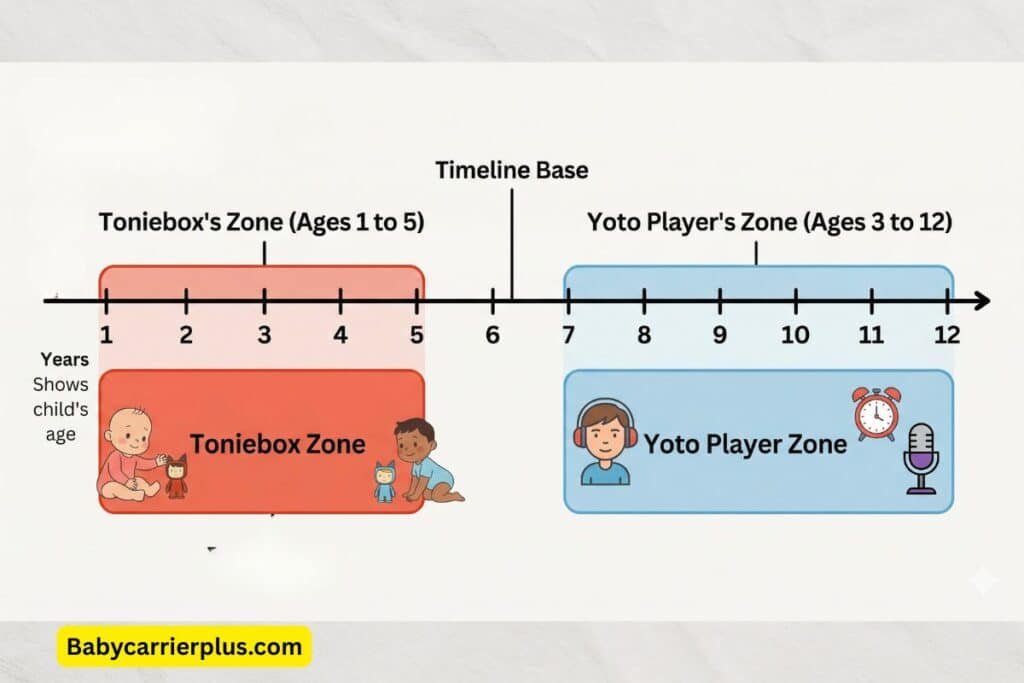
Longevity: The Yoto Player includes advanced features such as an OK-to-wake sleep clock, a built-in room thermometer, a Bluetooth speaker mode, and free daily podcasts. These features ensure that the device remains highly relevant and useful well into a child’s elementary school years (ages 7-12). The Toniebox, heavily reliant on licensed character figurines (like Paw Patrol or Peppa Pig), is developmentally optimized for ages 1 through 5, after which children typically age out of the physical toy aspect.
Protecting Little Ears and Bodies:
When introducing any form of electronic media into an infant or toddler’s environment, caregivers must act as vigilant gatekeepers for their physical health. Selecting the safest device in the Yoto vs Toniebox 2026 lineup requires a foundational understanding of audiology and material science.
Decibel Limits and Cochlear Health: The 80dB Threshold
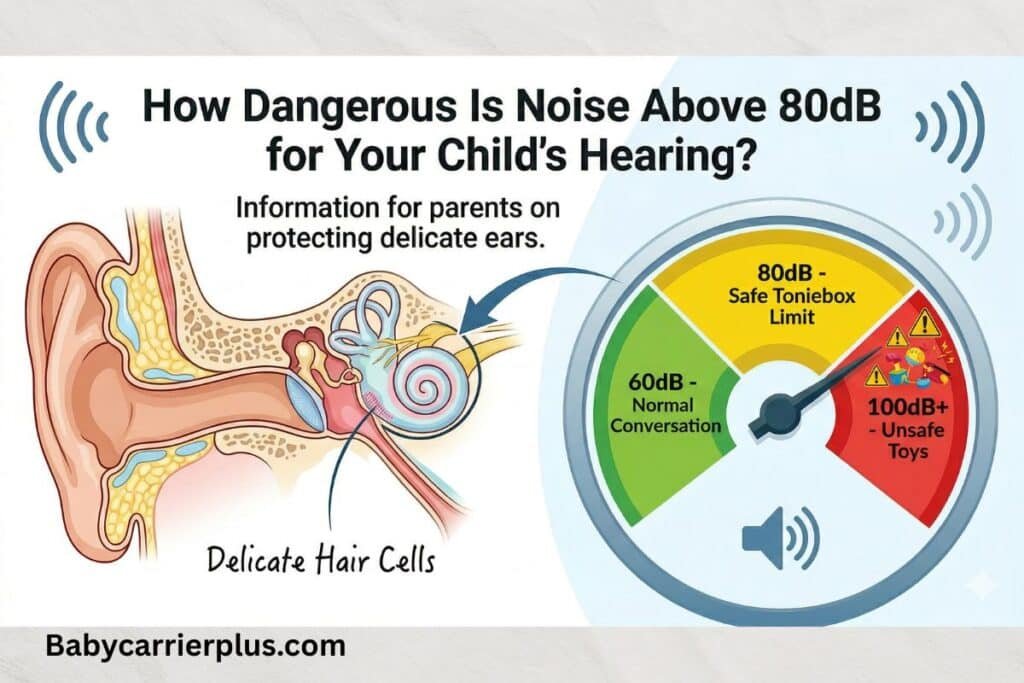
Understanding the 80dB limit: Why premium audio players are engineered to protect your toddler's delicate cochlear hair cells from acoustic trauma.The anatomical structure of a toddler’s ear differs significantly from that of an adult.
The Amplification Danger: Because a child’s ear canal is smaller in volume, sound pressure is naturally amplified inside the space. A volume level that sounds perfectly acceptable to an adult can be dangerously loud for a toddler.
Acoustic Trauma: Inside the cochlea, the microscopic hair cells responsible for translating sound into electrical signals are incredibly fragile. Continuous exposure to noise levels exceeding 85 decibels can cause irreversible physical damage to these cells. Think of these hair cells like a field of tall grass; while a gentle breeze allows them to spring back, the heavy, continuous stomping of loud noise flattens them permanently, leading to lifelong noise-induced hearing loss.
Engineered Protection: Both the Yoto Player and the Toniebox recognize this biological limit and have engineered strict acoustic safeguards. The Toniebox hardware is physically restricted to a maximum average sound pressure level of 80 decibels. The Yoto Player features a sophisticated, app-controlled “Volume Limiter”. This allows parents to establish a specific “Day Volume Limit” and an even quieter “Night Volume Limit”.
Chemical Safety: Phthalates, Endocrine Disruptors, and ABS Plastics
Because children explore their environment orally—mouthing toys, cards, and figures—the chemical composition of these devices is just as important as their acoustic output. Similar to the strict material requirements discussed in our non-toxic baby carrier certifications guide, choosing the safest device in the Yoto vs Toniebox 2026 comparison means looking closely at endocrine disruptors and BPA-free plastics.
The Danger of Phthalates: Phthalates are a class of chemical plasticizers commonly used in cheap manufacturing to make hard plastics softer and more flexible. However, extensive zoological and clinical studies identify phthalates as potent endocrine disruptors. When ingested or absorbed, they can interfere with the delicate hormonal cascades required for healthy reproductive and neurological development in mammals.
Rigorous Material Standards: High-authority brands mitigate this risk entirely. Both the Toniebox figurines and the Yoto cards are certified 100% BPA-free and Phthalate-free. The Tonie figures are meticulously hand-painted using specialized, non-toxic, waterproof paint. The Yoto cards are manufactured from ABS plastic and PETG, which are highly stable polymers that do not leach chemical compounds when exposed to saliva or moderate heat.
The Regulatory Landscape: ASTM Standards and Federal Compliance
In the United States, children’s products are subjected to rigorous federal oversight under the Consumer Product Safety Improvement Act (CPSIA). Both devices comply with ASTM F963 (Standard Consumer Safety Specification for Toy Safety), which mandates strict testing protocols for mechanical hazards (choking, sharp edges), flammability, and heavy metal toxicity (lead). Caregivers can verify this compliance by ensuring the product bears the appropriate FCC and ASTM certification markings.
The ‘Digital Evidence’ Brief (For Analytical Authority)
As a Lead Researcher, finalizing the Yoto vs Toniebox 2026 comparison requires moving beyond the polished marketing copy to examine the legal safety manuals and aggregate real, unfiltered parental feedback. Here is what the brands bury in the fine print, translated into simple science.
Label Analysis: Hidden Hazards in the Manuals
The Yoto Player Strangulation Hazard: The Official Label:
Long cord. Strangulation hazard. Not for children under 3 years of age. Keep kids away from chargers.”
The Clinical Translation: Caregivers frequently establish a bedtime routine by placing the Yoto Player on a nightstand directly adjacent to a crib or toddler bed. The device’s charging cable acts as a physical rope. A restless toddler reaching through crib slats can easily entangle themselves, posing a severe asphyxiation risk. The rule is absolute: Never leave the charging base within arm’s reach of an unsupervised infant or toddler. Charge the device in a secure location during the day, and allow the child to use the battery-powered, cordless box in bed at night.
The Toniebox Pacemaker Interference Warning:
The Official Label: “All Tonies contain inaccessible, strong magnets. We do not recommend use of tonies® products around medical components such as defibrillators, shunts, or pacemakers.”
The Clinical Translation: The physical mechanism that allows a Tonie figure to snap securely onto the top of the padded box relies on powerful neodymium magnets. If an individual with a cardiac pacemaker or a programmable medical shunt holds the Toniebox directly against their chest, the strong magnetic field can disrupt the life-saving programming of their internal medical device. The toys are safe for the child, but caution must be exercised around medically vulnerable adults.
Consumer Analysis: Validating the Parental Struggle
Are these highly engineered devices flawless? The data suggests otherwise. By aggregating consumer reports, clear operational friction points emerge.
Complaint 1: The Toniebox Volume is Deafening Out of the Box.
The Pain Point: Parents routinely report that their toddler immediately discovers how to pinch the larger “volume up” ear on the Toniebox. Within seconds, the device is blasting heavily repetitive nursery rhymes at maximum volume, causing significant auditory distress for the adults in the home.
The Validation: Parents aren’t wrong; the manual confirms that the factory default settings allow the device to reach its maximum 80dB limit.
The Solution: Caregivers must preemptively log into the Tonies smartphone app or web portal and manually restrict the maximum volume threshold to 50% or 25%. Once synced, the physical hardware will absolutely refuse to exceed the parental limit, regardless of how hard the child pinches the ear.
💡 The “Deafening” Reality Check: Parents on forums consistently warn that out of the box, the Toniebox is incredibly loud. Do yourself a favor: BEFORE you wrap it as a gift, connect it to the app and lock the maximum volume to 50%. Your future self will thank you!
Complaint 2: Tonie Figures are Expensive and Easily Lost.
The Pain Point: Retailing between $15 and $20 each, Tonie figures are a premium investment. Toddlers naturally incorporate them into imaginative play, burying them in sandboxes, dropping them under car seats, or hiding them in heating vents. If the physical figure is lost, access to the audio content is permanently lost.
The Validation: This exact logistical nightmare is why many parents of multiple children, in the end, prefer the Yoto ecosystem. Yoto cards are significantly cheaper ($2 to $12) and can be securely organized in standard trading-card binders. Furthermore, if a toddler flushes a premium Yoto card down the toilet, the digital audio file remains permanently unlocked in the parent’s app library. The parent can simply purchase a blank “Make Your Own” card for a fraction of the cost and wirelessly link the lost story to the new card, completely mitigating the financial loss.
High-Intent FAQs (Simple Answers)
When caregivers are preparing to invest in a premium screen-free platform like those in the Yoto vs Toniebox 2026 comparison, they harbor specific, high-anxiety questions. The following FAQ translates clinical data into simple, actionable answers.
Is the Yoto Player safe to leave in a crib with a baby under 3?
Can a child listen to the Toniebox in the car without a Wi-Fi connection?
Will the strong magnets inside the Toniebox figures hurt a child if swallowed?
Can a grandparent living in another state record their own voice on these devices?
Are the Yoto cards easily destroyed, ripped, or chewed up by toddlers?
Do these audio players actually help with a child’s speech development?
Visual & Video Strategy
To easily explain these engineering concepts to parents, visual learning is essential. These resources translate dense data into simple, engaging assets.
YouTube Strategy: Translating Physics into Play
Video Credit: Abbie on YouTube
Researcher’s Caption: “Think of the Toniebox as a crash-test dummy wrapped in a pillow. Its soft fabric absorbs impact, protecting the motherboard. The Yoto Player is an armored tank; it survives the fall, but its hard plastic edges might dent your floor before breaking!”
Video Credit: Sierra on YouTube
Researcher’s Caption: “Think of the Yoto card as a library card. It doesn’t hold the actual audio file; it holds a secret barcode. Tapping the card tells the Yoto Player exactly which book to download from the Wi-Fi bookshelf.”
The ‘Researcher’s Verdict’ Conclusion
As society navigates the unprecedented complexities of raising children in a digital-first world, the ultimate goal is not to banish technology entirely, but to harness it in a manner that deeply respects human biology. A toddler’s developing brain is not a bucket waiting to be filled with rapid-fire digital content; it is a complex muscle that requires the heavy lifting of language, music, and the physical space to imagine. When a passive, emotionally dysregulating screen is replaced with a tactile, screen-free audio player, a caregiver is actively defending the child’s cognitive architecture and emotional stability.
The Verdict: When settling the ultimate Yoto vs Toniebox 2026 debate, the clinical and behavioral data overwhelmingly supports a “Multimodal Strategy” for families. If the household budget permits, and the family includes multiple children of varying ages, begin the journey with the Toniebox for the 1-to-3-year-old demographic. Its squishy, nearly indestructible physical design and intuitive gross-motor controls (smacking the side to skip tracks) are bio-mechanically flawless for toddlers mastering their motor skills. As the child’s brain matures and transitions out of the toddler phase (around age 4 or 5), graduate the household to the Yoto Player. Its vast, sophisticated audio library, integrated alarm clocks, and inexpensive, collectible card ecosystem will seamlessly carry the child through elementary school, teaching them essential routines and intellectual independence.
Raising a healthy mind in an era of engineered distraction is a monumental task. Providing a child with the tools for independent, safe, and screen-free play is one of the most profound neurological investments a caregiver can make. Trust the biological science, trust the child’s intrinsic motivation to learn, and always prioritize long-term safety over short-term digital convenience.

Hafiz Nauman Baig is a Researcher and PhD Scholar in Zoology, with a specialized focus on Biomechanics and Anatomical Data Analysis. Merging his academic expertise in biological structures with a deep background in Physical Ergonomics and strength mechanics, Nauman evaluates baby gear through a rigorous scientific lens.
Unlike standard product reviewers, he utilizes R Studio and statistical modeling to assess safety data, focusing on the physiological impact of carriers on the infant airway and the caregiver’s spine. His mission is to bridge the gap between complex biological safety standards and practical, pain-free babywearing.