The Researcher Introduction: The Biomechanics of Forgeries
When a caregiver’s back aches intensely after just ten minutes of carrying an infant, the issue is rarely a lack of physical strength; rather, it is a fundamental failure in the science of how the body moves. From the perspective of a PhD Scholar in Zoology and a Lead Researcher specializing in Parent Education, ensuring infant survival is a biological imperative. In the animal kingdom, distinct evolutionary mechanisms exist to transport vulnerable young, yet modern humans must rely on manufactured textiles and highly engineered plastics to recreate this essential, natural support.
When these manufactured devices are unregulated imitations, they fundamentally disrupt normal movement patterns and place delicate developing skeletons at extreme risk. The current digital marketplace is saturated with sophisticated knock-offs that appear visually identical to authentic safety gear but utilize brittle, untested plastics and highly toxic textile dyes. This comprehensive analysis promises to decode the realities of counterfeit baby carrier safety, explaining exactly why these cheap materials inevitably fail under physical stress. The goal here is not merely to review products, but to equip modern caregivers with verifiable, scientific safety data to identify e-commerce scams and protect their infants from structural and toxicological hazards.
Comparative Specification Analysis: Authentic vs. Counterfeit Materials
The following table provides a rigorous scientific comparison between the materials utilized in legally compliant infant carriers versus those found in unregulated, imitation alternatives. Understanding these physical differences is the cornerstone of counterfeit baby carrier safety.
| Active Component / Material | How it Works (Simple Physics) | Safety / Age Limit | Regulatory & Clinical Notes | Avg. Market Price |
|---|---|---|---|---|
| Acetal / Delrin (Authentic Buckles) | Functions as a high-strength interlocking mechanism. Possesses high “memory retention,” snapping back to its exact original shape after thousands of bends without stretching. | Safe from newborn weights (7 lbs) up to maximum toddler capacities (45 lbs). | Demonstrates high tensile strength (up to 22,000 psi). Resists temperature-induced brittleness, preventing accidental release under stress. | $130 – $200 (Total Carrier) |
| Polypropylene / Nylon (Counterfeit Buckles) | Soft, highly flexible polymers. Under the physics of heavy lifting or continuous tension, the plastic stretches and permanently deforms, losing friction. | High risk of structural failure for infants weighing over 15 lbs. | Not approved for dynamic, load-bearing infant gear. Known to unbuckle silently when a caregiver bends forward. | $30 – $70 (Total Carrier) |
| Organic Cotton / Linen (Authentic Fabric) | Breathable, porous natural fibers permit continuous airflow, pulling excess thermal heat away from the infant’s body to naturally regulate temperature. | Safe for all developmental stages, specifically newborns with highly permeable skin. | Meets stringent OEKO-TEX Standard 100 Class 1 requirements. Completely free of chemical flame retardants and heavy metals. | Premium cost factored into authentic gear |
| Untested Synthetics (Counterfeit Fabric) | Acts similarly to a plastic barrier, trapping body heat. Weakly woven synthetic threads experience rapid shear failure under the bouncing weight of a toddler. | Dangerous for newborns due to the high risk of overheating and severe dermal irritation. | Frequently treated with carcinogenic Azo dyes and chemical flame retardants linked to respiratory distress. | Cheaply sourced, artificially reducing retail price |
Researcher’s Takeaway: In simple words: Cheap plastic buckles break. Only purchase carriers utilizing buckles made of “Delrin” or “Acetal” because they will not snap when a caregiver bends over to pick up a dropped item. Counterfeit manufacturers rely on weak plastics that stretch out in the sun and toxic dyes that can poison sensitive skin. Prioritizing counterfeit baby carrier safety is not merely paying for a brand name; it is a critical investment in the physics that keeps an infant from falling.
Table of Contents
The 2026 Regulatory Landscape and Federal Law
In the United States, the science of infant safety is strictly enforced by federal legislation. The Consumer Product Safety Commission (CPSC) categorizes soft infant and toddler carriers not as mere articles of clothing, but as highly regulated durable medical and safety equipment.
While authentic products undergo brutal physical stress tests (read our complete guide on ASTM F2236-24 compliance here), the absolute easiest way to identify a fake product is through federal documentation.
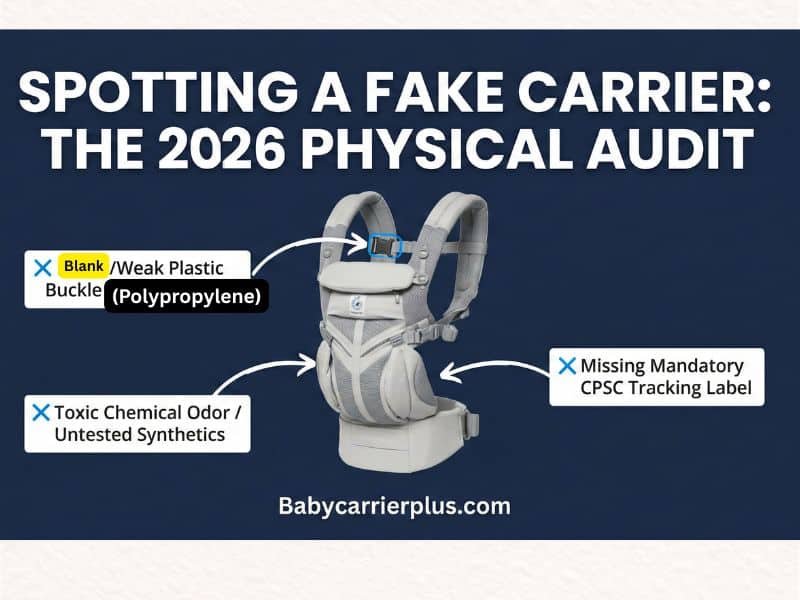
The Tracking Label Law (The Ultimate Fake Detector) To legally prove they have passed these exhaustive safety tests, authentic manufacturers must issue a Children’s Product Certificate (CPC). Furthermore, caregivers can physically verify compliance through the Tracking Label Law (16 CFR Part 1130). By federal law, every single durable infant product must feature a permanent, distinguishing tracking label.
If you want to guarantee counterfeit baby carrier safety, check your carrier for these legal requirements:
- The Stitched-In Tag: The warning label cannot be a simple removable sticker; it must be permanently sewn directly into the fabric of the carrier.
- Manufacturing Details: It must clearly state the manufacturer’s official name, the exact date of production, and the specific location of the factory.
- Batch/Lot Number: A specific batch or run number must be visibly printed on the tag for recall tracking.
- Registration Card: A postage-paid consumer registration card must be included in the original packaging.
Counterfeiters mass-produce illegal items in hidden factories to save money and virtually never include a valid, permanent tracking label. If your carrier is missing this stitched-in federal tag, it is almost certainly a dangerous fake. To fully grasp the strict legal standards surrounding counterfeit baby carrier safety, parents should review the official CPSC business guidance for soft infant carriers.
E-Commerce Scams: The 2026 Digital Safety Checklist
Counterfeit rings have evolved beyond selling obvious knock-offs at local flea markets. Today, they operate highly sophisticated digital scams, utilizing stolen photography from legitimate brands to create fake online storefronts that appear entirely credible at first glance. Ensuring counterfeit baby carrier safety begins before you even click the “Buy Now” button.
To protect your infant, caregivers must be hyper-vigilant for these specific digital red flags:
- The Impossible Price Discrepancy: Authentic carriers require expensive raw materials (like high-tensile Acetal buckles) and continuous, rigorous lab testing. If a trusted brand normally retails for $150, and a listing offers a “New in Box” version for $70, it is a guaranteed counterfeit. The mathematics of manufacturing safety do not allow for a 50% discount.
- Generic, Randomized Seller Names: Always check the small “Sold By” text located beneath the “Buy Now” button. If the brand is famous but the seller is listed as a random, nonsensical string of letters (e.g., “XYZ-Direct”), the listing is highly suspicious.
- Fabricated Reviews & Keyword Stuffing: If the product title contains an unnatural string of keywords, or if the reviews feature highly repetitive phrases, the listing has likely been compromised.
- Off-Platform Payment Requests: If a seller ever messages a buyer asking them to complete the purchase via a third-party payment app outside of the main retail platform, it is a definitive scam designed to bypass buyer protection.
Understanding counterfeit baby carrier safety requires staying updated on modern retail fraud, which you can explore further in Babylist’s comprehensive guide on spotting fake baby products online.
The Physical Inspection Audit: Testing Your Gear
If a caregiver has already purchased a carrier online, or acquired one second-hand from a marketplace, they must perform a rigorous physical audit to guarantee counterfeit baby carrier safety before ever placing an infant inside.
Unlike authentic products that pass stringent federal laws read our complete guide on ASTM F2236-24 compliance here, fake products leave distinct physical clues. Check your carrier against this scientific audit:
- The Gram Weight Test: Counterfeiters save money by utilizing thin fabrics and hollow plastics. A genuine, heavy-duty carrier (such as a standard Ergobaby model) weighs approximately 740 grams. Counterfeits frequently weigh under 700 grams because they are missing the dense, shock-absorbing support foam.
- The Hardware Manufacturer Audit: Inspect the buckles closely. Legitimate safety brands utilize premium, stamped hardware from recognized global manufacturers like Duraflex, YKK, or Woojin. Fake carriers almost exclusively feature blank, unmarked buckles.
- The Stitching and Seam Check: Authentic, weight-bearing safety gear utilizes highly reinforced “box-and-X” stitching at all major stress points. Fakes often feature single-line, sloppy stitching with loose, fraying threads that will inevitably unravel under dynamic load.
- The Olfactory (Smell) Test: If you open the packaging and are immediately hit with a harsh, overpowering chemical smell, you are detecting toxic VOCs off-gassing from unregulated industrial glues. Legitimate, naturally dyed cotton does not emit a strong chemical odor. Learn more about toxic chemical testing in our Non-Toxic Certifications guide.
- The Typographical Error Check: Because counterfeiters operate in covert factories, their printed materials frequently contain obvious misspellings, bizarre grammatical errors, or omit mandatory federal warning blocks entirely.
A critical aspect of counterfeit baby carrier safety is avoiding hidden chemical toxins, so we highly recommend reading the official OEKO-TEX Standard 100 framework to understand how authentic fabrics are rigorously tested.
Watch the Physical Audit in Action: A detailed visual comparison showing how to inspect hardware, stitching, and warning labels to spot a dangerous counterfeit baby carrier, as demonstrated by Oxford Sling Library on YouTube.
The Biological Framework: Zoology and Infant Transport
To thoroughly understand the critical importance of counterfeit baby carrier safety, it is necessary to examine the biology of human infants through a comparative zoological lens. In the animal kingdom, survival depends heavily on how a species transports its young.
Authentic carriers are engineered to mimic complex biological systems, while counterfeit carriers entirely fail to provide this necessary support:
- The Marsupial Analogy: A kangaroo’s pouch provides perfect ergonomic support, temperature regulation, and an unobstructed airway. Authentic carriers are engineered to replicate this biological perfection.
- Primate Evolution: Infant chimpanzees ride on their mothers by clinging to dense body hair. Because humans evolved to walk upright and lost this hair, our infants are born highly “altricial” (helpless) and require meticulously engineered artificial slings to survive.
- The Failure of Fakes: Counterfeit carriers, built with cheap, stretching fabrics, fail to provide the structural tension required to mimic a secure biological hold, putting the infant’s delicate physiology at severe risk.
Protecting the Airway and Soft Skeleton
The most immediate physiological threats posed by unregulated gear involve the respiratory and skeletal systems. Authentic carriers enforce strict postural rules, whereas fakes actively work against a baby’s anatomy.
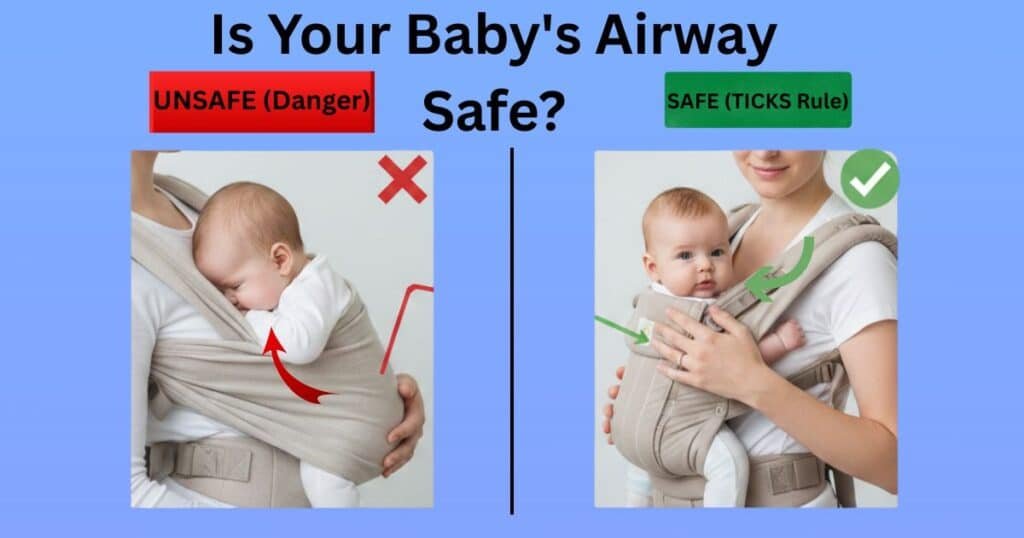
- Airway Management (The Paper Straw Effect): A newborn’s trachea is soft and pliable, like a wet paper drinking straw. Counterfeit fabrics stretch out under the baby’s weight, causing the infant to slump into a “C-shape.” This forces the chin onto the chest, kinking the airway and causing silent positional asphyxia. To master infant breathing mechanics, read our complete guide on the TICKS Rule here.
- Orthopedic Development (The Baseball & Cup): An infant’s hip joint is made of soft cartilage. Cheap, fake carriers often feature dangerously narrow bases that let the legs dangle straight down, deforming the hip socket over time (Hip Dysplasia). Authentic gear enforces the biomechanically optimal Spread-Squat position. Learn how to protect your baby’s skeleton in our definitive M-Position Guide here.
Hardware Physics: Tensile Strength and Buckle Integrity
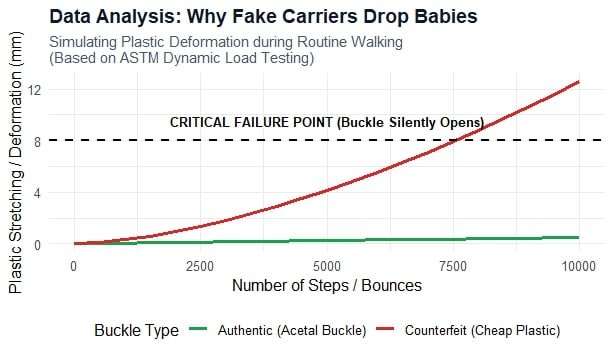
The structural integrity of a baby carrier relies entirely on the hidden physics of its hardware. When evaluating counterfeit baby carrier safety, the buckles and sliders are the most critical failure points, as they bear the entire dynamic kinetic weight of the child. When a caregiver walks or bends, the forces exerted on these small pieces of plastic multiply dramatically.
- The Science of Acetal (Authentic Gear): Legitimate safety gear utilizes premium engineering plastics, most notably Acetal (or Delrin). Acetal possesses incredibly high tensile strength and exceptional “memory retention.” This means that even after thousands of uses, the plastic prongs vigorously snap back to their exact original shape, securely locking the baby in place.
- The Danger of Polypropylene (Counterfeits): To artificially lower retail prices, counterfeiters substitute expensive Acetal with cheap, low-grade plastics like Polypropylene. When subjected to continuous stress—such as holding a bouncing 25-pound toddler—this weak plastic slowly stretches and permanently deforms.
- The “Silent Release” Hazard: Because the cheap plastic warps, the locking teeth lose their friction. A caregiver simply bending forward to tie a shoe generates enough outward leverage to cause the counterfeit buckle to pop open entirely without warning, resulting in a catastrophic fall.
High-Intent FAQs: Navigating the Market
Caregivers navigating the complex digital marketplace frequently share similar anxieties. Here are the scientifically grounded answers to the most common concerns regarding counterfeit baby carrier safety:
1. Can a fake baby carrier really hurt a child?
Yes. Counterfeit carriers utilize weak, untested plastics (like Polypropylene) that can literally snap under a bouncing infant’s weight, causing a catastrophic fall. Furthermore, their lack of engineered structural tension can lead to silent breathing obstruction.
2. Are all third-party sellers on large e-commerce sites selling fake gear?
No, because some legitimate businesses use major e-commerce platforms as a digital storefront. However, caregivers must always verify the specific “Sold By” name and cross-reference it with the “Authorized Retailer” list on the manufacturer’s official website.
3. Does a higher retail price genuinely mean the carrier is safer?
Yes. Authentic manufacturers must pay heavily for premium, high-grade materials (like Acetal buckles and OEKO-TEX certified fabrics) and fund extremely expensive, independent laboratory testing (ASTM F2236-24) to meet federal laws. An unusually low retail price guarantees the manufacturer skipped these life-saving steps.
4. Can a caregiver tell if the fabric is toxic just by looking at it?
No, hazardous chemicals like Azo dyes and heavy metals are invisible. If a new carrier smells like harsh chemicals right out of the plastic packaging, it is likely off-gassing toxic VOCs. Always look for serialized safety tags like OEKO-TEX Standard 100.
The Researcher’s Verdict
Protecting an infant in a poorly regulated digital marketplace requires a profound shift from superficial online shopping to rigorous scientific verification. The ultimate verdict for caregivers is to adopt a strictly analytical purchasing approach that vehemently refuses to compromise on counterfeit baby carrier safety.
When an infant is strapped to a caregiver’s chest, the adult is trusting the physics of that fabric and the chemistry of that plastic with the child’s life. Do not gamble with impossibly cheap online deals. Turn the carrier inside out, search for the legally mandated federal tracking labels, verify the density of the buckles, and always prioritize scientific compliance over a discounted price tag.
Works Cited & Scientific References
- U.S. Consumer Product Safety Commission (CPSC): “Soft Infant and Toddler Carriers Business Guidance.”
- Federal Register (Official US Government): “Safety Standard for Soft Infant and Toddler Carriers” (Regulatory updates for ASTM F2236-24).
- Electronic Code of Federal Regulations (eCFR): “16 CFR Part 1226 — Safety Standard for Soft Infant and Toddler Carriers.”
- International Hip Dysplasia Institute (IHDI): “Baby Carriers & Other Equipment” (Guidelines for proper M-Positioning).
- OEKO-TEX® Official Framework: “OEKO-TEX® STANDARD 100 Explained: Safe Baby Clothes” (Toxicology and material safety standards).
- Counterfeit Safety Awareness: “The Hidden Dangers of Imitation Baby Carriers: Why Quality Matters.”

Hafiz Nauman Baig is a Researcher and PhD Scholar in Zoology, with a specialized focus on Biomechanics and Anatomical Data Analysis. Merging his academic expertise in biological structures with a deep background in Physical Ergonomics and strength mechanics, Nauman evaluates baby gear through a rigorous scientific lens.
Unlike standard product reviewers, he utilizes R Studio and statistical modeling to assess safety data, focusing on the physiological impact of carriers on the infant airway and the caregiver’s spine. His mission is to bridge the gap between complex biological safety standards and practical, pain-free babywearing.