The Exhausting Reality of Travel Sleep: A Researcher’s Perspective
Is your back killing you after 10 minutes of hunching over a travel crib in a brightly lit hotel room, desperately praying your baby will just close their eyes? Every mother knows the exhausting reality of sitting silently in a hotel bathroom, terrified that a single sliver of daylight will ruin the afternoon nap.
As a PhD Scholar in Zoology, I analyze these maternal struggles through the lens of evolutionary biology. The science of how your baby’s body responds to its environment—specifically, how the brain processes daylight explains exactly why babies fight sleep when away from home.
This is not a behavioral failure; it is a biological light switch that has been flipped to the “awake” position by unfamiliar, bright surroundings. This comprehensive report promises to explain why this physiological confusion happens and how to fix it. Using rigorous safety data and textile physics, I will strip away the marketing fluff to help you find the best portable blackout canopy that protects your baby’s health and your sanity. While a blackout canopy addresses environmental sleep triggers, maintaining uncompromising physical safety is a non-negotiable pillar of infant care, much like adhering to rigorous Baby Carrier Safety Standards to protect your baby’s developing spine and airways.”
As an Amazon Associate, I earn from qualifying purchases.
Table of Contents
Portable Blackout Canopy Comparison Table
| Material / Product | How it Works (Physics) | Safety / Age Limit | Clinical & Safety Notes | Latest Price |
|---|---|---|---|---|
| SlumberPod 85% Polyester / 15% Spandex | Light Absorption: Dense, triple-weave synthetic fibers act like a dense thicket, catching and absorbing incoming light photons and converting them to mild heat. | 4+ months to 5 years. Crucial: Must be used indoors with strict climate control (AC). | Independent third-party medical lab assessed as a “low hazard” for CO2 rebreathing. CPSC compliant. | Check Price on Amazon |
| SnoozeShade Double-layer EziBreez™ Mesh | Light Scattering: Microscopic holes allow physical air passage while the geometric overlapping of the black mesh blocks 94% of direct light angles. | 0+ months. Requires constant parental supervision to prevent overheating in warm climates. | Scientifically tested for high air permeability (CFM). Endorsed by the Melanoma International Foundation. | Check Price on Amazon |
| Sleepout Curtains Thermal-Insulating Poly-Fabric | Light Blocking: Industrial suction cups adhere to the glass, preventing external light photons from entering the room’s atmosphere entirely. | 0+ months. Safe for all ages as it remains entirely external to the infant’s crib. | GREENGUARD Gold Certified, meaning the fabric undergoes zero toxic chemical off-gassing when heated by the sun. | Check Price on Amazon |
Researcher’s Takeaway:
In simple words: If you need to stop the sun from waking your baby, you have to block the light at the source. Sleepout Curtains block light at the window, which cools the room safely, but they don’t give parents privacy to keep their own reading lamps on. The SnoozeShade is highly breathable like a screen door on a porch making it great for quick naps, but it won’t make the crib pitch black. The SlumberPod acts like a heavy, dark winter coat blocking out the sun. It is incredibly dark and spacious, but because it is so thick, it naturally traps body heat. Therefore, you must always use a motorized fan with it to keep your baby safe and comfortable. This focus on safety is backed by independent lab results and the SlumberPod safety report, which confirms the structure is a ‘low hazard’ for CO2 rebreathing when used as directed.
Comprehensive Educational Analysis: The Necessity of a Portable Blackout Canopy
To fully appreciate the necessity of travel sleep aids, we must deeply analyze the intersection of maternal experience, mammalian biology, and textile physics. The exhaustion mothers face when traveling is profound.
Understanding this struggle comes down to a few core realities:
- The Ultimate Commodity: Sleep is the most valuable asset for traveling parents.
- The Primary Pain Point: Babies failing to sleep in unfamiliar, bright environments can easily ruin an otherwise meticulously planned family vacation.
- The Biological Fix: Utilizing a portable blackout canopy is not just a luxury; it is a scientifically backed necessity to recreate the safe, dark environment of a home nursery.
The Evolutionary Biology of Infant Sleep
To understand why a baby refuses to sleep in a sunlit beach condo, one must look at human development through a zoological lens. Humans are mammals, specifically primates. In the animal kingdom, mammals generally fall into two distinct reproductive categories:
- Altricial Mammals: Animals like mice and domestic cats give birth to highly dependent, blind young that are kept hidden in dark dens. They sleep almost constantly because they are heavily shielded from environmental light.
- Precocial Mammals: Animals like horses give birth to well-developed young that can see and walk immediately.
- The Human Evolutionary Bridge: Human infants are unique. They are highly dependent and neurologically vulnerable (like altricial young), yet their sensory organs—particularly their eyes—are highly developed and acutely sensitive to their environment.
Because human infants are incredibly sensitive to environmental light, their sleep patterns are entirely dictated by a biological timing system known as the circadian rhythm, which research shows is established during early infancy through consistent light exposure patterns. The circadian rhythm is essentially the body’s internal clock manager, driving physical, mental, and behavioral changes over a 24-hour cycle. In the human brain, this 24-hour clock is controlled by a tiny cluster of nerve cells in the hypothalamus called the suprachiasmatic nucleus, or SCN.
💡 In simple words: Think of the SCN as the master supervisor of a large, busy factory (your baby’s body). This supervisor works in a windowless office deep inside the brain and relies entirely on security cameras the baby’s eyes to know what is happening outside.
- The Retinal Alarm System: When daylight enters the infant’s eye, it strikes specialized alarms in the retina.
- Halting Sleep: These alarms send a direct electrical shock down the optic nerve to the SCN supervisor, shouting, “The sun is up; halt all sleep processes immediately!”
- The 4-Month Shift: For the first few months, a newborn’s circadian rhythm is immature. However, by 12 to 16 weeks of age, a mature daytime-awake and nighttime-asleep pattern establishes itself.
Consequently, exposing a 6-month-old infant to a brightly lit hotel room at 1:00 PM aggressively disrupts their delicate biological clock, causing them to fight their nap with intense distress.
The Pineal Gland and the Biological Light Switch
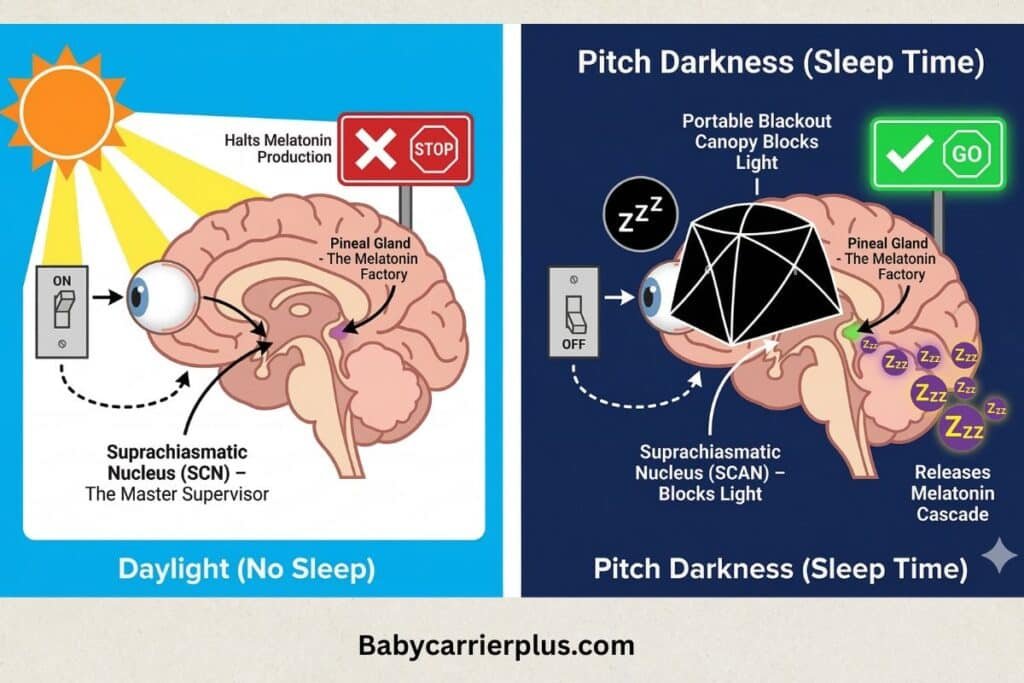
Adjacent to the SCN clock manager sits the pineal gland, a tiny, pinecone-shaped organ responsible for producing hormones. In the zoological world, the pineal gland’s function is universal across diurnal (day-waking) primates. Studies reveal that they, like human infants, experience decreased motor activity and intense sleepiness only when their pineal glands release specific hormones.
The specific hormone synthesized by the pineal gland is melatonin. Often referred to by researchers as the “chemical expression of darkness,” melatonin is the physiological signal that makes muscles relax, eyelids droop, and the brain prepare for deep, restorative rest.
In simple words: The pineal gland acts like a solar-powered battery that operates in reverse. It charges up all day by observing the sun, but it can only turn on and release its calming sleep energy when the room is plunged into total darkness. If even a sliver of bright hallway light hits the baby’s closed eyelids, the battery refuses to turn on.
To successfully manage travel sleep, parents must understand these critical zoological facts:
- Zero Initial Production: Newborn human infants do not produce their own melatonin efficiently after birth. They rely heavily on the melatonin naturally present in their mother’s evening breastmilk (night milk) to help them sleep.
- The Independence Phase: It is not until they reach roughly 3 to 4 months of age that their own pineal gland begins independently secreting melatonin in robust amounts.
- The Biological Requirement: Because their bodies are newly reliant on this self-produced hormone, achieving total environmental darkness is a strict biological requirement to trigger the natural melatonin cascade necessary for survival and brain development, not just a preference.
- The Travel Solution: When parents travel and face unpredictable lighting, setting up a portable blackout canopy over the travel crib is the most effective way to artificially recreate this total darkness and trigger the melatonin cascade.
The Physics of Artificial Nighttime and Fabric Engineering
When families leave the controlled environment of their home nursery, they lose control over ambient light. Sheer rental home curtains, flashing street lamps, and bright airport layovers all wage war on the infant’s melatonin production. This is where engineered textiles specifically a portable blackout canopy intervene to create an artificial nighttime environment.
To comprehend how these heavy fabrics work, we must examine the basic physics of light. When photons (tiny, invisible particles of light) travel from a lamp and hit an object, they can perform one of three actions:
- Reflect: Bounce off like a mirror.
- Transmit: Pass through like a clear glass window.
- Absorb: Soak in like a sponge.
Standard white cotton bedsheets reflect a small amount of light but transmit the vast majority of it, making them useless for darkening a room.
The Problem with Traditional Blackout Fabrics: Decades ago, traditional blackout curtains relied on heavy chemical coatings (such as thick white polyurethane foam or silver glue) to physically reflect light away from the window. While effective, these coated fabrics presented significant downsides:
- They were extremely stiff and hard to pack.
- When heated by intense sunlight, the chemical layers would crack and peel.
- They released toxic off-gassing odors directly into the room, which is highly undesirable for an infant’s immediate breathing zone.
The Modern Solution: Triple-Weave Architecture Modern, premium blackout canopies utilize a physical blackout technology known as “triple-weave architecture.” Instead of coating a cheap fabric in plastic foam, textile engineers take dense, dark synthetic yarns typically a durable polyester and weave them together in three incredibly tight, overlapping microscopic layers.
💡 In simple words: Imagine a basic chain-link fence. If you throw a handful of fine sand (representing light) at it, most of the sand flies right through the wide holes (transmission). Now imagine taking thick, black vines and weaving them tightly through every single hole in that fence. If you throw sand at it now, the dense vines catch and trap every single grain. This is exactly how triple-weave polyester absorbs up to 95% of incoming light without relying on toxic chemical pastes.
The Thermodynamic Reality: However, this light absorption triggers another law of physics: Thermodynamics. Energy cannot be destroyed; it merely changes forms.
- Heat Conversion: When a dense black canopy absorbs billions of high-energy light photons, that light energy is converted directly into thermal energy (heat).
- Temperature Rise: Because the heavy fabric traps this heat, the internal temperature of a blackout pod will naturally rise compared to the cooler ambient room temperature.
- Real-World Data: Data collected by parents using remote digital thermometers inside these canopies frequently shows an increase of 2 to 4 degrees Fahrenheit.
This inescapable thermal reality necessitates strict safety protocols regarding airflow and ventilation.
Air Permeability vs. Breathability: A Critical Safety Distinction
In the realm of baby sleep textiles, there is a dangerous and widespread consumer misunderstanding between the marketing terms “breathable” and “air-permeable.” Understanding this difference is crucial for your baby’s safety:
- Breathability (Moisture-Vapor Transmission): This refers strictly to a fabric’s ability to pull liquid sweat away from the body, turn it into vapor, and let it evaporate. A tightly woven polyester athletic shirt is highly “breathable” because it keeps marathon runners dry. However, if you pull that same breathable shirt tightly over your mouth and nose, you will struggle to draw a full breath of oxygen.
- Air Permeability (Cubic Feet per Minute – CFM): This refers to the physical volume of fresh air that can effortlessly flow through the microscopic gaps in a fabric.
Why Air Permeability Matters for Safe Sleep: When enclosing an infant in a small space, air permeability is a matter of life and death.
- Preventing CO2 Rebreathing: It prevents the dangerous accumulation of exhaled carbon dioxide, a hazard known as CO2 rebreathing.
- SIDS Risk: If a baby breathes in their own exhaled air repeatedly, oxygen levels drop, which is a major risk factor for Sudden Infant Death Syndrome (SIDS).
Mesh fabrics, by their very structural nature, are highly air-permeable. However, dense blackout fabrics because they must be woven tightly enough to trap light inherently restrict the passive flow of air.
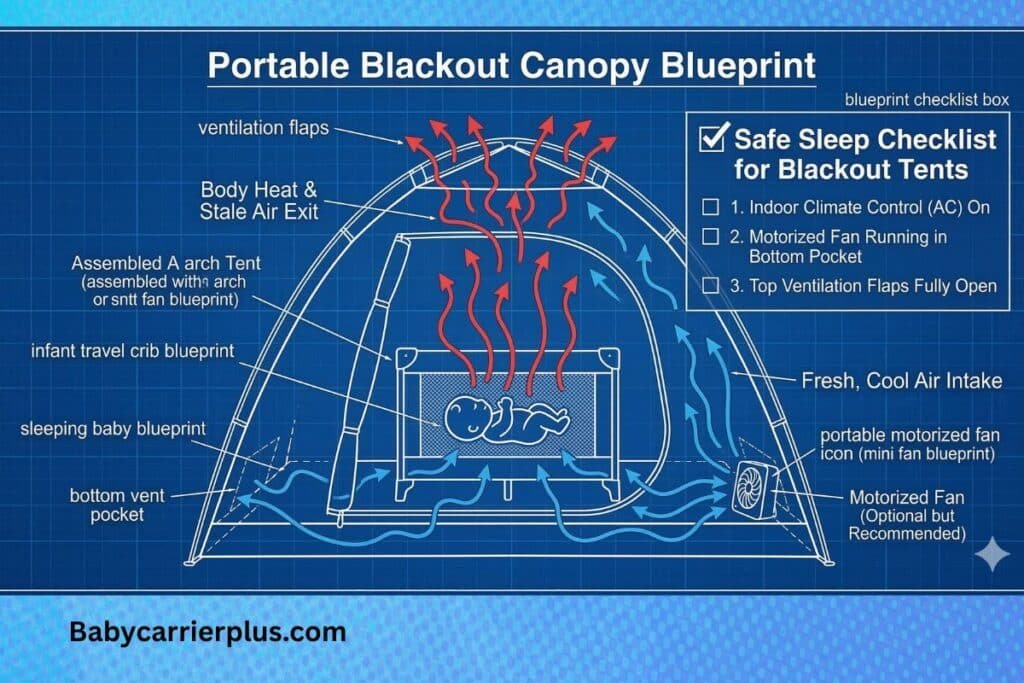
To mitigate this, any premium portable blackout canopy must be engineered with specialized ventilation flaps and, crucially, active mechanical airflow systems (such as a motorized fan) to maintain safe, continuous air exchange rates. A fabric can be marketed as “breathable,” but parents must ensure the actual structure allows for high air permeability.
Analyzing the Multimodal Solution for Modern Travel
In the modern infant care market, specific tools emerge that solve deep physiological pain points so effectively that they transition from luxury splurges to absolute essentials. The SlumberPod, a premium portable blackout canopy, is the textbook definition of this transition, cementing its status as a “Registry Must-Have.”
- The Investment: Retailing as a high-ticket item, it represents a substantial upfront financial investment for new parents.
- Account Protection: However, experienced mothers view it as a powerful tool for “account protection” meaning it protects the vast financial and emotional investment of a family vacation by guaranteeing the baby will actually sleep, thereby preserving the parents’ sanity.
The Structural Engineering of the Canopy The SlumberPod is structurally distinct from traditional, unsafe crib coverings:
- Freestanding Design: It utilizes two sturdy, shock-corded aluminum poles to create a freestanding, arched tent structure. Once assembled, it stands an impressive 56 inches tall, 50 inches long, and 36 inches wide.
Source: SlumberPod Official Channel
Watch on YouTube- Bottomless Safety: Crucially, from a regulatory standpoint, it utilizes a bottomless design. This is a vital safety distinction that every parent must understand.
- CPSC & SSBA Compliance: Historically, products known as “crib tents” physically clamped or attached to the top rails of a wooden crib, attempting to confine the child. These confining structures posed severe strangulation and entrapment hazards and have been heavily scrutinized and banned by the Consumer Product Safety Commission (CPSC). Furthermore, the Safe Sleep for Babies Act (SSBA) strictly regulates inclined sleepers, emphasizing that a baby’s sleep surface must remain flat and entirely bare.
- Room-Within-a-Room: The SlumberPod never attaches to the crib. It simply slides completely over an already-safe, independently CPSC-certified sleep space (like a mesh playard). It acts as an architectural room-within-a-room, entirely divorcing the child’s sleep environment from the parent’s room without altering the mattress’s safety mechanics.
Compatibility and Space Mechanics
- Wide Footprint: The spatial mechanics of the canopy are brilliantly engineered to fit over playards up to 44 inches long, 30 inches wide, and 38 inches tall. This wide footprint accommodates nearly all major travel cribs on the market, including the ubiquitous Graco Pack ‘n Play, Guava Lotus, and BabyBjörn Travel Crib.
- Vertical Clearance: Because the structure arcs to 56 inches in height, it provides sufficient vertical clearance for older infants and toddlers to stand up inside the crib without bumping their heads on the ceiling. This prevents them from feeling claustrophobic a common trigger that causes toddlers to panic in shorter canopies.
- Fabric Elasticity: The fabric itself is an 85% polyester and 15% spandex blend, providing the heavy elasticity needed to stretch safely over sharp crib corners while remaining taut.
Protecting the Parental Investment
- Room-Sharing Reality: When parents travel, utilizing a portable blackout canopy built with advanced physical blackout technology allows for 95%+ light absorption without the need for toxic chemical coatings. This makes room-sharing much more manageable, as without a physical barrier. Without a physical barrier, parents are forced to sit in pitch darkness from 7:00 PM onward, whispering in hushed tones.
- Visual & Thermal Control: The SlumberPod mitigates this shared-room misery by providing 95%+ light blockage. By integrating specialized vinyl pouches for a baby monitor camera and an active ventilation fan, it allows parents to maintain crucial visual safety checks and thermal control without ever breaching the dark environment. The integration of specialized vinyl pouches allows parents to maintain a constant visual connection with their infant. To ensure complete privacy while traveling, we recommend pairing the canopy with hack-proof non-WiFi baby monitors to prevent any digital security risks in unfamiliar hotel networks.

SlumberPod with Fan: The Original Blackout Sleep Canopy
The gold standard for travel sleep. Includes the essential motorized fan to ensure safe airflow and 95%+ light blockage for deep melatonin production.
(Amazon Associate Link: Supports our rigorous scientific research)
Evaluating Alternative Sleep Ecosystems
While the SlumberPod represents the premium tier, the market offers alternative portable blackout canopy solutions and room-darkening methods that manipulate light differently, each with distinct physics and applications.
The SnoozeShade for Pack ‘n Play For parents traveling to highly tropical, non-air-conditioned environments, the SnoozeShade offers a distinct physical approach.
- Material: Rather than using dense spandex, it is constructed from a double layer of EziBreez™ mesh.
- Light Scattering: This relies on light scattering rather than total absorption; the geometric overlapping of the black mesh blocks 94% of direct light while leaving microscopic holes wide open for massive passive air permeability.
- The Trade-off: Because it is highly air-permeable, it is much safer in hot environments. However, it does not offer 100% total darkness, and because it drapes flat over the top of the crib without poles, toddlers who stand up will immediately hit their heads on the fabric, potentially causing distress.

SlumberPod with Fan: The Original Blackout Sleep Tent
The only high-performance portable blackout canopy that combines 100% light elimination with a dedicated mechanical fan pouch for superior infant thermal safety.
*As an Amazon Associate, we earn from qualifying purchases at no extra cost to you.
Sleepout Portable Curtains Instead of covering the baby, Sleepout Curtains cover the room’s light source.
- Mechanism: Using heavy-duty suction cups, these thermal-insulating curtains attach directly to the window glass.
- The Trade-off: This is the safest method for cooling a room, as it prevents external solar radiation from entering the room entirely, and it features a GREENGUARD Gold certification, ensuring zero chemical off-gassing. However, it offers zero privacy for room-sharing parents; if the parent turns on a reading lamp or a TV, the baby’s melatonin production will immediately halt.

Amazon Basics Portable Blackout Window Shade
A highly effective external barrier that blocks 100% of light at the source. Using strong suction cups, it’s the most reliable way to darken a room without enclosing the crib itself.
*Prices and availability are subject to change.
💡 The High-Value Budget Alternative: Hiccapop Daydreamer
While the SlumberPod is the gold standard, we recognize the significant investment it requires. For parents seeking a similar arched-pole structure at a more accessible price point, the Hiccapop Daydreamer is our top budget recommendation.
Why it wins: It offers a freestanding design and high ratings (4.7 stars) at nearly 40% less cost.
The Trade-off: It may not offer the same level of “total” blackout as the triple-weave polyester found in premium portable blackout canopy solutions, but it is a formidable contender for travel-savvy families.

Hiccapop Daydreamer Blackout Tent
A high-quality arched-pole solution for parents who want the “sleep pod” experience at a more accessible price. Blocks over 90% of light and features a dedicated pocket for a motorized fan.
Researcher’s Note: Critical Safety & Real-World Observations
To maintain a rigorous, objective analysis, we must look beyond marketing claims and examine the microscopic details of user manuals and real-world data from parent communities.
1. Mechanical Integrity (The Pole Tension Warning): The SlumberPod manual explicitly warns against bending the poles with excessive force. From a physics standpoint:
- Torque & Leverage: The aluminum poles operate under high tension. Forceful assembly in cramped hotel rooms can cause the metal to snap.
- Safety Risk: A snapped pole creates jagged edges near your infant. Always use the “push-and-guide” technique rather than forcing the arc.
2. Thermal & Airflow Reality (The “Baby Smell” Phenomenon): Analyzing thousands of data points from parent forums like Reddit reveals a consistent theme: a concentrated “warm baby smell” when unzipping the pod in the morning.
- What it means: The dense triple-weave fabric that blocks light also traps heat and odors.
- The Solution: While the product is clinically tested for CO2 safety, this data validates the absolute necessity of using the motorized fan accessory. The fan actively pushes fresh air in and forces stale, warm air out.
3. Environmental Mandate: The manufacturer dictates that these pods must only be used in indoor, climate-controlled conditions. Placing a portable blackout canopy in a non-AC environment (like a beach or a stuffy cabin) turns it into a thermal greenhouse, posing an immediate overheating risk.
Consumer Analysis: Validating Real-World Pain Points
Analyzing thousands of data points from parent communities, such as Reddit and consumer reviews, reveals consistent themes that validate the physiological constraints of a portable blackout canopy.
- The “Baby Smell” Panic (Heat & Olfactory Trapping): Many mothers on Reddit report a concentrated wave of “baby smell” and warm air when unzipping the pod in the morning.
- The Physics: Parents are correct to notice this; the dense triple-weave fabric that blocks light also restricts passive airflow.
- The Fix: While these products pass clinical CO2 tests, the lack of rapid air exchange traps odors and heat. This data proves that the motorized fan accessory is not optional—it is a necessity to push fresh air into the vent and force stale air out.
- The Toddler Stand-Up Panic: For drape-over products that lack structural poles (like the SnoozeShade), parents report a common behavioral trigger:
- The Issue: Once a toddler learns to stand, their head hits the mesh ceiling immediately.
- The Reaction: This often causes a “trapped” feeling, leading to panic, screaming, and a ruined nap.
- The Architectural Solution: This behavioral data supports the superiority of arched-pole designs (like the SlumberPod), as the vertical clearance prevents claustrophobia and allows for a peaceful wake-up.
Frequently Asked Questions
1. Is it safe to put a portable blackout canopy over my baby’s travel crib?
Yes, but only if you follow the rules. Because these units are bottomless and slide over the crib, they do not physically trap the baby. However, you must only use them indoors in an air-conditioned room.
2. Will my baby get too hot inside a blackout canopy?
Yes, if you do not use a fan. Thick fabrics trap body heat, so you must always use a motorized fan in the designated pocket to circulate fresh air.
3. Do babies actually need total darkness to sleep?
Yes. Babies over 4 months rely on melatonin. A portable blackout canopy triggers this hormone by ensuring total darkness even in bright hotel rooms.
4. Can I just use a regular heavy blanket to cover the crib instead?
No. Regular blankets trap CO2 and heat. Engineered canopies use breathable synthetic fabrics and vents to keep the air safe.
5. Does the SlumberPod fit over a standard wooden crib at home?
No. It’s built for playards and mini-cribs. Stretching it over a full-sized crib will likely break the poles.
6. Is mesh better than solid fabric?
Mesh is better for airflow in hot climates, while solid fabric is better for 100% light blockage if you have AC and a fan.
The Researcher’s Verdict: Protecting Your Family’s Rest
For the modern, travel-savvy mother, managing an infant’s sleep in a new environment is an exhausting exercise in applied biology. The scientific data clearly indicates that attempting to force a baby to sleep in a brightly lit room fundamentally contradicts their evolutionary neurological wiring.
Therefore, adopting a “Multimodal Strategy” is the most scientifically sound approach. This strategy involves combining absolute light elimination using a high-quality portable blackout canopy to trigger the pineal gland’s melatonin production with active thermal management through integrated fans to safeguard the infant’s core temperature.
While these premium, highly engineered solutions represent a significant financial investment, their ability to replicate the safe, isolated darkness of a home nursery makes them an invaluable asset for protecting your family’s overall well-being and vacation joy.
Always remember: The absolute foundation of infant care is not just comfort, but uncompromising safety. Ensure your baby’s sleep environment is always bare, firmly supported, well-ventilated, and strictly adheres to CPSC safe sleep guidelines. By honoring your baby’s biological need for true darkness, you can finally reclaim your evenings, stop hiding in the hotel bathroom, and ensure deeply restorative rest for the entire family. Since these engineered sleep solutions represent a significant financial investment, savvy parents can strategically acquire them by utilizing a Free Amazon Baby Registry to take advantage of the 15% completion discount on premium travel gear.

Hafiz Nauman Baig is a Researcher and PhD Scholar in Zoology, with a specialized focus on Biomechanics and Anatomical Data Analysis. Merging his academic expertise in biological structures with a deep background in Physical Ergonomics and strength mechanics, Nauman evaluates baby gear through a rigorous scientific lens.
Unlike standard product reviewers, he utilizes R Studio and statistical modeling to assess safety data, focusing on the physiological impact of carriers on the infant airway and the caregiver’s spine. His mission is to bridge the gap between complex biological safety standards and practical, pain-free babywearing.