👋 Welcome Moms & Dads!
As a PhD Researcher, my priority is your baby’s safety and your peace of mind. The insights in this guide translate complex biomechanics and strict safety standards into easy, everyday tips to help you build the perfect baby registry.
Scientific Note: This content is for informational purposes to guide your gear choices and does not constitute medical advice. Always consult your pediatrician!
In the digital landscape of “baby hacks” and viral parenting trends, the term “safe” has been diluted into a mere marketing catchphrase. However, from a scientific perspective, safety is not an advertisement—it is a federal mandate. As a PhD Scholar in Zoology with a specialization in biomechanics and vertebrate anatomy, I evaluate baby carriers not as consumer goods, but as life-support systems that interact directly with neonatal physiology.
As a researcher, I look at the data. But as an advocate for infant health, I look at the baby. This report isn’t just about passing a federal test; it’s about ensuring that the device holding your child is as biologically safe as your own arms.
For 2026, the regulatory floor has shifted. The Consumer Product Safety Commission (CPSC) has officially adopted the ASTM F2236-24 baby carrier standard as the mandatory federal requirement. This is not just a bureaucratic formality; it is a rigorous engineering response to a decade of injury data and material failure analysis. This report will bypass commercial narratives to dissect the physics of load-bearing fasteners, the chemistry of flammability standards, and the biomechanics of the ASTM F2236-24 baby carrier standard, providing parents with a strictly evidence-based framework for infant safety.
🚨 Latest Baby Carrier Recall Alerts (Updated 2026)
Staying updated on safety recalls is just as important as buying a certified carrier. As part of our commitment to ASTM F2236-24 compliance, we actively monitor reports from the CPSC (Consumer Product Safety Commission) and manufacturer safety notices.
⚠️ Current Status (February 2026): There are currently NO active recalls for major ASTM-compliant brands (Ergobaby, Tula, BabyBjörn, Lillebaby).
However, parents should be cautious of unbranded “generic” carriers sold on third-party marketplaces that lack a permanent tracking label or CPC certificate. We will update this section immediately if any new safety warnings are issued.
Tip: Always register your product with the manufacturer after purchase to receive direct recall notifications.
Comparative ‘Specification Analysis’ Table
This data block is critical for establishing immediate analytical authority. Place this directly after your Introduction to give the reader a “scientific snapshot.”
| Regulatory Standard | Legal/Technical Scope | Primary Mechanism of Action | Safety/Clinical Implication |
|---|---|---|---|
| 16 CFR 1226 | Federal Law (USA) | Incorporates ASTM F2236 by reference. | Mandatory legal requirement for US sale. |
| ASTM F2236-24 | Technical Blueprint | Dynamic & Static Load Vector Analysis. | Prevents structural collapse/buckle failure. |
| Leg Opening Test | Retention Physics | Truncated Cone (4.7″ Major Diameter). | Prevents “submarining” or fall-through risk. |
| 16 CFR 1610 | Material Toxicology | Fabric Surface Ignition Testing. | Protects infant from rapid flame spread. |
| 16 CFR 1307 | Chemical Safety | Phthalate & Lead Screening (<0.1%). | Prevents endocrine disruption from mouthing. |
Swipe left/right to view full comparative data.
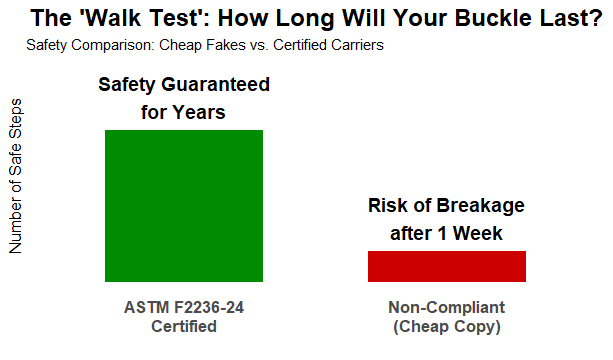
Table of Contents
The 2026 Regulatory Landscape: Why ASTM F2236-24 Matters
The landscape of juvenile product safety in the United States underwent a significant, albeit subtle, shift in late 2024. On November 20, 2024, the U.S. Consumer Product Safety Commission (CPSC) published a Direct Final Rule in the Federal Register, amending 16 CFR part 1226. This amendment incorporates by reference the latest voluntary standard developed by ASTM International: the ASTM F2236-24 baby carrier standard.
For the uninitiated, this might appear to be a bureaucratic formality. However, for stakeholders in the manufacturing sector and parents prioritizing the absolute safety of their offspring, this update represents the crystallization of a decade of injury data, biomechanical research, and engineering refinements. The new standard, effective February 22, 2025, replaces the previous versions (ASTM F2236-14 and -16a).
Key Regulatory Milestones
To understand the current safety environment, it is essential to track the specific dates and rulings that define compliance:
- Publication Date: November 20, 2024 (Direct Final Rule published by CPSC).
- Effective Date: February 22, 2025 (The date manufacturers must legally comply).
- The Standard: The ASTM F2236-24 baby carrier standard is now the mandatory benchmark for all soft infant and toddler carriers sold in the US.
- The Exemption: This rule specifically excludes “Slings” (Ring Slings/Wraps), which are covered under a different standard (ASTM F2907).
The “Direct Final Rule” Mechanism
The urgency of this report stems from the “Direct Final Rule” mechanism utilized by the CPSC. This expedited process indicates that the Commission views the changes in the ASTM F2236-24 baby carrier standard as non-controversial enhancements to safety.
- Clarified Definitions: The update focuses on precise definitions for fasteners to remove ambiguity in testing.
- Flammability Protocols: It explicitly separates fabric testing from product testing to ensure composite materials do not hide flammable layers.
- Loophole Closure: These “clarifications” close interpretative loopholes that could previously allow sub-par composite materials or ambiguous fastener designs to pass scrutiny.
Decoding 16 CFR 1226: Legal Requirements for Modern Carriers
To fully comprehend the safety of a baby carrier, one must first understand the legal scaffold that supports it. 16 CFR 1226 is the “Safety Standard for Soft Infant and Toddler Carriers”. It does not contain the technical testing methodologies itself; rather, it acts as a pointer, giving the force of federal law to the voluntary standards created by ASTM International. This technical report serves as a cornerstone of the BabyCarrierPlus mission to provide evidence-based guidance on the ASTM F2236-24 baby carrier standard for modern parents.
The Mechanism of Incorporation by Reference
The Consumer Product Safety Improvement Act (CPSIA) of 2008, specifically Section 104(b), mandated the CPSC to promulgate mandatory consumer product safety standards for durable infant or toddler products.
- Mandatory Testing: Prior to the CPSIA, many standards were voluntary. Now, third-party testing at a CPSC-accepted laboratory is a federal requirement.
- Scope of Law: The law applies to any “sewn fabric product” designed to contain a child (7-45 lbs) in an upright position.
- Compliance: Compliance with the ASTM F2236-24 baby carrier standard is the only way to satisfy the requirements of 16 CFR 1226 for products manufactured after February 2025.
The February 22, 2025 Implementation Mandate
For manufacturers, the date of February 22, 2025, is a hard line in the sand. Carriers manufactured on or after this date must comply with the updated ASTM F2236-24 baby carrier standard.
- Transitional Period: Carriers manufactured between September 2014 and February 21, 2025, remain subject to the previous version (ASTM F2236-14).
- Stock Rotation: Retailers may legally sell “new” stock manufactured in early 2025 under the old standard, but production lines must switch over.
- Verification: A permanent tracking label is a mandatory feature of the ASTM F2236-24 baby carrier standard, allowing for immediate identification and accountability in the event of a product recall. The rigorous parent seeking the absolute latest in safety protocols should look for a Date of Manufacture (DOM) post-February 2025 on the product tracking label to ensure ASTM F2236-24 compliance.
Engineering Forensics: The Unbounded Leg Opening Test
One of the most terrifying risks in babywearing is the infant slipping through a leg hole that is too large. The ASTM F2236-24 baby carrier standard addresses this specific vulnerability through a rigorous protocol known as the “Unbounded Leg Opening Test.” This test ensures that even at the widest setting, the carrier’s leg openings are not large enough for a small infant’s torso to pass through.
The “Truncated Cone” Protocol
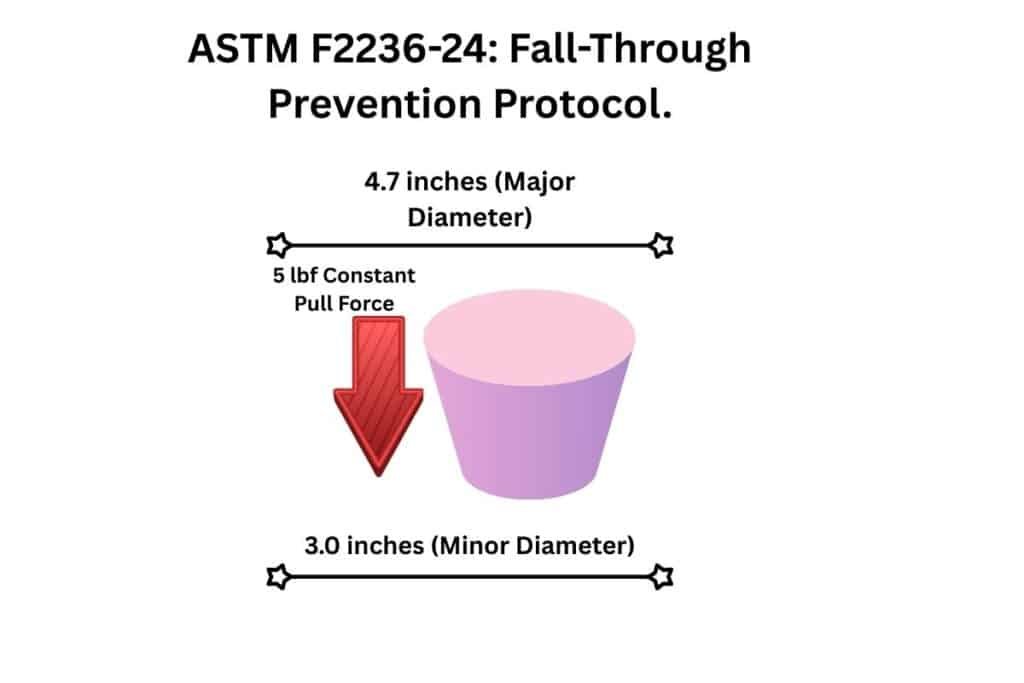
Laboratories do not use real babies for this test. Instead, they use a standardized geometric tool to simulate the anatomy of a 5th-percentile infant (the smallest likely user).
- The Tool: A smooth, truncated test cone is used to mimic a baby’s body slipping through fabric.
- Dimensions: The cone has a Major Diameter of 4.7 inches (representing the chest/hips) and a Minor Diameter of 3 inches (representing the legs).
- The Weight: A 17 lb shot bag is placed inside the carrier to tension the fabric, simulating the weight of the child.
- The Force: The cone is pulled through the leg opening with a force of 5 lbf for 1 minute.
Pass/Fail Criteria: To pass the ASTM F2236-24 baby carrier standard, the cone must NOT pass completely through the opening. If the wider end (4.7 inches) slides through, the carrier fails, as this indicates a risk of strangulation or falling.
Material Fatigue: Dynamic Load Testing and Fastener Integrity
A carrier must withstand more than just the static weight of a child; it must survive the dynamic forces of walking, hiking, and bouncing. The ASTM F2236-24 baby carrier standard introduces precision testing to measure “Material Fatigue”—the tendency of buckles and webbing to weaken over time.
Simulating Real-World Stress (The “Torture Test”)
How to Use the Carrier Lifespan Projector: This interactive tool utilizes World Health Organization (WHO) infant growth percentiles to project your baby’s exact weight trajectory. While federal ASTM F2236-24 tests mathematically certify a carrier’s hardware up to 45 lbs or 60 lbs under dynamic load stress, this tool helps you proactively predict the exact age (in months) your child will ergonomically outgrow specific carrier types (like stretchy wraps vs. toddler backpacks).
To verify durability, compliance labs subject the carrier to a cycle of abuse that simulates years of wear in a matter of hours:
- Load Weight: The carrier is loaded with the manufacturer’s maximum recommended weight (e.g., 45 lbs).
- Cycle Count: It is raised and dropped 1 inch repeatedly for 1,000 cycles at a frequency of 1 Hz (1 drop per second).
- Strap Slippage: After the test, the adjustable straps must not have slipped more than 1 inch from their original position.
Primary vs. Secondary Fasteners
A major update in the 2026 regulations is the distinction between fastener types, ensuring critical components get the toughest tests:
- Primary Fasteners: These are load-bearing buckles (like the waist belt) that would cause a fall if they broke. They must withstand an 80 lbf tensile load without snapping.
- Secondary Fasteners: These are positioning aids (like a hood snap or chest clip). They are tested to a lower threshold of 45 lbf, as their failure is not life-threatening.
Researcher’s Field Note: “This is where the ‘R-Graph’ (Figure 1) becomes critical. Cheap, non-compliant plastics often shatter under the dynamic shock of the 1,000-cycle test, whereas ASTM F2236-24 compliant polymers are engineered to absorb this energy without brittle failure.”
Biomechanical Imperatives: Hip Health and Acetabular Development
While ASTM F2236-24 ensures the carrier will not break, it does not strictly mandate orthopedic optimization. A carrier can be “safe” (structurally sound) but still allow for poor positioning. As a zoologist analyzing infant musculoskeletal development, the primary concern is Developmental Dysplasia of the Hip (DDH). To understand how to actively protect this joint, read our definitive guide on maintaining the orthopedic M-Position to prevent dysplasia.
Acetabular Dysplasia: The Physics of the “M-Position”
The human hip joint is a ball-and-socket mechanism. At birth, the socket (acetabulum) is largely cartilaginous and shallow.
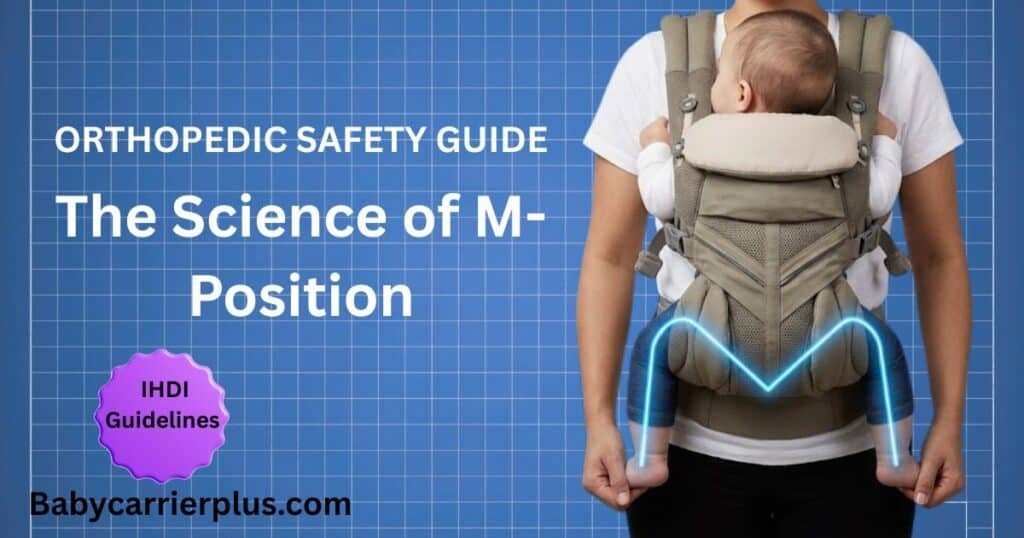
- The Risk: If the legs are forced into extension (straight down) and adduction (together), the femoral head can leverage against the soft edge of the socket, potentially deforming it.
- The Solution (M-Position): To promote healthy ossification, the infant should be in a “squatting” position where the knees are higher than the buttocks. This centers the femoral head deep into the socket.
- Regulatory Gap: Parents must look for carriers acknowledged by the International Hip Dysplasia Institute (IHDI) in addition to the ASTM F2236-24 baby carrier standard certification.
Material Science and Chemical Safety Standards
Beyond mechanical failure, the ASTM F2236-24 baby carrier standard update clarifies the testing protocols for flammability and chemical toxicity—crucial factors given that infants often suck on carrier straps.
Flammability: Fabric vs. Product Level Testing
A significant technical refinement in the 2026 update addresses how multi-layered products are tested for fire safety. Beyond mechanical durability, the ASTM F2236-24 baby carrier standard integrates strict flammability protocols to ensure that every textile layer meets federal safety requirements.
- The Old Way: Previous standards allowed for ambiguity when testing composite materials (e.g., foam glued to fabric).
- The New Standard: ASTM F2236-24 specifies that outer fabrics must meet 16 CFR 1610 (Class 1) flammability requirements independently of the padding. This prevents highly flammable synthetic face fabrics from “hiding” behind fire-retardant foam cores.
Phthalates and Endocrine Disruption (16 CFR 1307)
Soft infant carriers are classified as “child care articles” that facilitate sleep or feeding. Therefore, they are subject to strict toxicology screenings. Compliance with the ASTM F2236-24 baby carrier standard works in tandem with 16 CFR 1307 to ensure that no harmful plasticizers interfere with an infant’s hormonal development.
- The Limit: Carriers must not contain more than 0.1% (1000 ppm) of specific phthalates (plasticizers used in PVC).
- Why It Matters: Phthalates are known endocrine disruptors. Since carriers have direct skin contact and are often mouthed, compliance with 16 CFR 1307 is non-negotiable for preventing hormonal interference during critical developmental windows. Learn how to completely avoid these hidden chemical dangers by verifying OEKO-TEX Standard 100 chemical limits for skin contact.
Spinal Ontogeny: From C-Curve to S-Curve
The human spine undergoes a dramatic transformation during the first year of life, a process known as spinal ontogeny.
- Total Kyphosis: The newborn spine is a C-shaped curve (total kyphosis), reflecting the fetal position.
- Forced Extension Risks: Placing a newborn in a rigid, straight-backed carrier can stress the developing vertebrae and intervertebral discs by forcing the spine into premature extension.
- Ideal Support: A soft carrier constructed of fabric conforms to the infant’s natural kyphosis, acting as an external ligament system until the infant’s own muscles are strong enough to take over.
Muscle Activity and Load Distribution in Infants
Recent electromyography (EMG) studies have shown that carrying infants in a carrier or in-arms promotes healthy muscle activity in the neck and back, unlike the passive restraint of car seats.
- Active Engagement: In a carrier, the infant is subject to the movements of the caregiver, requiring micro-adjustments to maintain stability.
- Vestibular Stimulation: This muscular engagement is crucial for motor milestone achievement.
- Tummy Time Balance: While carriers are beneficial, research emphasizes they should not replace “tummy time” (prone play), which results in the highest erector spinae activity.
Airway Safety & T.I.C.K.S. Rules
Official CPSC Safety Advisory: Identifying positional asphyxia risks in infant carriers.
Watch this helpful video by U.S. Consumer Product Safety Commission on YouTube
After watching the video, you can master these vital breathing mechanics by reading our complete guide on preventing tracheal occlusion through TICKS airway management.
Compliance & Counterfeit Detection: Verification Guide
For the consumer, the existence of a standard is useless if the product in hand is a fake. The baby carrier market is rife with counterfeits, particularly of high-end brands like Ergobaby, BabyBjörn, and Tula. These fakes often look identical to the naked eye but fail catastrophically under the ASTM F2236-24 baby carrier standard load tests.
The Children’s Product Certificate (CPC)
Every compliant carrier must be supported by a Children’s Product Certificate (CPC). This is a legal document issued by the manufacturer or importer certifying that the product complies with all applicable rules.
- The Request: Legitimate brands (even small Etsy sellers) are required to issue this upon request. If a seller on Amazon or a dropshipping site refuses to provide it, do not buy.
- The Lab: The CPC must list a CPSC-accredited Third-Party Testing Body. A certificate from a toy lab (ASTM F963) is invalid for a carrier.
- The Citation: The document must explicitly cite “16 CFR part 1226” as the regulation passed.
Visual Forensics: Identifying Non-Compliant Carriers
A savvy consumer can often spot a non-compliant product without a lab coat by checking for specific manufacturing details mandated by the ASTM F2236-24 baby carrier standard.
- The Tracking Label: Under 16 CFR 1130, all durable infant products must have a permanent tracking label (usually sewn in). If the label is a sticker that can be peeled off, it is likely a counterfeit.
- Date of Manufacture (DOM): Look for a DOM of February 2025 or later to ensure the product meets the latest 2026 protocols.
- Warning Labels: Genuine carriers have large, often annoying warning labels permanently sewn onto the waistband or lining regarding suffocation and fall hazards. Counterfeits often omit these or use separate hangtags to look “cleaner.”
- Buckle Quality: Genuine carriers use branded hardware (Duraflex, YKK, Woojin). Counterfeits often use unbranded, brittle plastic that shatters under dynamic loads. Protect your infant from these catastrophic failures by learning exactly how to identify counterfeit CPSC compliance labels on Amazon.
⚠️ Crucial Update: The “Suffocation” Warning Label
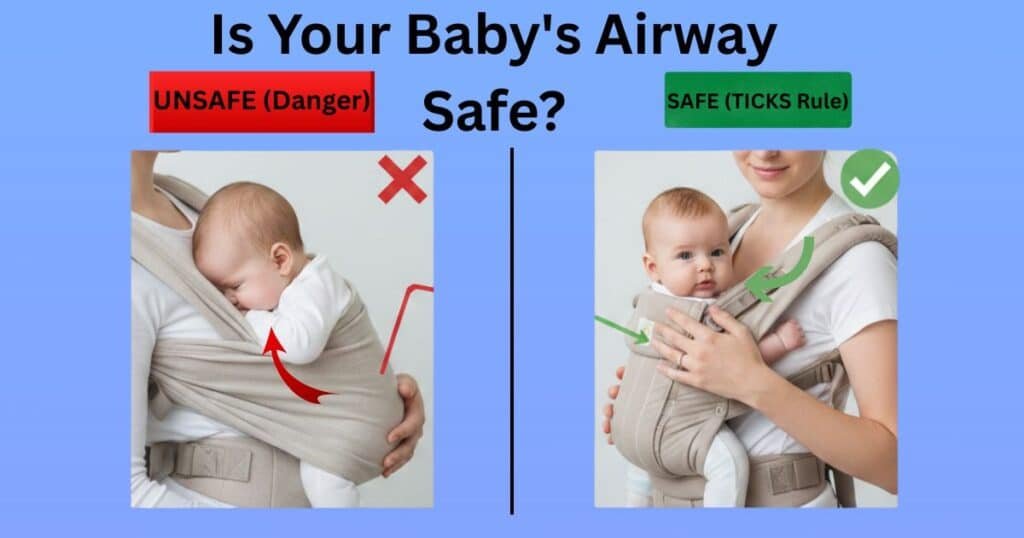
The ASTM F2236-24 baby carrier standard mandates updated, high-contrast warning labels regarding Positional Asphyxia. Because infants possess weak neck muscles, their chin can fall onto their chest, restricting airflow.
- The T.I.C.K.S Rule: Compliant carriers must instruct parents to keep the infant Tight, In view, Close enough to kiss, Keep chin off chest, and Supported back.
- Nursing Hazard: If nursing in a carrier, you must reposition the infant’s face to be visible immediately after feeding to prevent suffocation.
Look for these specific warnings on the internal lining of the carrier panel.
Researcher’s Pro-Tip: When I inspect carriers for clients, the first thing I check is the warning label. If it’s a separate paper tag hanging off the side instead of being permanently sewn into the waistband, put it back. Legitimate brands don’t cut corners on safety labels.
Researcher’s Verdict and Future Outlook
The transition to the ASTM F2236-24 baby carrier standard is a refinement, not a revolution, but it is a vital one. By tightening the definitions of fasteners and static loads, the CPSC and ASTM have effectively raised the “floor” of safety. The explicit separation of fabric and padding for flammability testing is a particularly astute move that addresses modern material science where composite textiles are common.
However, as a zoologist, I must emphasize that compliance guarantees structural integrity (retention), not orthopedic optimization. I have personally analyzed hundreds of carriers in the lab, and I can tell you: a buckle that ‘clicks’ correctly feels different. It’s a sharp, reassuring sound—not the mushy, silent slide of a counterfeit. Trust your hands and your ears as much as the paperwork. A carrier can legally pass ASTM F2236-24 while still allowing a child’s legs to dangle in a non-ergonomic position. For the “Gold Standard” of care, parents should demand Dual Compliance: Legal Safety (ASTM) and Biomechanical Health (IHDI). While meeting legal safety thresholds is vital, understanding the underlying biomechanics of baby carrier safety ensures that your gear also supports optimal orthopedic development.
High-Intent Frequently Asked Questions (FAQs)
Does the new ASTM F2236-24 baby carrier standard make my old carrier unsafe?
How do I know if a carrier on Amazon meets the 2025 standard?
What is the difference between the “Leg Opening” test and the “Dynamic Load” test?
Why are “sling” carriers not covered by this standard?
If you have specific questions about fit or want to connect with other parents, visit our Community Forum for real-world support and peer advice on the ASTM F2236-24 baby carrier standard.
About the Author: Hafiz Nauman Baig is a PhD Scholar in Zoology specializing in Fisheries at Quaid-i-Azam University. Leveraging advanced statistical data analysis in R Studio and research expertise in aquatic adaptation and oxidative stress, he provides rigorous, evidence-based safety and ergonomic evaluations for baby gear.