
Infant CPR is one of the most worthwhile skills any parent, caregiver, or new mother can learn. In a newborn or infant emergency, having the knowledge of how to respond immediately can be the difference between life and death. This guide will take you through step by step the required skills of infant CPR, rescue breathing, and first aid so that you feel comfortable and at ease in an emergency.
Unlike CPR for adults, infant CPR requires gentle, precise movements tailored to a baby’s smaller size and fragile body. Chest compressions, rescue breaths, and choking relief steps all differ for infants—and understanding these differences is key. By learning CPR for new parents, you’ll be better prepared to stay composed and take life-saving action when every second truly matters.
Watch video given below: CPR for Infants (Newborn to 1 Year)
Watch this helpful video by Cincinnati Children’s on YouTube
⚠️ Medical Disclaimer: The information provided in this guide adheres to the late 2025/2026 American Heart Association (AHA) and American Academy of Pediatrics (AAP) guidelines for educational purposes. It does not replace certified, professional medical training or immediate emergency medical dispatch.
Understanding Pediatric Cardiac Arrest: Why It’s Different
It is a dangerous misconception that infant CPR is simply adult CPR performed with less force. Unlike adult sudden cardiac arrest, which is predominantly cardiogenic (heart-related), infant cardiac arrest is almost entirely asphyxial (respiratory) in origin. This means an infant’s heart typically stops secondary to severe oxygen deprivation caused by choking, drowning, or acute respiratory infections. Because the underlying issue is oxygen starvation, the rapid initiation of high-quality CPR—prioritizing both chest compressions and crucial rescue breaths—is paramount to preserving neurological function.
Furthermore, clinical data suggests that pediatric cardiac arrest is frequently comorbid with hypoglycemia (low blood sugar), which can severely impair the infant’s ability to respond to resuscitation efforts. Maintaining glucose stability is a critical component of the post-resuscitation care plan managed by clinical professionals.
What Is Infant CPR?
Cardiopulmonary resuscitation (CPR) for infants, also referred to as infant CPR, is a lifesaving technique every caregiver and parent should learn. It’s done when an infant’s heart has stopped beating, or they are no longer breathing. The procedure involves soft chest compressions and rescue breaths that help restore circulation of blood and supply oxygen to the baby’s vital organs. Having the skill to do infant CPR can provide you with the self-assurance to move quickly in a crisis — and that swift action can literally save the life of a baby.
Understanding Basic Life Support (BLS) for Infants
Infant basic life support (BLS) involves applying simple but essential methods to maintain a baby’s heart and lungs functioning until medical professionals arrive. The steps are specifically created for infants since their small bodies are delicate and require careful handling. Learning basic life support can become the difference-maker during those initial few minutes in an emergency.
Key components of BLS for infants include:
- Assessing responsiveness: Gently tap the infant’s foot and call their name loudly to check if they are alert.
- Calling for help: Immediately contact emergency services (like 911) and find an AED if the infant is unresponsive.
- Chest compressions: Use the two-thumb-encircling hands technique or the heel of one hand to deliver compressions exactly 1.5 inches deep.
- Rescue breaths: Give gentle breaths, enough to make the chest rise, ensuring the airway is open in a neutral sniffing position.
When and How to Start CPR
Once an unresponsive newborn is identified, follow these steps:
- Call for Help: Immediately alert emergency services or shout for nearby assistance.
- Position the Infant: Place the baby on a firm, flat surface on their back.
- Open the Airway: Tilt the head slightly back into a neutral position to open the airway without overextending.
- Check for Breathing: Look, listen, and feel for normal breathing for no more than 10 seconds. Distinguishing between normal breathing and agonal gasping is critical. Agonal gasps are irregular, labored, and infrequent sounds that are not normal breathing and are often a sign of cardiac arrest. Do not mistake this for a stable airway; proceed with CPR immediately if gasping is identified.
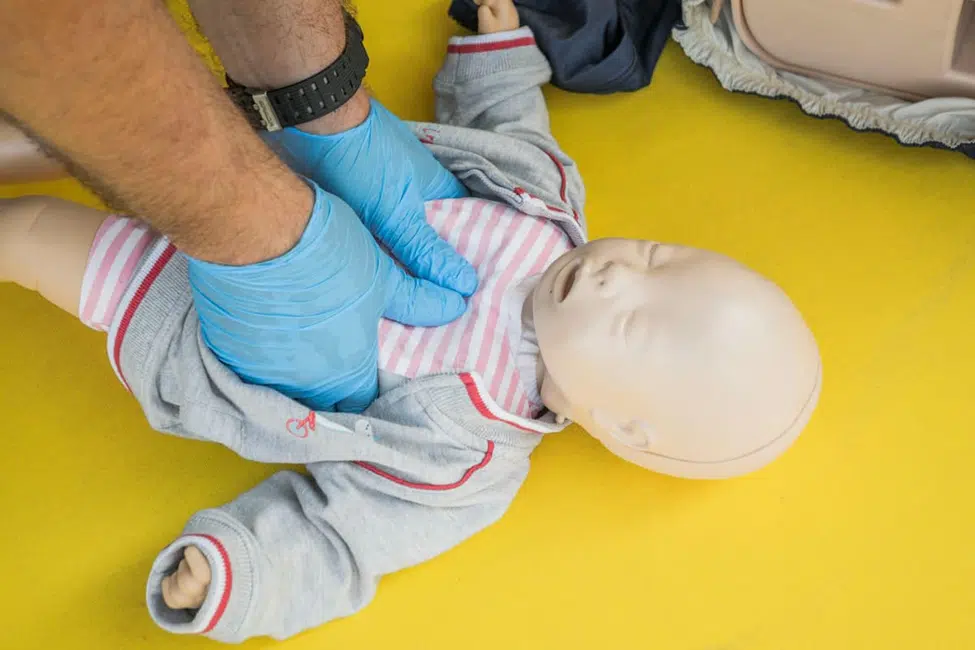
- Start Chest Compressions: If the newborn is not breathing, give 30 gentle chest compressions using the two-thumb-encircling technique or the heel of one hand at the center of the chest.
- Give Rescue Breaths: Deliver 2 gentle breaths, just enough for the chest to rise.
- Repeat Cycles: Continue cycles of 30 compressions and 2 breaths until help arrives or the baby starts breathing.
Step-by-Step Infant Rescue Breathing
Rescue breathing in infant rescue is a vital component of infant CPR, delivering oxygen to the baby’s lungs if they’re not breathing well. Rescue breaths must be done correctly to avoid brain damage and enhance the survival rate.
How to Perform Infant Rescue Breathing
Follow these steps carefully:
1. Place the Infant: Place the infant on a flat, firm surface on his or her back.
2. Open the Airway: Tilt the head back slightly and lift the chin to open the airway.
3. Cover Nose and Mouth: Cover the infant’s nose and mouth with your mouth, making a soft seal.
4. Give Gentle Breaths: Provide 2 slow breaths, each of approximately 1 second, sufficient to cause the chest to visibly rise.
5. Test Chest Rise: Make sure the chest rises with each breath. If not, reset head and repeat.
6. Integrate with Compressions: Continue rescue breaths in cycles with chest compressions during CPR.
Learn about the causes, symptoms, and treatment options for heart failure by visiting the MedlinePlus – Congestive Heart Failure guide.
Dos and Don’ts of Infant Rescue Breathing
Dos:
- Use gentle, controlled breaths.
- Make sure the airway is open before each breath.
- Continue breathing cycles until the infant starts breathing or emergency help arrives.
Don’t:
- Don’t blow too forcefully — this can cause lung injury.
- Don’t interrupt compressions for longer than 10 seconds.
- Don’t panic; stay calm and follow the steps methodically.
Tip: Refining infant rescue breathing on mankind through a CPR course can greatly enhance confidence and proficiency during actual emergencies.
Step-by-Step Guide for Chest Compressions
1. Infant Position: Put the infant on a flat, firm surface on his or her back.
2. Hand Placement: Use the two thumb-encircling hands technique (placing both thumbs side-by-side on the lower half of the sternum) OR the heel of one hand.
3. Depth of Compression: Push down approximately 1.5 inches (4 cm) to achieve adequate perfusion.
4. Compression Rate: Deliver 100–120 compressions per minute at a regular rhythm.
5. Release Fully: Let the chest recoil fully after every compression to allow blood to flow back into the heart.
6. Accompany with Rescue Breaths: Provide 2 soft rescue breaths following every 30 compressions.
Infant CPR vs Adult CPR
Everyone should know the distinction between CPR for infants and adults. Infants are delicate beings with narrower air passages and softer bones, so the CPR needs to be done with specific adapted techniques.
Key Differences Between Infant and Adult CPR
- Hand Placement:
- Infants: Use two thumb-encircling hands or the heel of one hand.
- Adults: Use both hands interlaced on the center of the chest.
- Compression Depth:
- Infants: Compress exactly 1.5 inches (4 cm).
- Adults: Compress at least 2 inches (5 cm).
One-Rescuer vs. Two-Rescuer Infant CPR Protocols
The operational mechanics of performing pediatric resuscitation adjust dynamically depending on the number of certified rescuers present on the scene.
- One-Rescuer Protocol: The lone rescuer utilizes the **two thumb-encircling hands technique** as the primary standard, centering both thumbs side-by-side on the lower half of the sternum while wrapping the fingers around the infant’s torso. This structure provides optimal compression force, maintaining a strict **30:2 ratio**. Note: The heel-of-one-hand technique is only a secondary alternative if the rescuer’s hands cannot physically encircle the infant’s chest.
- Two-Rescuer Protocol: When two certified rescuers are present, the compression-to-ventilation ratio optimizes to **15:2**. The first rescuer exclusively executes compressions using the two thumb-encircling hands technique, while the second rescuer focuses entirely on maintaining an open airway in a neutral sniffing position and delivering rescue breaths, switching positions every 2 minutes to prevent performance fatigue.
Managing Severe Foreign-Body Airway Obstruction (Choking)
⚠️ CRITICAL WARNING: You must never perform abdominal thrusts (the Heimlich maneuver) on an infant. An infant’s liver is disproportionately large and protrudes below the lower rib cage. Applying forceful abdominal thrusts carries a catastrophic risk of inducing severe liver lacerations and massive internal hemorrhage.
Instead, follow the approved 2025/2026 AHA sequence:
- 5 Back Blows: Hold the infant face down along your forearm, supporting their jaw. Deliver 5 firm back blows between the shoulder blades using the heel of your hand.
- 5 Chest Thrusts: Turn the infant face up. Deliver 5 quick downward chest thrusts in the center of the chest (mimicking CPR depth).
- Relentlessly alternate between 5 back blows and 5 chest thrusts until the object is expelled or the infant becomes unresponsive.
Emergency Action Plan & CPR Certification in the USA
For parents and caregivers residing in the United States, navigating a pediatric emergency requires immediate action and prior preparation.
- Dial 911 Immediately: If you are alone, perform 2 minutes of CPR before leaving the infant to call 911. If others are present, have them call 911 and find an AED immediately.
- Find Local Training: To acquire hands-on muscle memory, enroll in official courses provided by the American Heart Association (AHA) or the American Red Cross. These organizations offer localized training centers across all 50 states where you can practice on electronic depth-feedback infant manikins.
The 2025/2026 Infant CPR Algorithm (Updated Guidelines)
In late 2025, the AHA officially eliminated the “two-finger” chest compression technique for infants because it consistently failed to achieve the necessary 1.5-inch compression depth. Rescuers must now use either the two thumb-encircling hands technique or the heel-of-one-hand technique.
| Sequence Step | Primary Action Protocol | Scientific Rationale & 2026 Rules |
|---|---|---|
| 1. Assessment | Check responsiveness via foot tap; monitor for gasping. | Lay rescuers must not waste time searching for a brachial pulse. |
| 2. Activation | Dispatch local EMS and procure an AED immediately. | If alone, complete 2 minutes (5 cycles) of CPR before leaving the infant to call. |
| 3. Compressions | NEW: Use the 2 thumb-encircling hands OR heel-of-1-hand. | The 2-finger technique is eliminated. Compress 1.5 inches deep at a strict rate of 100-120 bpm. |
| 4. Ventilation (30:2) | Seal the mouth and nose; give two 1-second breaths after every 30 compressions. | Oxygen delivery is non-negotiable. Interruptions must remain under 10 seconds. |
| 5. AED Usage | Apply the AED as soon as it arrives on scene. | Use pediatric pads. If unavailable, use adult pads positioned anterior-posterior (front and back) to prevent arcing. |
Combining CPR and First Aid for Infants
Learning first aid infant CPR helps parents and caregivers stay calm and act quickly when every second counts. By adding infant CPR to basic first aid skills, you can maintain your baby’s life functions until medical professionals take over. This combined treatment—also referred to as infant resuscitation—is what can really save your baby’s life.
How CPR and First Aid Work Together
During an emergency, CPR restores breathing and circulation, while first aid treats other medical emergencies. When the two are combined, they maintain the infant’s stability and ensure that the situation does not escalate until the professional is on the stage.
Key points to remember:
- CPR maintains oxygen flow to the brain and vital organs.
- First aid manages bleeding, choking, or other injuries alongside CPR.
- Observation: Continuously monitor the infant’s color, breathing, and responsiveness.
- Emergency response: Always call for professional medical help as soon as possible.
Scenarios Where Infant Resuscitation Is Needed
Parents and caregivers may need to use infant resuscitation in situations such as:
- The infant stops breathing suddenly due to suffocation or illness.
- Choking on food or small objects blocks the airway.
- Drowning incidents where the infant is unresponsive.
- Severe allergic reactions causing airway obstruction.
Tip: Enrolling on a certified first aid CPR course instructs hands-on techniques and increases confidence, so you’ll be able to respond rapidly in true-life crises. For practical advice on selecting the right sleepwear, check out our guide on Baby Sleep Sack: 10 Safe Use Tips, Sizing & Sleeved Options.
CPR for Parents — Why Every Parent Should Learn
All parents and carers need to take new parent CPR, because infant emergencies may arise suddenly and without warning. It is essential to know how to react in those moments of need, for it not only saves lives but also brings parents immense confidence and peace of mind.
Importance of CPR Training for Parents
- Quick response saves lives: Infants can deteriorate rapidly without immediate CPR.
- Reduces panic: Training helps parents stay calm and act effectively during emergencies.
- Prevents complications: Proper CPR and first aid reduce the risk of brain damage and other serious injuries.
- Empowers caregivers: Parents and guardians feel more capable and confident when they know how to respond.

Infant First Aid CPR Classes
Enrolling in a structured infant first aid CPR course is among the finest options for parents to gain genuine confidence in responding to emergencies. Classes allow you to practice saving lives in a secure, supported environment—so you’re ready if the unthinkable occurs. The best news is training can be done online or in-person, so busy parents have the convenience of learning at their pace and on their schedule. Learn how to create a learning-friendly space at home by visiting our guide on Montessori Nursery: 5 Top Preschools & Daycare Prep Tips.
Options include:
- Online Classes:
- It is convenient for parents to learn at home.
- Includes video demonstrations, quizzes, and guided practice.
- In-Person Classes:
- Hands-on practice with manikins.
- Immediate feedback from certified instructors.
- Often includes certification upon completion.
Tip: Merging online theory and in-person practice provides the most effective learning environment and allows parents to administer CPR with confidence when they need to the most. “For a detailed step-by-step guide on how to resuscitate a child, visit the NHS page: How to resuscitate a child”.
Unique Precautions for Infants
- Avoid excessive force; their ribs and chest are fragile.
- Always check airways before giving rescue breaths.
- Ensure proper positioning of the head and neck to prevent injury.
- Remaining calm and methodical — rushing can cause harm.
Tip: Practicing CPR for infants and adults separately in certified classes ensures parents and caregivers are confident and capable in both scenarios. “For detailed instructions on performing CPR for children and babies, visit the American Red Cross: Child & Baby CPR guide”
FAQs About Infant CPR and First Aid
1. What is the correct way to perform infant CPR?
According to 2025/2026 guidelines, you must place the baby on a firm, flat surface. Use the two-thumb-encircling hands technique or the heel of one hand to give 30 compressions exactly 1.5 inches deep, followed by 2 rescue breaths. The outdated two-finger method is no longer recommended.
2. How do I give rescue breaths to a newborn?
Infant rescue breathing requires covering both the mouth and nose with your mouth and giving 2 gentle breaths, just enough to make the chest rise. Ensure the head is slightly tilted back in a neutral position, avoiding overextension.
3. Can I use an adult AED on an infant?
Yes. While pediatric pads are preferred, if they are unavailable, you must use standard adult pads. Place one pad on the center of the infant’s chest and the other on the center of their back (anterior-posterior) to prevent the pads from touching.
4. What should I do if my infant is choking?
Never perform abdominal thrusts (the Heimlich maneuver) on an infant. You must alternate strict cycles of 5 firm back blows delivered between the shoulder blades and 5 deep chest thrusts until the object is cleared.
Conclusion — Learn Infant CPR Today
Learning Infant CPR is one of the most important skills a parent or caregiver can acquire. Emergencies can happen without warning and knowing how to respond can save a baby’s life. By understanding infant resuscitation techniques, including chest compressions, rescue breathing, and first aid, you are better prepared to act quickly and confidently.
Enrolling in a certified first aid infant CPR class—whether online or in-person—provides hands-on practice and ensures you perform these life-saving techniques correctly. Keep in mind that constant practice and practice refreshing are necessary to ensure readiness when it matters most. “For guidance on infant CPR, check out this resource: Cardiopulmonary Resuscitation (CPR): Infants”. Act now: Don’t wait for a crisis—learn infant CPR, practise consistently, and empower yourself to save the most valuable lives.

Hafiz Nauman Baig is a Lead Researcher and PhD Scholar in Zoology, with a specialized focus on Biomechanics, Anatomical Data Analysis, and Environmental Toxicology. Merging his academic expertise in biological structures with a deep background in physical ergonomics, Nauman evaluates pediatric safety interventions through a rigorous scientific lens.
Unlike standard product reviewers, he utilizes R Studio and statistical modeling to assess clinical safety data. His research spans from evaluating the physiological impact of ergonomic carriers on the infant airway and caregiver’s spine, to analyzing how environmental chemicals (like municipal water additives) compromise the fragile infant skin barrier.
His mission is to bridge the gap between complex biological safety standards and practical, data-driven infant care.
View my verified academic research and clinical profile on ResearchGate.


