
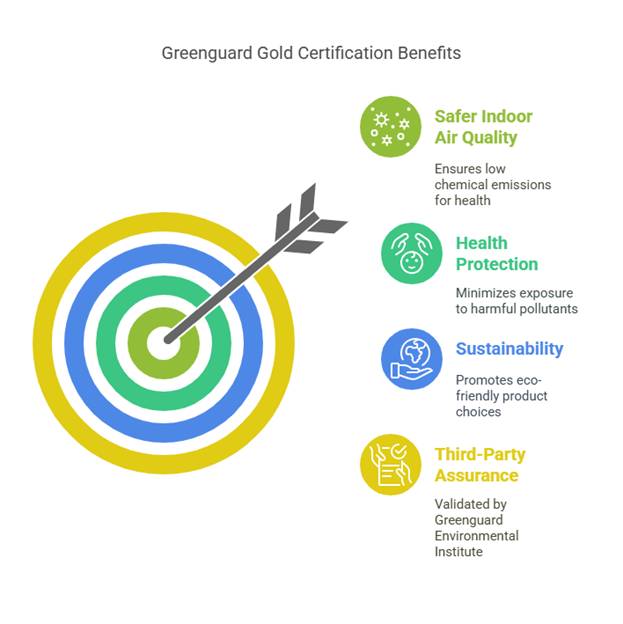
The GREENGUARD Gold Certified label is becoming increasingly common on baby gear like cribs, mattresses, and car seats—but what does this certification actually mean? In simple terms, products with this label have been rigorously tested for low chemical emissions (Low-VOC), ensuring safer indoor air quality for your little one’s developing lungs. Managed by the Greenguard Environmental Institute (GEI), this third-party certification helps parents minimize their family’s exposure to harmful indoor air pollutants. Whether you are shopping for a new crib, an organic mattress, or nursery furniture, choosing certified eco-friendly items is one of the best ways to prioritize both sustainability and your infant’s long-term health.
Watch the video given below That’s How You Learn – Episode 7: UL Environment/GREENGUARD
Watch this helpful Video by The Future of Safety Science on YouTube
Table of Contents
What Are VOCs?
Understanding VOCs and Their Impact on Health
To entirely grasp GREENGUARD Gold Certification, it’s essential to first understand VOCs (Volatile Organic Compounds). These are chemical compounds that simply evaporate at room temperature and can be found in several products, from building materials to nursery furniture and cleaning resources.
The Role of VOCs in Products
While several VOCs are colorless and odorless, some products like paint and mattresses emit VOCs complete a process called off-gassing, which can establish noticeable odors. However, these odors are commonly not harmful in small amounts or with reduced exposure. Ability the presence of VOCs in everyday items helps you make more informed selections, like picking Greenguard Gold Certified products for your place.
The “Smell Paradox” in New Baby Gear
A comprehensive analysis of consumer feedback reveals a persistent paradox: caregivers often associate strong chemical odors immediately upon unboxing with toxic danger. However, the critical scientific distinction is that odor intensity has zero correlation with chemical toxicity. Highly toxic compounds, such as specific phthalates or low-level formaldehyde, can be entirely odorless, silently bypassing an infant’s olfactory warning system. Conversely, safe materials like natural latex emit a distinct but harmless scent when their compressed vacuum-seal is broken
| Product | Certification | Benefit | Example |
|---|---|---|---|
| Cribs | GREENGUARD Gold Certified | Ensures low VOC emissions for safer indoor air. | Cribs for babies |
| Mattresses | GREENGUARD Gold Certified | Reduces exposure to harmful chemicals. | Organic crib mattresses |
| Car Seats | GREENGUARD Gold Certified | Ensure safer air quality in cars. | Infant car seats |
| Nursery Furniture | GREENGUARD Gold Certified | Improves air quality in baby’s room. | Dressers, changing tables |
| Paint | GREENGUARD Gold Certified | Low VOC emissions, improving indoor air. | Non-toxic baby room paint |
| Air Purifiers | GREENGUARD Gold Certified | Reduces indoor air pollutants. | HEPA air purifiers for nursery |
This table covers important GREENGUARD Gold Certified products, their benefits, and specific examples.
Can VOCs Make You Sick?
Immediate and Long-Term Health Effects of VOC Exposure
Reliable exposure to VOCs can lead to various health problems. In the short term, exposure can cause indications like:
- Eye, nose, and throat irritation
- Headaches
- Nausea and dizziness
- Visual impairment
- Impaired memory
Prolonged exposure can affect in more acute symptoms such as:
- Fatigue
- Allergic reactions
- Coughing
- Sneezing and sinus congestion
- Shortness of breath
Over long-term exposure, encountering high levels of VOCs in poorly ventilated spaces can potentially irritate a child’s sensitive respiratory system and affect their developing nervous system. While everyday off-gassing from standard furniture is generally low, choosing GREENGUARD Gold certified items adds an essential layer of safety for your peace of mind.
Although public health agencies suggest minimizing exposure, there are no specific state or federal laws controlling VOC emissions. This is where independent companies, like Greenguard, step in to help guarantee safer products.
What Is GREENGUARD?
Greenguard Environmental Institute (GEI), part of Underwriters Laboratory (UL), is an individual, non-profit organization that analyses products for chemical emissions. Greenguard offers two levels of documentation:
- GREENGUARD Certified
- GREENGUARD Gold Certified
These certifications help confirm that the products you bring into your residence, like furniture and mattresses, meet stringent guidelines for low chemical emissions, making them protected for your health.
What Is GREENGUARD Certified?
GREENGUARD Certified indicates that a product and its production process have been tested for over 10,000 chemicals and VOC emissions. Products that receive this certification meet industry standards for low emissions, confirming safer indoor air conditioning.
What Is GREENGUARD Gold Certified?
GREENGUARD Gold Certified brings things a step further by needing even stricter chemical and VOC emission requirements. This certification is particularly related to sensitive environments like schools, daycare, hospitals, and healthcare abilities. GREENGUARD Gold Certified products are tested to emit lower levels of VOCs evaluated to standard GREENGUARD Certified products, compelling them a great selection for baby products. Additionally, GREENGUARD Gold Certified products are examined for formaldehyde emissions, a harmful chemical correlated to respiratory issues and cancer risks. While GREENGUARD Gold Certification does not test poisonous chemicals like flame retardants or PVC, it confirms that products emit minimal volatile combinations, making it a safe decision for nurseries and play spaces.
During rigorous dynamic environmental chamber testing, a product must meet extremely strict biological parameters. To achieve GREENGUARD Gold status, a product’s Total Volatile Organic Compounds (TVOC) must remain at or below 0.22 mg/m³. Furthermore, aggressive formaldehyde emissions must not exceed 7.3 parts per billion (ppb).

Does the GREENGUARD Gold Test Include Lead?
GREENGUARD Gold Certification does not contain testing for lead, as lead does not directly impact air quality or cause pollution in the house. However, lead remains a concern in some imported products, specifically toys, nursery furniture, or antique objects. Therefore, parents should do their due diligence when buying baby gear, remarkably items from other countries or online supplies.
What Types of Baby Gear Are GREENGUARD Gold Certified?
GREENGUARD Gold Certified products aim to decrease pollutants and enhance indoor air quality. Many types of baby gear are qualified for this certification, including:
- Cribs
- Crib mattresses
- Nursery furniture (e.g., dressers, changing tables, gliders, and rockers)
- Strollers
- Car seats
- Nursing pillows
Additionally, knowing which yields are GREENGUARD Gold Certified can help you prevent potential irritations or long-term health problems caused by VOC emissions, confirming a healthier environment for your infant.
Looking to stay active during pregnancy? While you are setting up a safe and non-toxic nursery for your baby, don’t forget your own physical health. Read my complete biomechanical guide on “Prenatal Pilates: Maternity Pilates and Exercise Ball Workouts” to prepare your body for a safe delivery.

Why Should You Look for GREENGUARD Gold Certified Baby Gear?
The Biomechanics of Infant Respiration (A Researcher’s Perspective) As a researcher specializing in infant airway biomechanics, I evaluate environmental safety through an anatomical lens. An infant’s respiratory mechanics are vastly different from an adult’s. Babies have a baseline respiratory rate ranging between 40 and 60 breaths per minute. In biomechanical terms, their minute ventilation—expressed via the equation $V_E = V_T \times f$—dictates that infants inhale a vastly disproportionate volume of ambient air relative to their minute body weight. Furthermore, critical enzymatic pathways in neonates, specifically the cytochrome P450 (CYP450) system, are immature. This means their internal filtration systems cannot effectively metabolize or clear heavy volatile organic compounds (VOCs)
When an infant sleeps in a crib that is actively off-gassing VOCs, the biomechanical load on their respiratory system is immense. This is exactly why GREENGUARD Gold Certification is not just a marketing term—it is a critical biological safeguard. By strictly limiting emissions, it prevents airborne toxins from placing unnecessary stress on your baby’s fragile airway.
Furthermore, the EPA estimates that indoor levels of pollutants may be up to 10 times higher than outdoor levels. Choosing GREENGUARD Gold certified products helps limit your child’s exposure to not only VOCs but also dangerous chemicals like phthalates, which the American Academy of Pediatrics (AAP) has flagged as a serious concern for child development.
Does GREENGUARD Gold Certification Mean That a Product Is 100% Safe?
While GREENGUARD Gold Certification reveals that a product meets strict standards for minimal chemical emissions, it does not promise that a product is 100% free of all toxic chemicals. It just addresses emissions and VOCs. To guarantee a product’s overall safety, it’s desirable to check its full chemical content for extra comprehensive consideration.
The Disadvantage of GREENGUARD Gold Certification Programs
While GREENGUARD Gold Certification confirms that products meet specific thresholds for VOC emissions, it can be problematic to know the exact number of VOCs a product emits. This is specifically important if you’re sensitive to chemical emissions. Unfortunately, companies do not disclose specific VOC levels once they’ve taken GREENGUARD Gold Certification, making it demanding for shoppers with chemical sensitivities to make notified choices. In such cases, it may be safer to opt for companies that are willing to reveal the exact chemical emission facts of their products.
Additionally, the GREENGUARD Gold Certification just measures emissions, not the chemical subject in the material itself. This means that while emissions are down, the material may still have substances that could be dangerous.
Other Ways to manage Indoor Chemical Pollutants
To further improve indoor air quality, consider these tips:
- Ventilate your home: Open windows to increase fresh air circulation, lowering the concentration of indoor chemical pollutants.
- Use indoor plants: Specific plants, like aloe vera, absorb chemical emissions and increase air quality.
- Install an air quality monitor: It better track the level of pollutants in your environment.
- Use an air purifier: Opt for one with activated carbon filters to eliminate harmful gases.
- Ask for VOC details: When purchasing products, demand customer service for the total VOC emissions to make a more educated decision.
- Turn on exhaust fans: Use them after cooking or cleaning to dissipate VOC emissions and increase air quality. Some prefer to sleep with a fan on for fresh air, though the sound may be distracting to others.
- Pre-emptive Off-gassing: Remove new products from their plastic packaging and place them in a highly ventilated, unoccupied space (like a garage) for a minimum of 72 hours. The highest concentration of trapped gas is released within the first 48 hours
By ensuing these tips, you can further reduce exposure to dangerous chemicals and maintain a beneficial indoor environment.
Watch another video given below Things to Know About Crib Mattresses: Greenguard Gold, GOTS, EWG Verified & More | Babylist
Watch this helpful Video by Babylist on YouTube
Conclusion
While GREENGUARD Gold Certification is a respected standard that confirms products emit low levels of dangerous VOCs, it’s important to recognize its limitations. Products with this certification concentration on emissions but don’t test for the chemical substance in materials. Therefore, for those with sensitivities, it may be beneficial to seek out manufacturers who supply more detailed knowledge on chemical emissions. To further increase indoor air quality, believe steps like ventilating your residence, using indoor plants, and providing in air purifiers. By combining GREENGUARD Gold Certified products with these evaluations, you can create a safer, beneficial environment for you and your family.
FAQs About GREENGUARD Gold Certification
1. What is GREENGUARD Gold Certification?
GREENGUARD Gold Certification verifies that a product meets strict standards for low chemical emissions, helping improve indoor air quality by reducing VOCs and other pollutants.
2. Why is this certification important?
This certification is important because it ensures products (like furniture and baby gear) emit minimal harmful chemicals into the air. It helps protect your home environment, especially sensitive spaces such as nurseries.
3. What products can have GREENGUARD Gold Certification?
A wide range of products can earn this certification, including cribs, mattresses, car seats, and nursery furniture. It’s particularly beneficial for baby gear to ensure a safer indoor environment for children.
4. How is GREENGUARD Gold different from regular GREENGUARD?
GREENGUARD Gold uses stricter emissions limits than standard GREENGUARD, making it better suited for sensitive environments such as schools, daycare centers, and nurseries.
5. Does the certification guarantee 100% safety?
No — while the certification indicates low VOC emissions, it does not guarantee the total absence of all harmful chemicals. It’s still wise to review full product materials and tests when possible.
6. Is this certification a good choice for baby products?
Yes — GREENGUARD Gold is highly recommended for baby products because it ensures low VOC emissions, reducing exposure to harmful chemicals during early development.
About the Author: Hafiz Nauman Baig is a PhD Scholar in Zoology specializing in Fisheries at Quaid-i-Azam University. Leveraging advanced statistical data analysis in R Studio and research expertise in aquatic adaptation and oxidative stress, he provides rigorous, evidence-based safety and ergonomic evaluations for baby gear.